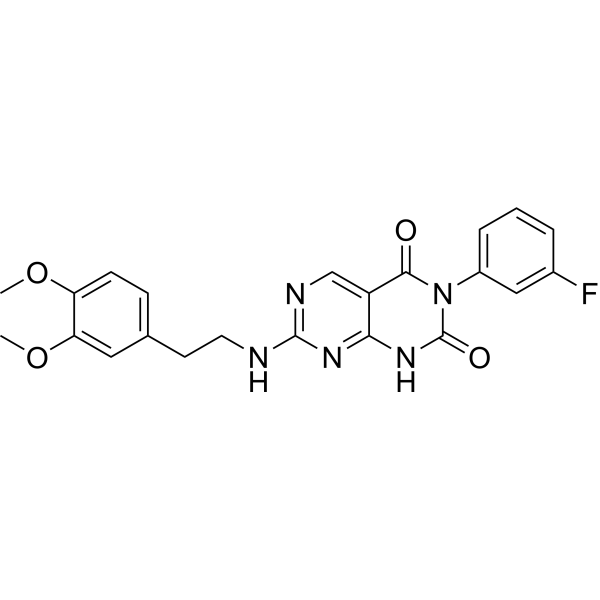
Physicochemical Properties
| Molecular Formula | C22H20FN5O4 |
| Molecular Weight | 437.423707962036 |
| Exact Mass | 437.149 |
| CAS # | 1326852-06-5 |
| PubChem CID | 53333307 |
| Appearance | Off-white to light yellow solid powder |
| LogP | 3.1 |
| Hydrogen Bond Donor Count | 2 |
| Hydrogen Bond Acceptor Count | 8 |
| Rotatable Bond Count | 7 |
| Heavy Atom Count | 32 |
| Complexity | 670 |
| Defined Atom Stereocenter Count | 0 |
| SMILES | FC1=CC=CC(=C1)N1C(NC2C(=CN=C(N=2)NCCC2C=CC(=C(C=2)OC)OC)C1=O)=O |
| InChi Key | FPVFCXYTLUJPQJ-UHFFFAOYSA-N |
| InChi Code | InChI=1S/C22H20FN5O4/c1-31-17-7-6-13(10-18(17)32-2)8-9-24-21-25-12-16-19(26-21)27-22(30)28(20(16)29)15-5-3-4-14(23)11-15/h3-7,10-12H,8-9H2,1-2H3,(H2,24,25,26,27,30) |
| Chemical Name | 2-[2-(3,4-dimethoxyphenyl)ethylamino]-6-(3-fluorophenyl)-8H-pyrimido[4,5-d]pyrimidine-5,7-dione |
| HS Tariff Code | 2934.99.9001 |
| Storage |
Powder-20°C 3 years 4°C 2 years In solvent -80°C 6 months -20°C 1 month |
| Shipping Condition | Room temperature (This product is stable at ambient temperature for a few days during ordinary shipping and time spent in Customs) |
Biological Activity
| Targets |
Ku70/80 heterodimer (IC₅₀ = 3.5 μM in Ku-DNA binding assay) DNA-PKCS kinase activity (IC₅₀ = 2.5 μM in Ku-dependent activation assay) [1] |
| ln Vitro |
STL127705 (Compound L) is inhibitory to Ku-dependent activation of DNA-PKCS kinase and inhibits Ku70/80 binding to DNA substrates at concentrations of 0-100 μM [1]. In SF-767 cells, STL127705 (0-100 μM; 6h) can decrease DNA-PKCS autophosphorylation expression [1]. In a dose-dependent manner, STL127705 (0–40 μM; 6h) exhibits anti-proliferative action [1]. When gemcitabine and TL127705 (1 μM; 48 h) are used together, they can greatly increase apoptosis [2]. STL127705 (Compound L) disrupts the binding of the Ku70/80 heterodimer to DNA in an electrophoretic mobility shift assay (EMSA), with an IC₅₀ of 3.5 μM. It inhibits Ku-dependent activation of the DNA-PKCS kinase in a biochemical assay, with an IC₅₀ of 2.5 μM. In SF-767 glioblastoma cells, treatment with STL127705 followed by etoposide-induced DNA damage results in a dose-dependent decrease in DNA-PKCS autophosphorylation at Ser2056, as shown by Western blot, without affecting total DNA-PKCS protein levels. STL127705 exhibits dose-dependent cytotoxicity in SF-767 and immortalized prostate epithelial (PrEC) cell lines when used as a single agent. At sub-cytotoxic concentrations (20–35 μM), STL127705 synergistically sensitizes both SF-767 and PrEC cells to ionizing radiation (4 Gy), leading to a greater reduction in cell viability than the additive effects of either treatment alone. [1] |
| Enzyme Assay |
Ku70/80-DNA Binding Assay (EMSA): A radioactively labeled double-stranded DNA substrate was incubated with purified human Ku70/80 protein in a buffer containing Tris-HCl, KCl, and DTT. The compound, dissolved in DMSO, was pre-incubated with the protein for 5 minutes at 37°C before adding the DNA substrate. After a 15-minute incubation at 37°C, the reaction mixtures were separated on a non-denaturing polyacrylamide gel. The binding of Ku70/80 to DNA causes a mobility shift, and inhibition by the compound is observed as a reduction or loss of this shifted band. DNA-PKCS Kinase Activity Assay: A commercially available kinase assay system was used. Reactions contained reaction buffer, a biotinylated p53-derived peptide substrate, purified human Ku70/80, γ-³²P-ATP, and purified human DNA-PKCS. The compound, dissolved in DMSO, was pre-incubated with Ku70/80 for 5 minutes at 37°C before adding ATP and DNA-PKCS. Phosphorylation of the peptide substrate was measured by capturing the biotinylated peptide on a membrane, washing away unincorporated ATP, and quantifying the bound radioactivity with a scintillation counter. [1] |
| Cell Assay |
Cell Viability Assay[1] Cell Types: SF-767, PrEC Cell Tested Concentrations: 0-40 µM Incubation Duration: 6 hrs (hours) Experimental Results: Demonstrated dose-dependent cytotoxicity. Western Blot Analysis[1] Cell Types: SF-767 Cell Tested Concentrations: 0-100 µM Incubation Duration: 2 hrs (hours) of pretreatment, followed by a total incubation of 4 hrs (hours). Experimental Results: DNA-PKCS autophosphorylation was diminished, but total DNA-PKCS was not increased. STL127705 suppressed. Apoptosis analysis [1] Cell Types: H1299 Cell Tested Concentrations: 1 µM Incubation Duration: 48 h Experimental Results: STL127705 induced cell apoptosis when combined with gemcitabine, and the cell apoptosis rate Dramatically increased to 76%. DNA-PKCS Autophosphorylation Assay: SF-767 cells were pre-treated with STL127705 for 2 hours, followed by induction of DNA double-strand breaks with etoposide (25 μM) for 4 hours in the continued presence of the compound. Total cell extracts were prepared and analyzed by Western blot using a phospho-specific antibody against DNA-PKCS (Ser2056) and an antibody against total DNA-PKCS. Band intensities were quantified using image analysis software. Cell Viability/Proliferation Assay (MTS): SF-767 or PrEC cells were seeded in 96-well plates and allowed to adhere overnight. Cells were pre-treated with a range of concentrations of STL127705 (1–100 μM) for 2 hours, followed by exposure to 4 Gy of γ-radiation or mock treatment. Cells were then cultured for 6 days without removing the compound. Cell viability was assessed by replacing the medium with a colorless medium containing MTS reagent, incubating for 2 hours, and measuring the absorbance at 490 nm. Absorbance values, proportional to the number of viable cells, were normalized to untreated controls. [1] |
| Toxicity/Toxicokinetics |
STL127705 shows dose-dependent cytotoxicity in human cell lines (SF-767 and PrEC). Cytotoxicity remains low (below 5% non-viability) at concentrations up to 25 μM, after which an exponential increase in cell death is observed. The therapeutic window for its radiation-sensitizing effect is close to the onset of this rapid increase in cytotoxicity. [1] |
| References |
[1]. A novel small molecule inhibitor of the DNA repair protein Ku70/80. DNA Repair (Amst). 2016 Jul;43:98-106. [2]. Inhibiting nonhomologous end-joining repair would promote the antitumor activity of gemcitabine in nonsmall cell lung cancer cell lines. Anticancer Drugs. 2022 Jun 1;33(5):502-508. |
| Additional Infomation |
STL127705 is identified as a first-in-class small molecule inhibitor of the Ku70/80 heterodimer, a key DNA repair protein in the Non-Homologous End Joining (NHEJ) pathway. It was discovered through an in silico structure-based drug design approach, utilizing the crystal structure of Ku70/80 to identify a putative binding pocket near the DNA-binding canal and the subunit interface. Molecular docking predicts that STL127705 occupies this pocket and forms hydrogen bonds with Ser257 and Arg363 of Ku70 and Gln269 and Arg486 of Ku80. By inhibiting Ku70/80's binding to DNA ends, it disrupts the initial step of NHEJ and subsequent activation of downstream effectors like DNA-PKCS. Its ability to synergistically sensitize cancer cells to radiation suggests potential as a radiosensitizer for tumors, including glioblastoma, where NHEJ activity can contribute to therapy resistance. The compound's structure is considered a promising starting point ("hit") for medicinal chemistry optimization to improve affinity, reduce cytotoxicity, and develop a "lead" compound for cancer therapy, potentially applied in synthetic lethality approaches or combination with radiotherapy/chemotherapy. [1] |
Solubility Data
| Solubility (In Vitro) |
DMSO : ~2.4 mg/mL (~5.49 mM) H2O : < 0.1 mg/mL |
| Solubility (In Vivo) |
Note: Listed below are some common formulations that may be used to formulate products with low water solubility (e.g. < 1 mg/mL), you may test these formulations using a minute amount of products to avoid loss of samples. Injection Formulations (e.g. IP/IV/IM/SC) Injection Formulation 1: DMSO : Tween 80: Saline = 10 : 5 : 85 (i.e. 100 μL DMSO stock solution → 50 μL Tween 80 → 850 μL Saline) *Preparation of saline: Dissolve 0.9 g of sodium chloride in 100 mL ddH ₂ O to obtain a clear solution. Injection Formulation 2: DMSO : PEG300 :Tween 80 : Saline = 10 : 40 : 5 : 45 (i.e. 100 μL DMSO → 400 μLPEG300 → 50 μL Tween 80 → 450 μL Saline) Injection Formulation 3: DMSO : Corn oil = 10 : 90 (i.e. 100 μL DMSO → 900 μL Corn oil) Example: Take the Injection Formulation 3 (DMSO : Corn oil = 10 : 90) as an example, if 1 mL of 2.5 mg/mL working solution is to be prepared, you can take 100 μL 25 mg/mL DMSO stock solution and add to 900 μL corn oil, mix well to obtain a clear or suspension solution (2.5 mg/mL, ready for use in animals). Injection Formulation 4: DMSO : 20% SBE-β-CD in saline = 10 : 90 [i.e. 100 μL DMSO → 900 μL (20% SBE-β-CD in saline)] *Preparation of 20% SBE-β-CD in Saline (4°C,1 week): Dissolve 2 g SBE-β-CD in 10 mL saline to obtain a clear solution. Injection Formulation 5: 2-Hydroxypropyl-β-cyclodextrin : Saline = 50 : 50 (i.e. 500 μL 2-Hydroxypropyl-β-cyclodextrin → 500 μL Saline) Injection Formulation 6: DMSO : PEG300 : castor oil : Saline = 5 : 10 : 20 : 65 (i.e. 50 μL DMSO → 100 μLPEG300 → 200 μL castor oil → 650 μL Saline) Injection Formulation 7: Ethanol : Cremophor : Saline = 10: 10 : 80 (i.e. 100 μL Ethanol → 100 μL Cremophor → 800 μL Saline) Injection Formulation 8: Dissolve in Cremophor/Ethanol (50 : 50), then diluted by Saline Injection Formulation 9: EtOH : Corn oil = 10 : 90 (i.e. 100 μL EtOH → 900 μL Corn oil) Injection Formulation 10: EtOH : PEG300:Tween 80 : Saline = 10 : 40 : 5 : 45 (i.e. 100 μL EtOH → 400 μLPEG300 → 50 μL Tween 80 → 450 μL Saline) Oral Formulations Oral Formulation 1: Suspend in 0.5% CMC Na (carboxymethylcellulose sodium) Oral Formulation 2: Suspend in 0.5% Carboxymethyl cellulose Example: Take the Oral Formulation 1 (Suspend in 0.5% CMC Na) as an example, if 100 mL of 2.5 mg/mL working solution is to be prepared, you can first prepare 0.5% CMC Na solution by measuring 0.5 g CMC Na and dissolve it in 100 mL ddH2O to obtain a clear solution; then add 250 mg of the product to 100 mL 0.5% CMC Na solution, to make the suspension solution (2.5 mg/mL, ready for use in animals). Oral Formulation 3: Dissolved in PEG400 Oral Formulation 4: Suspend in 0.2% Carboxymethyl cellulose Oral Formulation 5: Dissolve in 0.25% Tween 80 and 0.5% Carboxymethyl cellulose Oral Formulation 6: Mixing with food powders Note: Please be aware that the above formulations are for reference only. InvivoChem strongly recommends customers to read literature methods/protocols carefully before determining which formulation you should use for in vivo studies, as different compounds have different solubility properties and have to be formulated differently. (Please use freshly prepared in vivo formulations for optimal results.) |
| Preparing Stock Solutions | 1 mg | 5 mg | 10 mg | |
| 1 mM | 2.2861 mL | 11.4307 mL | 22.8613 mL | |
| 5 mM | 0.4572 mL | 2.2861 mL | 4.5723 mL | |
| 10 mM | 0.2286 mL | 1.1431 mL | 2.2861 mL |