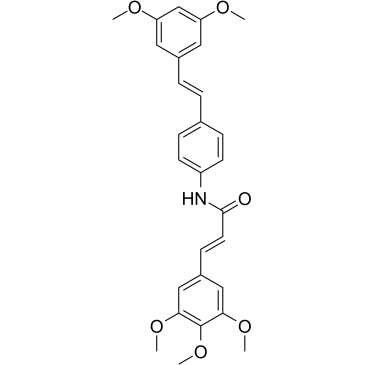
STAT3-IN-1 is a novel, oral and selective STAT3 inhibitor with anticancer activity. It inhibits STAT3 with IC50 values of 1.82 μM and 2.14 μM in HT29 and MDA-MB 231 cells, respectively.It can induce tumor apoptosis.
Physicochemical Properties
| Molecular Formula | C28H29NO6 |
| Molecular Weight | 475.5329682827 |
| Exact Mass | 475.199 |
| CAS # | 2059952-75-7 |
| PubChem CID | 134130166 |
| Appearance | Light yellow to orange solid powder |
| LogP | 5.3 |
| Hydrogen Bond Donor Count | 1 |
| Hydrogen Bond Acceptor Count | 6 |
| Rotatable Bond Count | 10 |
| Heavy Atom Count | 35 |
| Complexity | 663 |
| Defined Atom Stereocenter Count | 0 |
| SMILES | O(C)C1C(=CC(/C=C/C(NC2C=CC(=CC=2)/C=C/C2C=C(C=C(C=2)OC)OC)=O)=CC=1OC)OC |
| InChi Key | KOZAEBHIXYBHKA-FCXQYMQBSA-N |
| InChi Code | InChI=1S/C28H29NO6/c1-31-23-14-20(15-24(18-23)32-2)7-6-19-8-11-22(12-9-19)29-27(30)13-10-21-16-25(33-3)28(35-5)26(17-21)34-4/h6-18H,1-5H3,(H,29,30)/b7-6+,13-10+ |
| Chemical Name | (E)-N-(4-((E)-3,5-dimethoxystyryl)phenyl)-3-(3,4,5-trimethoxyphenyl)acrylamide |
| Synonyms | STAT3-IN 1 STAT3 IN-1 STAT3-IN1STAT3IN1 STAT3 IN 1STAT3-IN-1 STAT3IN-1 STAT3-IN-compound 7d |
| HS Tariff Code | 2934.99.9001 |
| Storage |
Powder-20°C 3 years 4°C 2 years In solvent -80°C 6 months -20°C 1 month |
| Shipping Condition | Room temperature (This product is stable at ambient temperature for a few days during ordinary shipping and time spent in Customs) |
Biological Activity
| Targets |
|
|
| ln Vitro | Compound 7d, STAT3-IN-1, suppresses the acetylation of STAT3 lysine 685 and modifies the expression of its specific gene [1]. In MDA-MB-231 cells, STAT3-IN-1 (compound 7d: 0-10 μM, 48 h) causes tumor cell death [1]. | |
| ln Vivo | In a mouse xenograft model, STAT3-IN-1 (Compound 7d: 10, 20 mg/kg, two weeks) inhibits tumor growth with minimal toxicity [1]. | |
| Cell Assay |
Apoptosis Analysis[1] Cell Types: MDA-MB-231 cell lines. Tested Concentrations: 0-10 μM. Incubation Duration: 48 hrs (hours). Experimental Results: The induced apoptosis rates (early and late apoptosis) at 1, 2, 5, 8 and 10 μM were 9.0%, 11.2%, 20.9%, 43.3% and 85.2% versus control 3.0%. Western Blot Analysis[1] Cell Types: MDA-MB-231 and HT-29 cell lines. Tested Concentrations: 0-10 μM. Incubation Duration: 48 hrs (hours). Experimental Results: Inhibited STAT3 acetylation and STAT3 tyrosine phosphorylation in MDA-MB-231 cells. Increased the expressions of these tumor-suppressor genes (PTPN6 (SHP-1), CDKN2A and DLEC1) which were related to STAT3 acetylation at Lys685. |
|
| Animal Protocol |
Animal/Disease Models: Mouse-xenograft model bearing inoculation of mice breast cancer 4T1 cells[1]. Doses: 10, 20 mg/kg. Route of Administration: Oral administration once every other day for two weeks. Experimental Results: Arrested tumor growth with no obvious body weight loss. |
|
| References |
[1]. Discovery of oral-available resveratrol-caffeic acid based hybrids inhibiting acetylated and phosphorylated STAT3 protein. Eur J Med Chem. 2016 Nov 29;124:1006-1018. |
Solubility Data
| Solubility (In Vitro) | DMSO : ~125 mg/mL (~262.86 mM) |
| Solubility (In Vivo) |
Solubility in Formulation 1: 6.25 mg/mL (13.14 mM) in 10% DMSO + 40% PEG300 +5% Tween-80 + 45% Saline (add these co-solvents sequentially from left to right, and one by one), suspension solution; with sonication. For example, if 1 mL of working solution is to be prepared, you can add 100 μL of 62.5 mg/mL clear DMSO stock solution to 400 μL PEG300 and mix evenly; then add 50 μL Tween-80 + to the above solution and mix evenly; then add 450 μL normal saline to adjust the volume to 1 mL. Preparation of saline: Dissolve 0.9 g of sodium chloride in 100 mL ddH₂ O to obtain a clear solution. (Please use freshly prepared in vivo formulations for optimal results.) |
| Preparing Stock Solutions | 1 mg | 5 mg | 10 mg | |
| 1 mM | 2.1029 mL | 10.5146 mL | 21.0292 mL | |
| 5 mM | 0.4206 mL | 2.1029 mL | 4.2058 mL | |
| 10 mM | 0.2103 mL | 1.0515 mL | 2.1029 mL |