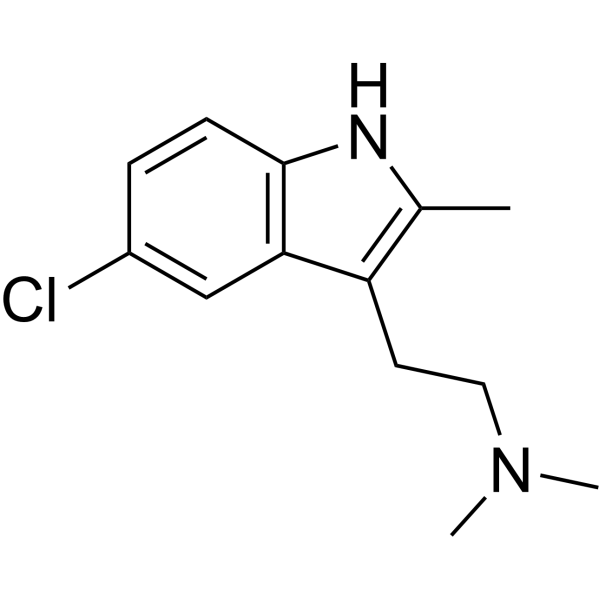
Physicochemical Properties
| Molecular Formula | C13H17CLN2 |
| Molecular Weight | 236.74 |
| Exact Mass | 236.108 |
| CAS # | 1210-81-7 |
| Related CAS # | ST1936 oxalate;1782228-83-4 |
| PubChem CID | 9921064 |
| Appearance | White to light yellow solid powder |
| Density | 1.2±0.1 g/cm3 |
| Boiling Point | 377.0±42.0 °C at 760 mmHg |
| Flash Point | 181.8±27.9 °C |
| Vapour Pressure | 0.0±0.9 mmHg at 25°C |
| Index of Refraction | 1.614 |
| LogP | 3.31 |
| Hydrogen Bond Donor Count | 1 |
| Hydrogen Bond Acceptor Count | 1 |
| Rotatable Bond Count | 3 |
| Heavy Atom Count | 16 |
| Complexity | 232 |
| Defined Atom Stereocenter Count | 0 |
| SMILES | CN(CCC1=C(C)NC2=CC=C(C=C12)Cl)C |
| InChi Key | KSYMELKKLOFABL-UHFFFAOYSA-N |
| InChi Code | InChI=1S/C13H17ClN2/c1-9-11(6-7-16(2)3)12-8-10(14)4-5-13(12)15-9/h4-5,8,15H,6-7H2,1-3H3 |
| Chemical Name | 2-(5-chloro-2-methyl-1H-indol-3-yl)-N,N-dimethylethanamine |
| HS Tariff Code | 2934.99.9001 |
| Storage |
Powder-20°C 3 years 4°C 2 years In solvent -80°C 6 months -20°C 1 month |
| Shipping Condition | Room temperature (This product is stable at ambient temperature for a few days during ordinary shipping and time spent in Customs) |
Biological Activity
| Targets | 5-HT6 Receptor 13 nM (Ki) 5-HT7 Receptor 168 nM (Ki) 5-HT2B Receptor 245 nM (Ki) α1-adrenergic receptor 390 nM (Ki, rat) α2-adrenergic receptor 300 nM (Ki, rat) α2-adrenergic receptor 300 nM (Ki, human) |
| ln Vitro | ST1936 was tested in a broad crossreactivity panel that included G-protein-coupled receptors, ion channel binding sites, transporters, enzymes, and 5-HT6 receptors. It has demonstrated affinity for 5-HT2B, 5-HT1A, 5-HT7, and α-adrenergic receptors, but it appears to be relatively selective for 5-HT6 receptors[1]. In cloned cells, ST1936 acts as a complete 5-HT6 agonist and can raise Ca2+ levels, phosphorylate Fyn kinase, and control the activation of ERK1/2, which is Fyn kinase's downstream target[2]. With an IC50 of 1.3 μM, ST1936 lowers the frequency of spontaneous excitatory postsynaptic currents[3]. |
| ln Vivo | In the prefrontal cortex (PFCX), ST1936 (5, 10, 20 mg/kg; ip) raises extracellular dopamine (DA) and NA levels in a dose-dependent manner[4]. The nucleus accumbens (NAc) core's extracellular DA and NA levels are raised by ST1936 (5, 10, 20 mg/kg; ip). Dialysate DA (peak: 179%) is increased by doses of 10 mg/kg, but dialysate NA (231% and 201%, respectively) is increased by greater doses. Five milligrams per kilogram has no effect[4]. |
| References |
[1]. Borsini F, et al. Effects of ST1936, a selective serotonin-6 agonist, on electrical activity of putative mesencephalic dopaminergic neurons in the rat brain. J Psychopharmacol. 2015 Jul;29(7):802-11. [2]. Riccioni T, et al. ST1936 stimulates cAMP, Ca2+, ERK1/2 and Fyn kinase through a full activation of cloned human 5-HT6 receptors. Eur J Pharmacol. 2011;661(1-3):8-14. [3]. Tassone A, et al. Activation of 5-HT6 receptors inhibits corticostriatal glutamatergic transmission. Neuropharmacology. 2011;61(4):632-637. [4]. Valentini V, et al. A microdialysis study of ST1936, a novel 5-HT6 receptor agonist. Neuropharmacology. 2011;60(4):602-608. |
Solubility Data
| Solubility (In Vitro) | DMSO: 100 mg/mL (422.40 mM) |
| Solubility (In Vivo) |
Solubility in Formulation 1: ≥ 2.5 mg/mL (10.56 mM) (saturation unknown) in 10% DMSO + 40% PEG300 + 5% Tween80 + 45% Saline (add these co-solvents sequentially from left to right, and one by one), clear solution. For example, if 1 mL of working solution is to be prepared, you can add 100 μL of 25.0 mg/mL clear DMSO stock solution to 400 μL PEG300 and mix evenly; then add 50 μL Tween-80 to the above solution and mix evenly; then add 450 μL normal saline to adjust the volume to 1 mL. Preparation of saline: Dissolve 0.9 g of sodium chloride in 100 mL ddH₂ O to obtain a clear solution. Solubility in Formulation 2: ≥ 2.5 mg/mL (10.56 mM) (saturation unknown) in 10% DMSO + 90% (20% SBE-β-CD in Saline) (add these co-solvents sequentially from left to right, and one by one), clear solution. For example, if 1 mL of working solution is to be prepared, you can add 100 μL of 25.0 mg/mL clear DMSO stock solution to 900 μL of 20% SBE-β-CD physiological saline solution and mix evenly. Preparation of 20% SBE-β-CD in Saline (4°C,1 week): Dissolve 2 g SBE-β-CD in 10 mL saline to obtain a clear solution. Solubility in Formulation 3: ≥ 2.5 mg/mL (10.56 mM) (saturation unknown) in 10% DMSO + 90% Corn Oil (add these co-solvents sequentially from left to right, and one by one), clear solution. For example, if 1 mL of working solution is to be prepared, you can add 100 μL of 25.0 mg/mL clear DMSO stock solution to 900 μL of corn oil and mix evenly. (Please use freshly prepared in vivo formulations for optimal results.) |
| Preparing Stock Solutions | 1 mg | 5 mg | 10 mg | |
| 1 mM | 4.2240 mL | 21.1202 mL | 42.2404 mL | |
| 5 mM | 0.8448 mL | 4.2240 mL | 8.4481 mL | |
| 10 mM | 0.4224 mL | 2.1120 mL | 4.2240 mL |