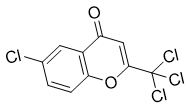
Physicochemical Properties
| Molecular Formula | C10H4CL4O2 |
| Molecular Weight | 297.949559211731 |
| Exact Mass | 295.897 |
| Elemental Analysis | C, 40.31; H, 1.35; Cl, 47.59; O, 10.74 |
| CAS # | 133406-29-8 |
| Related CAS # | 133406-29-8 |
| PubChem CID | 867466 |
| Appearance | Off-white to light yellow solid powder |
| LogP | 4.273 |
| Hydrogen Bond Donor Count | 0 |
| Hydrogen Bond Acceptor Count | 2 |
| Rotatable Bond Count | 0 |
| Heavy Atom Count | 16 |
| Complexity | 334 |
| Defined Atom Stereocenter Count | 0 |
| SMILES | C1(C(Cl)(Cl)Cl)OC2=CC=C(Cl)C=C2C(=O)C=1 |
| InChi Key | NTDHYMSVCBGQJF-UHFFFAOYSA-N |
| InChi Code | InChI=1S/C10H4Cl4O2/c11-5-1-2-8-6(3-5)7(15)4-9(16-8)10(12,13)14/h1-4H |
| Chemical Name | 6-chloro-2-(trichloromethyl)chromen-4-one |
| Synonyms | ST034307 |
| HS Tariff Code | 2934.99.9001 |
| Storage |
Powder-20°C 3 years 4°C 2 years In solvent -80°C 6 months -20°C 1 month |
| Shipping Condition | Room temperature (This product is stable at ambient temperature for a few days during ordinary shipping and time spent in Customs) |
Biological Activity
| Targets | AC1 ( IC50 = 2.3 μM ) |
| ln Vitro | ST034307 shows that AC1 is selectively inhibited, and it slightly increases the activity of AC8. Phenol-12-myristate 13-acetate (PMA)-stimulated cAMP production by AC2 is enhanced by ST034307. Forskolin- or isoproterenol-stimulated AC1 activity in HEK cells that express AC1 is markedly inhibited by ST034307. In contrast, ST034307 has no discernible effects on HEK cells that are wild-type. The accumulation of cAMP in the hippocampal homogenates stimulated by Ca2+ and calmodulin is strongly inhibited by ST034307. In a dose-dependent manner, ST034307 prevents AC1's MOR-mediated sensitization from developing and from continuing[1]. |
| ln Vivo | ST034307 (0.25 μg) significantly reduces inflammatory pain induced by CFA in mice. ST034307 has an estimated median effective dose (E50) value of 0.28 μg for analgesia in the mouse pain model[1]. |
| Cell Assay | HEK-AC1 cells are used in cell viability assays, and the plating and compound incubation protocols used are the same as those outlined in "cAMP accumulation in cells." Cell viability is expressed as a percentage of vehicle, with a control of 2% Triton X-100. As directed by the manufacturer, cell viability is evaluated using the Promega CellTiter-Glo Luminescent Cell Viability Assay kit. Synergy 4 is used to measure luminosity counts. |
| References |
[1]. Identification of a selective small-molecule inhibitor of type 1 adenylyl cyclase activity with analgesic properties. Sci Signal. 2017 Feb 21;10(467). |
Solubility Data
| Solubility (In Vitro) | DMSO: ~16 mg/mL (~53.7 mM) |
| Solubility (In Vivo) |
Solubility in Formulation 1: ≥ 1.67 mg/mL (5.60 mM) (saturation unknown) in 10% DMSO + 40% PEG300 + 5% Tween80 + 45% Saline (add these co-solvents sequentially from left to right, and one by one), clear solution. For example, if 1 mL of working solution is to be prepared, you can add 100 μL of 16.7 mg/mL clear DMSO stock solution to 400 μL PEG300 and mix evenly; then add 50 μL Tween-80 to the above solution and mix evenly; then add 450 μL normal saline to adjust the volume to 1 mL. Preparation of saline: Dissolve 0.9 g of sodium chloride in 100 mL ddH₂ O to obtain a clear solution. Solubility in Formulation 2: ≥ 1.67 mg/mL (5.60 mM) (saturation unknown) in 10% DMSO + 90% Corn Oil (add these co-solvents sequentially from left to right, and one by one), clear solution. For example, if 1 mL of working solution is to be prepared, you can add 100 μL of 16.7 mg/mL clear DMSO stock solution to 900 μL of corn oil and mix evenly. (Please use freshly prepared in vivo formulations for optimal results.) |
| Preparing Stock Solutions | 1 mg | 5 mg | 10 mg | |
| 1 mM | 3.3563 mL | 16.7813 mL | 33.5627 mL | |
| 5 mM | 0.6713 mL | 3.3563 mL | 6.7125 mL | |
| 10 mM | 0.3356 mL | 1.6781 mL | 3.3563 mL |