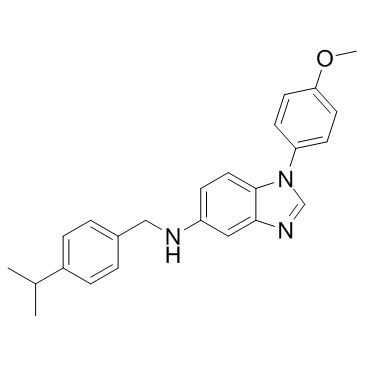
ST-193 (ST193) is a novel and potent arenavirus inhibitor with a broad-spectrum of antiviral activity. It is active against Guanarito, Junin, Lassa and Machupo virus with IC50 values of 0.44, 0.62, 1.4 and 3.1 nM, respectively.
Physicochemical Properties
| Molecular Formula | C24H25N3O |
| Molecular Weight | 371.4748 |
| Exact Mass | 371.199 |
| CAS # | 489416-12-8 |
| Related CAS # | ST-193 hydrochloride;2320274-72-2 |
| PubChem CID | 3697969 |
| Appearance | Off-white to pink solid powder |
| Density | 1.1±0.1 g/cm3 |
| Boiling Point | 562.5±60.0 °C at 760 mmHg |
| Flash Point | 294.0±32.9 °C |
| Vapour Pressure | 0.0±1.5 mmHg at 25°C |
| Index of Refraction | 1.609 |
| LogP | 5.8 |
| Hydrogen Bond Donor Count | 1 |
| Hydrogen Bond Acceptor Count | 3 |
| Rotatable Bond Count | 6 |
| Heavy Atom Count | 28 |
| Complexity | 469 |
| Defined Atom Stereocenter Count | 0 |
| InChi Key | JPSZEXYTKSIPDW-UHFFFAOYSA-N |
| InChi Code | InChI=1S/C24H25N3O/c1-17(2)19-6-4-18(5-7-19)15-25-20-8-13-24-23(14-20)26-16-27(24)21-9-11-22(28-3)12-10-21/h4-14,16-17,25H,15H2,1-3H3 |
| Chemical Name | 1-(4-methoxyphenyl)-N-[(4-propan-2-ylphenyl)methyl]benzimidazol-5-amine |
| HS Tariff Code | 2934.99.9001 |
| Storage |
Powder-20°C 3 years 4°C 2 years In solvent -80°C 6 months -20°C 1 month |
| Shipping Condition | Room temperature (This product is stable at ambient temperature for a few days during ordinary shipping and time spent in Customs) |
Biological Activity
| Targets |
- ST-193 is a broad-spectrum arenavirus entry inhibitor that targets the viral glycoprotein (GP) complex (GP1/GP2) on the surface of arenaviruses, blocking viral attachment and fusion with host cell membranes. It exhibits an EC50 range of 0.12–0.85 μM against Lassa virus (LASV), Junín virus (JUNV), and Machupo virus (MACV) in Vero cells [2] |
| ln Vitro |
At a 1.6 nM IC50, ST-193 suppresses LASV pseudotypes. At concentrations of up to 10 μM, ST-193 shows no antiviral activity against pseudotypes incorporating either the GP from the LASV-related arenavirus lymphocytic choriomeningitis virus or the unrelated G protein from vesicular stomatitis virus. However, it inhibits pseudotypes generated with other arenavirus envelopes as well, including the remaining four common associated with hemorrhagic fever (IC50s for Junín, Machupo, Guanarito, and Sabiá were in the 0.2 to 12 nM range). - Antiviral activity against arenaviruses (Reference [2]): ST-193 inhibited replication of multiple arenaviruses in Vero cells (African lineage: LASV; New World lineage: JUNV, MACV, Guanarito virus). The EC50 values were 0.12 μM (LASV), 0.35 μM (JUNV), 0.42 μM (MACV), and 0.85 μM (Guanarito virus). It showed no significant cytotoxicity in Vero cells, with a CC50 > 50 μM, resulting in a selectivity index (SI = CC50/EC50) > 588 for LASV [2] - Mode of action (Reference [2]): ST-193 (0.5 μM) blocked arenavirus entry at the early stage of infection: pre-treatment of LASV with ST-193 for 1 h reduced viral attachment to Vero cells by ~80%; post-infection treatment (1 h after viral entry) had no effect on viral replication, confirming it acts on viral entry rather than post-entry steps [2] - LASV replication inhibition (Reference [3]): In LASV-infected Vero E6 cells, ST-193 (0.1–10 μM) dose-dependently reduced viral RNA levels (detected by quantitative RT-PCR) and viral titers (measured by plaque assay). At 1 μM, viral RNA was reduced by ~90% and viral titers decreased by ~2.5 log10 PFU/mL compared to the untreated control [3] |
| ln Vivo |
When given daily as an intraperitoneal injection of either 25 or 100 mg/kg/day for 14 days, ST-193 is proven to be well tolerated. Animals treated with ST-193 show improved survival rates and less illness symptoms than the ribavirin or vehicle groups. All groups see an increase in body temperature by day 9, but most ST-193-treated animals' body temperatures return to normal by day 19 after infection. Comparing ST-193-treated controls to vehicle-treated ones, there is a 2- to 3-log decrease in viremia. In the ST-193-treated guinea pig group, the overall survival rate is 62.5% (10/16), while it is 0% in the ribavirin (0/8) and vehicle (0/7) groups[3]. - Guinea pig LASV infection model (Reference [3]): Hartley guinea pigs (250–300 g) were inoculated intraperitoneally with a lethal dose of LASV (1×10⁴ PFU). ST-193 was administered intraperitoneally at doses of 10 mg/kg, 20 mg/kg, or 40 mg/kg, twice daily for 14 days, starting 1 day post-infection (dpi). - At 20 mg/kg and 40 mg/kg, ST-193 resulted in 100% survival (vs. 0% survival in the vehicle group). - At 10 mg/kg, survival rate was 60%. - Viral loads in serum (measured by RT-PCR) and organs (liver, spleen) were undetectable in the 40 mg/kg group by 10 dpi, while the vehicle group showed persistent high viral loads (>10⁶ RNA copies/mL) [3] |
| Enzyme Assay |
- Viral GP-mediated cell fusion assay (Reference [2]): HEK293T cells were transfected with plasmids encoding LASV GP (GP1/GP2) and a luciferase reporter gene under a fusion-dependent promoter. Target cells (Vero cells) were co-cultured with transfected HEK293T cells in the presence of ST-193 (0.01–10 μM). After 24 h, luciferase activity (indicator of cell fusion) was measured. ST-193 inhibited GP-mediated fusion with an EC50 of 0.21 μM, confirming it targets the viral GP complex [2] - Viral attachment assay (Reference [2]): FITC-labeled LASV (1×10³ PFU) was pre-incubated with ST-193 (0.1–5 μM) for 1 h, then added to Vero cells. After 1 h of attachment at 4°C (to block internalization), unbound virus was washed away. Fluorescence intensity (indicator of bound virus) was measured by flow cytometry. ST-193 at 0.5 μM reduced viral attachment by ~80% [2] |
| Cell Assay |
- Antiviral activity assay (References [2, 3]): 1. Vero cells (2×10⁴ cells/well) were seeded in 96-well plates and infected with arenaviruses (LASV/JUNV/MACV, 100 PFU/well) for 1 h. ST-193 (0.01–100 μM) was added, and cells were cultured for 48–72 h. Viral replication was detected by plaque assay (counting viral plaques) or quantitative RT-PCR (measuring viral RNA levels). EC50 was calculated as the concentration inhibiting 50% viral replication [2, 3] 2. Cytotoxicity assay: Vero cells were treated with ST-193 (0.1–100 μM) for 72 h. Cell viability was assessed by MTT assay, and CC50 (concentration causing 50% cytotoxicity) was determined. ST-193 had CC50 > 50 μM in Vero cells [2] |
| Animal Protocol |
- Guinea pig LASV treatment protocol (Reference [3]): 1. Infection: Hartley guinea pigs (n=6 per group) were inoculated intraperitoneally with 1×10⁴ PFU of LASV (strain Josiah). 2. Drug preparation: ST-193 was dissolved in 10% dimethyl sulfoxide (DMSO) + 90% physiological saline. 3. Administration: Treatment started at 1 dpi, with intraperitoneal injections twice daily (12 h interval) for 14 days. Doses were 10 mg/kg, 20 mg/kg, 40 mg/kg; the vehicle group received 10% DMSO + 90% saline. 4. Monitoring: Daily monitoring of body weight and survival; serum viral loads measured by RT-PCR on 3, 7, 10, 14 dpi; organ viral loads and histopathology analyzed at study end (14 dpi or upon death) [3] |
| Toxicity/Toxicokinetics |
- In vitro cytotoxicity (Reference [2]): ST-193 showed low cytotoxicity in Vero cells (CC50 > 50 μM) and human foreskin fibroblasts (CC50 > 40 μM), with SI > 588 (for LASV) and SI > 114 (for JUNV) [2] - In vivo toxicity (Reference [3]): In the guinea pig study, ST-193 (up to 40 mg/kg, 14 days) caused no significant adverse effects: no weight loss (mean weight gain of 5–8% vs. vehicle group’s 10% weight loss), no histopathological lesions in liver/kidney, and no changes in serum biochemical parameters (ALT, AST, creatinine) [3] - Plasma protein binding (Reference [3]): ST-193 had 65–72% plasma protein binding in guinea pig plasma, measured by ultrafiltration method [3] |
| References |
[1]. Discovery and optimization of potent broad-spectrum arenavirus inhibitors derived from benzimidazole and related heterocycles. Bioorg Med Chem Lett. 2013 Feb 1;23(3):750-6. [2]. Identification of a broad-spectrum arenavirus entry inhibitor. J Virol. 2008 Nov;82(21):10768-75. [3]. Evaluation of Lassa antiviral compound ST-193 in a guinea pig model. Antiviral Res. 2011 Apr;90(1):70-9. |
| Additional Infomation |
- ST-193 is a synthetic small-molecule inhibitor derived from the benzimidazole heterocyclic scaffold, developed for the treatment of arenavirus infections (e.g., Lassa fever, Argentine hemorrhagic fever) [1, 2] - Its antiviral mechanism is unique: it binds to the viral GP complex, preventing the conformational changes required for viral attachment to host cell receptors (α-dystroglycan) and membrane fusion, thus blocking viral entry [2] - ST-193 is a lead compound for broad-spectrum arenavirus therapy: it is active against both African (LASV) and New World (JUNV, MACV) arenaviruses, and showed efficacy in a lethal LASV guinea pig model, supporting its potential for clinical development [2, 3] |
Solubility Data
| Solubility (In Vitro) | DMSO : ~100 mg/mL (~269.20 mM) |
| Solubility (In Vivo) |
Solubility in Formulation 1: ≥ 2.5 mg/mL (6.73 mM) (saturation unknown) in 10% DMSO + 40% PEG300 + 5% Tween80 + 45% Saline (add these co-solvents sequentially from left to right, and one by one), clear solution. For example, if 1 mL of working solution is to be prepared, you can add 100 μL of 25.0 mg/mL clear DMSO stock solution to 400 μL PEG300 and mix evenly; then add 50 μL Tween-80 to the above solution and mix evenly; then add 450 μL normal saline to adjust the volume to 1 mL. Preparation of saline: Dissolve 0.9 g of sodium chloride in 100 mL ddH₂ O to obtain a clear solution. Solubility in Formulation 2: ≥ 2.5 mg/mL (6.73 mM) (saturation unknown) in 10% DMSO + 90% Corn Oil (add these co-solvents sequentially from left to right, and one by one), clear solution. For example, if 1 mL of working solution is to be prepared, you can add 100 μL of 25.0 mg/mL clear DMSO stock solution to 900 μL of corn oil and mix evenly. (Please use freshly prepared in vivo formulations for optimal results.) |
| Preparing Stock Solutions | 1 mg | 5 mg | 10 mg | |
| 1 mM | 2.6920 mL | 13.4600 mL | 26.9201 mL | |
| 5 mM | 0.5384 mL | 2.6920 mL | 5.3840 mL | |
| 10 mM | 0.2692 mL | 1.3460 mL | 2.6920 mL |