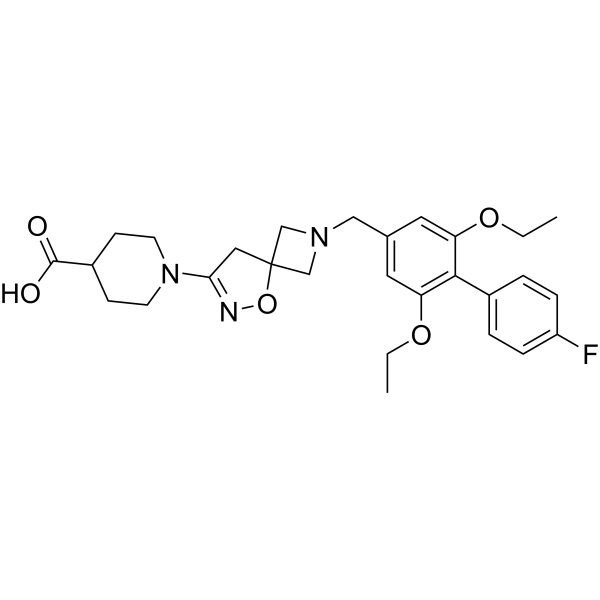
Physicochemical Properties
| Molecular Formula | C28H34FN3O5 |
| Molecular Weight | 511.585071086884 |
| Exact Mass | 511.248 |
| CAS # | 1628741-91-2 |
| PubChem CID | 90423921 |
| Appearance | White to off-white solid powder |
| LogP | 1.1 |
| Hydrogen Bond Donor Count | 1 |
| Hydrogen Bond Acceptor Count | 8 |
| Rotatable Bond Count | 9 |
| Heavy Atom Count | 37 |
| Complexity | 790 |
| Defined Atom Stereocenter Count | 0 |
| SMILES | FC1C=CC(=CC=1)C1=C(C=C(C=C1OCC)CN1CC2(CC(=NO2)N2CCC(C(=O)O)CC2)C1)OCC |
| InChi Key | UQRAIIGEZLINAT-UHFFFAOYSA-N |
| InChi Code | InChI=1S/C28H34FN3O5/c1-3-35-23-13-19(14-24(36-4-2)26(23)20-5-7-22(29)8-6-20)16-31-17-28(18-31)15-25(30-37-28)32-11-9-21(10-12-32)27(33)34/h5-8,13-14,21H,3-4,9-12,15-18H2,1-2H3,(H,33,34) |
| Chemical Name | 1-[2-[[3,5-diethoxy-4-(4-fluorophenyl)phenyl]methyl]-5-oxa-2,6-diazaspiro[3.4]oct-6-en-7-yl]piperidine-4-carboxylic acid |
| HS Tariff Code | 2934.99.9001 |
| Storage |
Powder-20°C 3 years 4°C 2 years In solvent -80°C 6 months -20°C 1 month |
| Shipping Condition | Room temperature (This product is stable at ambient temperature for a few days during ordinary shipping and time spent in Customs) |
Biological Activity
| ln Vitro | SSTR5 antagonist 1 (compound 25a) reduced hERG activity by 5.6% at 30 μM[1]. The inhibitory effect of SSTR5 antagonist 1 (10 μM) on SSTR5 is higher than that of SSTR1-4, with respective inhibition rates of 11%, 8%, 14%, and 10% [1]. On both human and mouse microsomes, SSTR5 antagonist 1 (1 μM; 15 min and 30 min) shows good metabolic stability, with in vitro CLint values of <10 μL/min/kg (HLM) and 19 μL/min/kg (MLM), respectively [1]. |
| ln Vivo | In pharmacokinetic screens, SSTR5 antagonist 1 (compound 25a) (1 mg/kg; oral; single dose) was given orally with good solubility (260 μg/mL, pH= 6.8) and acceptable mouse plasma exposure[1]. In C57BL/6J mice fed a high-fat diet, SSTR5 antagonist 1 (100 mg/kg; oral; single dose; measured 0-120 minutes) lowers blood glucose concentrations and increases insulin secretion in a glucose-dependent manner [1]. In C57BL/6J mice given a high-fat diet, SSTR5 antagonist 1 (1, 3, 10, and 30 mg/kg; oral; single dose) exhibits a dose-dependent effect on glucose excursions as assessed by an oral glucose tolerance test [1]. Male ICR mice (8 weeks old) with respect to pharmacokinetic characteristics [1]: route dose (mg/kg), CLtotal (mL/h/kg), Vss (mL/kg), MRT (h) iv 0.1 1761 3052 1.7 / route Dose (mg/kg) Cmax (ng/mL) Tmax (h) AUC0-8 h (ng·h/mL) F (%) po 1 74.8 2.0 332 58 |
| Animal Protocol |
Animal/Disease Models: C57BL/6J mice fed with high-fat diet [1] Doses: 100 mg/kg Doses: po (oral gavage); single dose; monitoring over 2 hrs (hrs (hours)) Experimental Results: demonstrated maximum efficacy better than 10 mg/kg glibenclamide and equivalent to 30 mg/kg alogliptin . Increases insulin secretion in a glucose-dependent manner and exhibits hypoglycemic effects, indicating its antidiabetic efficacy in vivo. |
| References |
[1]. Discovery of novel 5-oxa-2,6-diazaspiro[3.4]oct-6-ene derivatives as potent, selective, and orally available somatostatin receptor subtype 5 (SSTR5) antagonists for treatment of type 2 diabetes mellitus. Bioorg Med Chem. 2017 Aug 1;25(15):4175-4193. |
Solubility Data
| Solubility (In Vitro) | DMSO : ~90 mg/mL (~175.92 mM) |
| Solubility (In Vivo) |
Solubility in Formulation 1: ≥ 2.25 mg/mL (4.40 mM) (saturation unknown) in 10% DMSO + 40% PEG300 + 5% Tween80 + 45% Saline (add these co-solvents sequentially from left to right, and one by one), clear solution. For example, if 1 mL of working solution is to be prepared, you can add 100 μL of 22.5 mg/mL clear DMSO stock solution to 400 μL PEG300 and mix evenly; then add 50 μL Tween-80 to the above solution and mix evenly; then add 450 μL normal saline to adjust the volume to 1 mL. Preparation of saline: Dissolve 0.9 g of sodium chloride in 100 mL ddH₂ O to obtain a clear solution. Solubility in Formulation 2: ≥ 2.25 mg/mL (4.40 mM) (saturation unknown) in 10% DMSO + 90% (20% SBE-β-CD in Saline) (add these co-solvents sequentially from left to right, and one by one), clear solution. For example, if 1 mL of working solution is to be prepared, you can add 100 μL of 22.5 mg/mL clear DMSO stock solution to 900 μL of 20% SBE-β-CD physiological saline solution and mix evenly. Preparation of 20% SBE-β-CD in Saline (4°C,1 week): Dissolve 2 g SBE-β-CD in 10 mL saline to obtain a clear solution. Solubility in Formulation 3: ≥ 2.25 mg/mL (4.40 mM) (saturation unknown) in 10% DMSO + 90% Corn Oil (add these co-solvents sequentially from left to right, and one by one), clear solution. For example, if 1 mL of working solution is to be prepared, you can add 100 μL of 22.5 mg/mL clear DMSO stock solution to 900 μL of corn oil and mix evenly. (Please use freshly prepared in vivo formulations for optimal results.) |
| Preparing Stock Solutions | 1 mg | 5 mg | 10 mg | |
| 1 mM | 1.9547 mL | 9.7735 mL | 19.5469 mL | |
| 5 mM | 0.3909 mL | 1.9547 mL | 3.9094 mL | |
| 10 mM | 0.1955 mL | 0.9773 mL | 1.9547 mL |