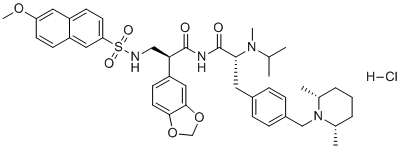
SSR-240612 HCl, the hydrochloride salt of SSR240612, is a novel, potent, and orally bioactive specific non-peptide bradykinin B(1) receptor antagonist. SSR-240612 has the potential for the treatment of inflammation and chronic pain. In human fibroblast MRC5 and recombinant human B(1) receptor expressed in human embryonic kidney cells, SSR240612 inhibits the binding of [(3)H]Lys(0)-des-Arg(9)-BK to the B(1) receptor. The inhibition constants (K(i)) of these two receptors are 0.48 and 0.73 nM, respectively. With an IC(50) of 1.9 nM, SSR240612 prevented human fibroblast MRC5 from forming inositol monophosphate in response to Lys(0)-desAr(9)-BK (10 nM). Also, it inhibited the des-Arg(9)-BK-induced contractions in the rat ileum's mesenteric plexus and isolated rabbit aorta, with pA(2) values of 8.9 and 9.4, respectively.
Physicochemical Properties
| Molecular Formula | C42H53CLN4O7S | |
| Molecular Weight | 793.42 | |
| Exact Mass | 792.332 | |
| Elemental Analysis | C, 63.58; H, 6.73; Cl, 4.47; N, 7.06; O, 14.12; S, 4.04 | |
| CAS # | 464930-42-5 | |
| Related CAS # | 465539-70-2 | |
| PubChem CID | 44235958 | |
| Appearance | White to off-white solid powder | |
| LogP | 9.395 | |
| Hydrogen Bond Donor Count | 3 | |
| Hydrogen Bond Acceptor Count | 9 | |
| Rotatable Bond Count | 14 | |
| Heavy Atom Count | 55 | |
| Complexity | 1330 | |
| Defined Atom Stereocenter Count | 4 | |
| SMILES | Cl.S(C1C=CC2C=C(C=CC=2C=1)OC)(N[C@@H](C1=CC=C2C(=C1)OCO2)CC(N[C@@H](C(N(C)C(C)C)=O)CC1C=CC(=CC=1)CN1[C@H](C)CCC[C@@H]1C)=O)(=O)=O |
|
| InChi Key | GLHHFOSVBQQNAW-GDYXXZBVSA-N | |
| InChi Code | InChI=1S/C42H52N4O7S.ClH/c1-27(2)45(5)42(48)38(20-30-10-12-31(13-11-30)25-46-28(3)8-7-9-29(46)4)43-41(47)24-37(34-16-19-39-40(23-34)53-26-52-39)44-54(49,50)36-18-15-32-21-35(51-6)17-14-33(32)22-36;/h10-19,21-23,27-29,37-38,44H,7-9,20,24-26H2,1-6H3,(H,43,47);1H/t28-,29+,37-,38-;/m1./s1 | |
| Chemical Name | (2R)-2-[[(3R)-3-(1,3-benzodioxol-5-yl)-3-[(6-methoxynaphthalen-2-yl)sulfonylamino]propanoyl]amino]-3-[4-[[(2R,6S)-2,6-dimethylpiperidin-1-yl]methyl]phenyl]-N-methyl-N-propan-2-ylpropanamide;hydrochloride | |
| Synonyms |
|
|
| HS Tariff Code | 2934.99.9001 | |
| Storage |
Powder-20°C 3 years 4°C 2 years In solvent -80°C 6 months -20°C 1 month Note: Please store this product in a sealed and protected environment, avoid exposure to moisture. |
|
| Shipping Condition | Room temperature (This product is stable at ambient temperature for a few days during ordinary shipping and time spent in Customs) |
Biological Activity
| Targets |
bradykinin B1 receptor, Human MRC5 ( Ki = 0.48 nM ); bradykinin B1 receptor, Human HEK-B1 ( IC50 = 0.73 nM ); bradykinin B2 receptor, guinea pig ileum membranes ( IC50 = 481 nM ); bradykinin B2 receptor, Human CHO-B2 ( IC50 = 358 nM ) |
|
| ln Vitro |
|
|
| ln Vivo |
|
|
| Enzyme Assay | [3H]Lys0-des-Arg9-BK The following ingredients make up the binding buffer used for binding to cell membranes: 137 mM NaCl, 5.4 mM KCl, 1.05 mM MgCl2, 1.8 mM CaCl2, 1.2 mM NaH2PO4, 15.5 mM NaHCO3, 10 mM HEPES, 1 g/L bovine serum albumin (BSA), 140 mg/L bacitracin, and 1 μM captopril, pH 7.4. The membranes are incubated in 500 μL of binding buffer containing 1 nM [3H]Lys0-des-Arg9-BK for 30 minutes at 25°C. for saturation isotherms and 0.1 to 10 nM for competition curves. Filters are washed three times with 5 mL of binding buffer, and radioactivity is determined by liquid scintillation spectrometry. One way to measure nonspecific binding is to add 1 μM of unlabeled Lys0-des-Arg9BK[1]. | |
| Cell Assay | SSR240612 is a strong antagonist of the bradykinin B1 receptor, with Kis values of 0.48 nM and 0.73 nM for the B2 kinin receptors of human fibroblast MRC5 and HEK cells that express human B1 receptors, respectively, and 481 nM and 358 nM for the B1 receptors of guinea pig ileum membranes and CHO cells that express human B1 receptor. SSR240612 inhibits the formation of inositol phosphate-1 with an IC50 of 1.9 nM, but has no discernible effect on the formation of inositol phosphate-1 in human fibroblast MRC5 that is triggered by BK (3 nM) activation of the B2 receptor. | |
| Animal Protocol |
|
|
| References |
[1]. SSR240612 [(2R)-2-[((3R)-3-(1,3-benzodioxol-5-yl)-3-[[(6-methoxy-2-naphthyl)sulfonyl]amino]propanoyl)amino]-3-(4-[[2R,6S)-2,6-dimethylpiperidinyl]methyl]phenyl)-N-isopropyl-N-methylpropanamide hydrochloride], a new nonpeptide antagonist of the bradykinin B1 receptor: biochemical and pharmacological characterization. J Pharmacol Exp Ther . 2004 May;309(2):661-9 [2]. The kinin B1 receptor antagonist SSR240612 reverses tactile and cold allodynia in an experimental rat model of insulin resistance. Br J Pharmacol . 2007 Sep;152(2):280-7. |
Solubility Data
| Solubility (In Vitro) |
|
|||
| Solubility (In Vivo) |
Solubility in Formulation 1: ≥ 2.5 mg/mL (3.15 mM) (saturation unknown) in 10% DMSO + 40% PEG300 + 5% Tween80 + 45% Saline (add these co-solvents sequentially from left to right, and one by one), clear solution. For example, if 1 mL of working solution is to be prepared, you can add 100 μL of 25.0 mg/mL clear DMSO stock solution to 400 μL PEG300 and mix evenly; then add 50 μL Tween-80 to the above solution and mix evenly; then add 450 μL normal saline to adjust the volume to 1 mL. Preparation of saline: Dissolve 0.9 g of sodium chloride in 100 mL ddH₂ O to obtain a clear solution. Solubility in Formulation 2: ≥ 2.5 mg/mL (3.15 mM) (saturation unknown) in 10% DMSO + 90% (20% SBE-β-CD in Saline) (add these co-solvents sequentially from left to right, and one by one), clear solution. For example, if 1 mL of working solution is to be prepared, you can add 100 μL of 25.0 mg/mL clear DMSO stock solution to 900 μL of 20% SBE-β-CD physiological saline solution and mix evenly. Preparation of 20% SBE-β-CD in Saline (4°C,1 week): Dissolve 2 g SBE-β-CD in 10 mL saline to obtain a clear solution. Solubility in Formulation 3: ≥ 2.5 mg/mL (3.15 mM) (saturation unknown) in 10% DMSO + 90% Corn Oil (add these co-solvents sequentially from left to right, and one by one), clear solution. For example, if 1 mL of working solution is to be prepared, you can add 100 μL of 25.0 mg/mL clear DMSO stock solution to 900 μL of corn oil and mix evenly. (Please use freshly prepared in vivo formulations for optimal results.) |
| Preparing Stock Solutions | 1 mg | 5 mg | 10 mg | |
| 1 mM | 1.2604 mL | 6.3018 mL | 12.6037 mL | |
| 5 mM | 0.2521 mL | 1.2604 mL | 2.5207 mL | |
| 10 mM | 0.1260 mL | 0.6302 mL | 1.2604 mL |