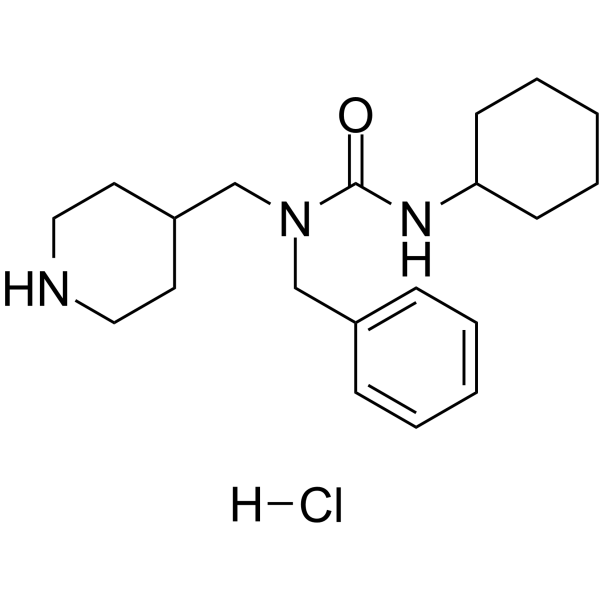
Physicochemical Properties
| Molecular Formula | C20H32CLN3O |
| Molecular Weight | 365.9406 |
| Exact Mass | 365.223 |
| CAS # | 2070014-88-7 |
| Related CAS # | SRI-011381;1629138-41-5 |
| PubChem CID | 122198132 |
| Appearance | White to off-white solid powder |
| Hydrogen Bond Donor Count | 3 |
| Hydrogen Bond Acceptor Count | 2 |
| Rotatable Bond Count | 5 |
| Heavy Atom Count | 25 |
| Complexity | 369 |
| Defined Atom Stereocenter Count | 0 |
| SMILES | Cl[H].O=C(N([H])C1([H])C([H])([H])C([H])([H])C([H])([H])C([H])([H])C1([H])[H])N(C([H])([H])C1C([H])=C([H])C([H])=C([H])C=1[H])C([H])([H])C1([H])C([H])([H])C([H])([H])N([H])C([H])([H])C1([H])[H] |
| InChi Key | GPNMJVSGNMDOJN-UHFFFAOYSA-N |
| InChi Code | InChI=1S/C20H31N3O.ClH/c24-20(22-19-9-5-2-6-10-19)23(15-17-7-3-1-4-8-17)16-18-11-13-21-14-12-18;/h1,3-4,7-8,18-19,21H,2,5-6,9-16H2,(H,22,24);1H |
| Chemical Name | 1-benzyl-3-cyclohexyl-1-(piperidin-4-ylmethyl)urea;hydrochloride |
| HS Tariff Code | 2934.99.9001 |
| Storage |
Powder-20°C 3 years 4°C 2 years In solvent -80°C 6 months -20°C 1 month Note: Please store this product in a sealed and protected environment, avoid exposure to moisture. |
| Shipping Condition | Room temperature (This product is stable at ambient temperature for a few days during ordinary shipping and time spent in Customs) |
Biological Activity
| Targets | TGF-beta[1] |
| ln Vitro | SRI-011381 (10 μM) hydrochloride greatly boosts the expression of TGF-β1, NALP3, collagen-1, and α-SMA while also encouraging the growth of mice lung fibroblasts[1]. |
| ln Vivo | The deficiencies in the optic nerve and retina of YAPGFAP-CKO EAE mice are largely restored by SRI-011381 (30 mg/kg; ip; every 2 d; for 22 days) hydrochloride[2]. |
| Animal Protocol |
Animal/Disease Models: YAPGFAP-CKO mice bearing experimental autoimmune encephalomyelitis (EAE)[2] Doses: 30 mg/kg Route of Administration: intraperitoneally (ip) injection; every 2 d; for 22 days Experimental Results: Dramatically inhibited inflammatory infiltration and relieved the loss of neurons in YAPGFAP-CKO EAE mice. |
| References |
[1]. The Improvement Effect of Sodium Ferulate on the Formation of Pulmonary Fibrosis in Silicosis Mice Through the Neutrophil Alkaline Phosphatase 3 (NALP3)/Transforming Growth Factor-β1 (TGF-β1)/α-Smooth Muscle Actin (α-SMA) Pathway. Med. [2]. Astrocytic YAP protects the optic nerve and retina in an experimental autoimmune encephalomyelitis model through TGF-β signaling. Theranostics. 2021 Jul 25;11(17):8480-8499. |
Solubility Data
| Solubility (In Vitro) |
DMSO: 33.33 mg/mL (91.08 mM) H2O: 25 mg/mL (68.32 mM) |
| Solubility (In Vivo) |
Solubility in Formulation 1: ≥ 2.5 mg/mL (6.83 mM) (saturation unknown) in 10% DMSO + 40% PEG300 + 5% Tween80 + 45% Saline (add these co-solvents sequentially from left to right, and one by one), clear solution. For example, if 1 mL of working solution is to be prepared, you can add 100 μL of 25.0 mg/mL clear DMSO stock solution to 400 μL PEG300 and mix evenly; then add 50 μL Tween-80 to the above solution and mix evenly; then add 450 μL normal saline to adjust the volume to 1 mL. Preparation of saline: Dissolve 0.9 g of sodium chloride in 100 mL ddH₂ O to obtain a clear solution. Solubility in Formulation 2: ≥ 2.5 mg/mL (6.83 mM) (saturation unknown) in 10% DMSO + 90% (20% SBE-β-CD in Saline) (add these co-solvents sequentially from left to right, and one by one), clear solution. For example, if 1 mL of working solution is to be prepared, you can add 100 μL of 25.0 mg/mL clear DMSO stock solution to 900 μL of 20% SBE-β-CD physiological saline solution and mix evenly. Preparation of 20% SBE-β-CD in Saline (4°C,1 week): Dissolve 2 g SBE-β-CD in 10 mL saline to obtain a clear solution. Solubility in Formulation 3: ≥ 2.5 mg/mL (6.83 mM) (saturation unknown) in 10% DMSO + 90% Corn Oil (add these co-solvents sequentially from left to right, and one by one), clear solution. For example, if 1 mL of working solution is to be prepared, you can add 100 μL of 25.0 mg/mL clear DMSO stock solution to 900 μL of corn oil and mix evenly. Solubility in Formulation 4: 50 mg/mL (136.63 mM) in PBS (add these co-solvents sequentially from left to right, and one by one), clear solution; with ultrasonication. (Please use freshly prepared in vivo formulations for optimal results.) |
| Preparing Stock Solutions | 1 mg | 5 mg | 10 mg | |
| 1 mM | 2.7327 mL | 13.6634 mL | 27.3269 mL | |
| 5 mM | 0.5465 mL | 2.7327 mL | 5.4654 mL | |
| 10 mM | 0.2733 mL | 1.3663 mL | 2.7327 mL |