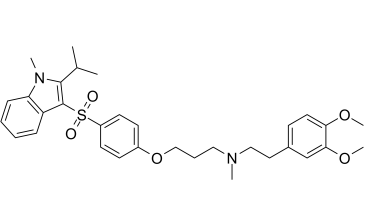
Physicochemical Properties
| Molecular Formula | C32H40N2O5 |
| Molecular Weight | 564.7354 |
| Exact Mass | 564.266 |
| Elemental Analysis | C, 68.06; H, 7.14; N, 4.96; O, 14.16; S, 5.68 |
| CAS # | 121345-64-0 |
| Related CAS # | 121346-33-6 (oxalate);121345-64-0; |
| PubChem CID | 129426 |
| Appearance | White to off-white solid powder |
| Density | 1.15g/cm3 |
| Boiling Point | 724.1ºC at 760mmHg |
| Flash Point | 391.7ºC |
| Vapour Pressure | 8.05E-21mmHg at 25°C |
| Index of Refraction | 1.57 |
| LogP | 7.175 |
| Hydrogen Bond Donor Count | 0 |
| Hydrogen Bond Acceptor Count | 6 |
| Rotatable Bond Count | 13 |
| Heavy Atom Count | 40 |
| Complexity | 856 |
| Defined Atom Stereocenter Count | 0 |
| SMILES | S(C1C([H])=C([H])C(=C([H])C=1[H])OC([H])([H])C([H])([H])C([H])([H])N(C([H])([H])[H])C([H])([H])C([H])([H])C1C([H])=C([H])C(=C(C=1[H])OC([H])([H])[H])OC([H])([H])[H])(C1C2=C([H])C([H])=C([H])C([H])=C2N(C([H])([H])[H])C=1C([H])(C([H])([H])[H])C([H])([H])[H])(=O)=O |
| InChi Key | OGLMUIRZIMTHMN-UHFFFAOYSA-N |
| InChi Code | InChI=1S/C32H40N2O5S/c1-23(2)31-32(27-10-7-8-11-28(27)34(31)4)40(35,36)26-15-13-25(14-16-26)39-21-9-19-33(3)20-18-24-12-17-29(37-5)30(22-24)38-6/h7-8,10-17,22-23H,9,18-21H2,1-6H3 |
| Chemical Name | N-(3,4-dimethoxyphenethyl)-3-(4-((2-isopropyl-1-methyl-1H-indol-3-yl)sulfonyl)phenoxy)-N-methylpropan-1-amine |
| Synonyms | SR33805 SR-33805 SR 33805 |
| HS Tariff Code | 2934.99.9001 |
| Storage |
Powder-20°C 3 years 4°C 2 years In solvent -80°C 6 months -20°C 1 month |
| Shipping Condition | Room temperature (This product is stable at ambient temperature for a few days during ordinary shipping and time spent in Customs) |
Biological Activity
| Targets |
L-type cardiac calcium channel (IC50 = 1.8 μM for guinea pig cardiac L-type Ca²⁺ current); Vascular smooth muscle L-type calcium channel (IC50 = 2.3 μM for porcine vascular smooth muscle cell proliferation) [1][3] |
| ln Vitro |
Growth factor-induced SMC proliferation is inhibited by SR33805 (0.01-10 µM; 3 d) in a dose-dependent manner (0.2050<0.46 µM) [3]. Without altering the Ca2+ transient amplitude, SR33805 (10 µM; 10 min) recovers the cell shortening that was changed after a myocardial infarction (MI) [2]. SR33805 (10 µM) inhibits recombinant PKA activity [2]. SR33805 dose-dependently inhibited L-type calcium currents in isolated guinea pig ventricular myocytes, as measured by whole-cell patch-clamp technique, with an IC50 of 1.8 μM and maximal inhibition (85%) at 10 μM [1] - The inhibition was voltage-dependent, with stronger effects at depolarized membrane potentials (e.g., +20 mV) compared to resting potentials (-80 mV) [1] - In cultured porcine vascular smooth muscle cells, SR33805 suppressed cell proliferation in a dose-dependent manner, with an IC50 of 2.3 μM, and reduced DNA synthesis (measured by [³H]-thymidine incorporation) by 62% at 5 μM [3] - SR33805 (5 μM) did not affect endothelial cell viability or proliferation, showing selectivity for smooth muscle cells [3] |
| ln Vivo |
Rats with MI who receive a single intraperitoneal injection of SR33805 (20 mg/kg) show improved fractional shortening and end-systolic strain [2]. Pigs treated with SR33805 (5 mg/kg/day; orally for 38 days) have significantly less intimal hyperplasia [3]. In a rat model of pressure-overload-induced heart failure (abdominal aortic banding), oral administration of SR33805 (3 mg/kg/day for 8 weeks) improved left ventricular systolic function: left ventricular ejection fraction increased from 35% (vehicle) to 52%, and left ventricular end-diastolic volume decreased by 30% [2] - SR33805 (3 mg/kg/day, po) reduced myocardial fibrosis in heart failure rats, with collagen volume fraction decreasing from 18% (vehicle) to 9%, and downregulated expression of fibrosis-related genes (collagen I, TGF-β1) [2] - In a porcine carotid artery injury model (balloon angioplasty), intravenous administration of SR33805 (1 mg/kg, weekly for 4 weeks) significantly reduced neointimal hyperplasia, with intimal area decreasing by 40% compared to vehicle-treated pigs [3] - The drug did not affect systemic blood pressure or heart rate in normal pigs at therapeutic doses (1 mg/kg) [3] |
| Enzyme Assay |
Whole-cell patch-clamp assay for cardiac L-type Ca²⁺ current: Guinea pig ventricular myocytes were enzymatically isolated and maintained in physiological buffer. SR33805 was applied at serial concentrations (0.1 μM-10 μM) via bath perfusion. L-type calcium currents were recorded using a patch-clamp amplifier at a holding potential of -80 mV, with step depolarizations to +20 mV (50 ms duration). Current amplitudes were normalized to vehicle control, and IC50 values were calculated by nonlinear regression [1] |
| Cell Assay |
Cell Viability Assay [3] Cell Types: Smooth Muscle Cells (SMC) Tested Concentrations: 0.01, 0.1, 1, 10 µM Incubation Duration: 3 days Experimental Results: Inhibited FCS, bFGF and PDGF-induced porcine proliferation in a dose-dependent manner IC50 of SMC respectively are 0.26±0.08, 0.46±0.1 and 0.20±0.04 µM. Vascular smooth muscle cell proliferation assay: Porcine carotid artery smooth muscle cells were seeded in 96-well plates and cultured for 24 hours. Cells were treated with serial dilutions of SR33805 (0.1 μM-10 μM) and stimulated with 10% fetal bovine serum. After 72 hours of incubation, cell viability was assessed using a colorimetric assay, and IC50 values were calculated [3] - [³H]-thymidine incorporation assay: Porcine vascular smooth muscle cells were seeded in 24-well plates, treated with SR33805 (1 μM-5 μM) for 24 hours, then incubated with [³H]-thymidine for an additional 24 hours. Cells were lysed, and incorporated radioactivity was measured by liquid scintillation counting to assess DNA synthesis [3] |
| Animal Protocol |
Animal/Disease Models: Male Wistar rats (5 weeks) underwent coronary artery ligation [2] Doses: 0.2, 2, 20 mg/kg Route of Administration: single intraperitoneal (ip) injection Experimental Results: End-systolic strain (ESS) and fractional shortening were significant Increases (FS) were approximately +38% and +26%, respectively, at the 20 mg/kg dose. Does not affect other shrinkage parameters. Rat heart failure model: Male Wistar rats (250-300 g) underwent abdominal aortic banding to induce pressure-overload heart failure. Four weeks after surgery, rats with left ventricular ejection fraction <40% were randomly divided into vehicle and SR33805 groups (n=8/group). SR33805 was dissolved in 0.5% carboxymethylcellulose sodium and administered orally at 3 mg/kg/day for 8 weeks. Cardiac function was evaluated by echocardiography at baseline and study end; myocardial tissues were collected for fibrosis analysis [2] - Porcine carotid artery injury model: Female domestic pigs (25-30 kg) underwent balloon angioplasty of the left carotid artery to induce endothelial injury. Immediately after injury, SR33805 (1 mg/kg) was administered intravenously, followed by weekly intravenous injections for 3 more weeks (total 4 doses). Four weeks after injury, pigs were euthanized, and carotid arteries were excised for histomorphometric analysis of intimal thickness and area [3] |
| References |
[1]. Effects of two chemically related new Ca2+ channel antagonists, SR33557 (fantofarone) and SR33805, on the L-type cardiac channel. Eur J Pharmacol. 1994 Sep 22; 263(1-2): 101-5. [2]. Beneficial effects of SR33805 in failing myocardium. Cardiovasc Res. 2011 Aug 1; 91(3): 412-9. [3]. The calcium inhibitor SR33805 reduces intimal formation following injury of the porcine carotid artery. Atherosclerosis. 2001 Feb 1; 154(2): 301-8. |
| Additional Infomation |
SR33805 is a synthetic L-type calcium channel antagonist, structurally related to fantofarone (SR33557), with selective activity on cardiac and vascular smooth muscle L-type calcium channels [1][2][3] - Its mechanism of action involves blocking L-type calcium influx, which reduces myocardial calcium overload in heart failure and inhibits vascular smooth muscle cell proliferation/migration in vascular injury [1][2][3] - Preclinical data support its potential for the treatment of heart failure and restenosis (neointimal hyperplasia) following vascular interventions [2][3] - Unlike non-selective calcium channel blockers, SR33805 shows minimal effects on systemic hemodynamics at therapeutic doses, reducing the risk of hypotension [3] |
Solubility Data
| Solubility (In Vitro) | DMSO : ≥ 100 mg/mL (~177.07 mM) |
| Solubility (In Vivo) |
Solubility in Formulation 1: ≥ 2.08 mg/mL (3.68 mM) (saturation unknown) in 10% DMSO + 40% PEG300 + 5% Tween80 + 45% Saline (add these co-solvents sequentially from left to right, and one by one), clear solution. For example, if 1 mL of working solution is to be prepared, you can add 100 μL of 20.8 mg/mL clear DMSO stock solution to 400 μL PEG300 and mix evenly; then add 50 μL Tween-80 to the above solution and mix evenly; then add 450 μL normal saline to adjust the volume to 1 mL. Preparation of saline: Dissolve 0.9 g of sodium chloride in 100 mL ddH₂ O to obtain a clear solution. Solubility in Formulation 2: ≥ 2.08 mg/mL (3.68 mM) (saturation unknown) in 10% DMSO + 90% Corn Oil (add these co-solvents sequentially from left to right, and one by one), clear solution. For example, if 1 mL of working solution is to be prepared, you can add 100 μL of 20.8 mg/mL clear DMSO stock solution to 900 μL of corn oil and mix evenly. (Please use freshly prepared in vivo formulations for optimal results.) |
| Preparing Stock Solutions | 1 mg | 5 mg | 10 mg | |
| 1 mM | 1.7707 mL | 8.8536 mL | 17.7073 mL | |
| 5 mM | 0.3541 mL | 1.7707 mL | 3.5415 mL | |
| 10 mM | 0.1771 mL | 0.8854 mL | 1.7707 mL |