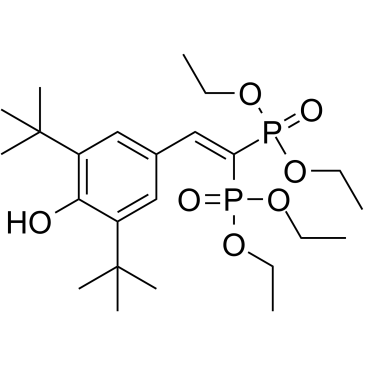
SR12813, a 1,1-bisphosphonate ester, is a novel and potent pan retinoid X receptor (RXR) agonist that is devoid of any RAR activity. SR-12813 exhibits hypocholesterolemic activity by enhancing the degradation of HMG-CoA reductase in various animal models. SR-12813 is also a high affinity ligand for human and rabbit pregnane X receptors (Kd = 41 nM; EC50 = 137 nM for hPXR in vitro) and can induce cytochrome P450 3A expression in human and rabbit hepatocytes.
Physicochemical Properties
| Molecular Formula | C24H42O7P2 |
| Molecular Weight | 504.53368 |
| Exact Mass | 504.241 |
| CAS # | 126411-39-0 |
| PubChem CID | 446313 |
| Appearance | White to off-white solid powder |
| Density | 1.117g/cm3 |
| Boiling Point | 552.6ºC at 760mmHg |
| Flash Point | 288ºC |
| Vapour Pressure | 8.02E-13mmHg at 25°C |
| Index of Refraction | 1.504 |
| LogP | 7.817 |
| Hydrogen Bond Donor Count | 1 |
| Hydrogen Bond Acceptor Count | 7 |
| Rotatable Bond Count | 13 |
| Heavy Atom Count | 33 |
| Complexity | 660 |
| Defined Atom Stereocenter Count | 0 |
| InChi Key | YQLJDECYQDRSBI-UHFFFAOYSA-N |
| InChi Code | InChI=1S/C24H42O7P2/c1-11-28-32(26,29-12-2)21(33(27,30-13-3)31-14-4)17-18-15-19(23(5,6)7)22(25)20(16-18)24(8,9)10/h15- |
| Chemical Name | 4-[2,2-bis(diethoxyphosphoryl)ethenyl]-2,6-ditert-butylphenol |
| Synonyms | GW 485801; GW-485801; GW485801; SR 12813; SR-12813; SR12813 |
| HS Tariff Code | 2934.99.9001 |
| Storage |
Powder-20°C 3 years 4°C 2 years In solvent -80°C 6 months -20°C 1 month |
| Shipping Condition | Room temperature (This product is stable at ambient temperature for a few days during ordinary shipping and time spent in Customs) |
Biological Activity
| Targets |
3-Hydroxy-3-methylglutaryl-coenzyme A reductase (HMG-CoA reductase) [1] |
| ln Vitro |
SR-12813 has no effect on the production of fatty acids, however it inhibits the binding of tritiated water to cholesterol with an IC50 of 1.2 μM. Furthermore, with an IC50 of 0.85 μM, SR-12813 can also lower the activity of the cellular 3-hydroxy-3-methylglutaryl coenzyme A (HMG-CoA) reductase[1]. Because they both prevent cholesterol production, 25-HC and SR-12813 are excellent candidates for fatal selection. At doses ranging from 8 µM to 16 µM, SR-12813 kills HeLa cells. While mutant SL-5 is alive in this situation, SR-12813 kills wild-type cells and mutant cells infected with Ad-Cre (SL-5+Cre). In HeLa cells of the wild type and SL-5 mutant cells, SR-12813 or 25-HC stimulates the breakdown of 95-KDa full-length HMG-CoA reductase [1]. SR-12813 inhibited the incorporation of tritiated water into cholesterol in Hep G2 cells with an IC₅₀ of 1.2 µM. It also inhibited incorporation of [¹⁴C]acetate into cholesterol with an IC₅₀ of 0.6 µM. The drug had no effect on the incorporation of tritiated water into fatty acids, nor on the incorporation of [³H]mevalonic acid lactone into cholesterol, squalene, or farnesol. [1] SR-12813 inhibited cellular HMG-CoA reductase activity in Hep G2 cells with an apparent IC₅₀ of 0.85 µM. The inhibition was rapid, with a T₁/₂ of 10 minutes. Maximum inhibition of about 80% of initial activity was achieved at 5 µM. [1] SR-12813 did not directly inhibit the activity of the cloned catalytic subunit of human HMG-CoA reductase (HR58) at concentrations up to 0.5 mM, nor did it inhibit HMG-CoA reductase activity in Hep G2 cell extracts at 10 µM. [1] After overnight (16-hour) incubation, SR-12813 (3 µM) increased the mRNA levels of both HMG-CoA reductase and the low-density lipoprotein (LDL) receptor in Hep G2 cells, as determined by Northern blot analysis. [1] Western blot analysis showed that SR-12813 (5 µM) rapidly decreased the amount of HMG-CoA reductase protein. The half-life (T₁/₂) of HMG-CoA reductase degradation, as determined by pulse-chase experiments with [³⁵S]methionine, decreased from 90 minutes in control cells to 20 minutes in the presence of SR-12813. [1] SR-12813 (3 and 10 µM) increased both the LDL receptor-mediated association and degradation of ¹²⁵I-LDL in Hep G2 cells after overnight incubation. [1] Pre-incubation with a high concentration of lovastatin (50 µM), which depletes cellular mevalonate, did not prevent SR-12813 from accelerating HMG-CoA reductase degradation, indicating its action is independent of mevalonate-derived regulators. [1] The suppression of HMG-CoA reductase activity by SR-12813 was not due to increased phosphorylation of the enzyme, as the effect persisted when total (dephosphorylated) activity was measured. [1] |
| Enzyme Assay |
The activity of HMG-CoA reductase in Hep G2 cells was measured. Cells were pre-incubated overnight in medium containing 5% lipoprotein-deficient serum (LPDS). SR-12813 or vehicle (DMSO) was added to the cells. After the incubation period, cells were lysed using a buffer containing Brij 96 detergent. The HMG-CoA reductase activity in the cell lysate was determined by measuring the conversion of [¹⁴C]HMG-CoA to [¹⁴C]mevalonate. The reaction was performed in the presence of fluoride ions to measure "expressed" activity (reflecting the phosphorylated state in the cell) or in the absence of fluoride to measure "total" activity (after dephosphorylation). Radioactive product was separated by thin-layer chromatography and quantified. [1] A direct enzyme inhibition assay was performed using the cloned catalytic subunit of human HMG-CoA reductase (HR58). The enzyme was incubated with varying concentrations of SR-12813 (up to 0.5 mM) in the presence of substrates and co-factors, and the conversion of HMG-CoA to mevalonate was measured. [1] |
| Cell Assay |
Tritiated water incorporation assay: Hep G2 cells were grown to 80% confluency and pre-incubated with SR-12813 for 1 hour. Then, ³H₂O was added, and cells were incubated for a further hour. Lipids were extracted, and the incorporation of radioactivity into the cholesterol and fatty acid fractions was determined after separation by thin-layer chromatography. [1] Acetate incorporation assay: Hep G2 cells were pre-incubated for 16 hours in 5% LPDS medium with or without SR-12813. Then, [¹⁴C]acetate was added for 1.5 hours. Lipids were extracted, and cholesterol was isolated by TLC for radioactivity measurement. [1] Mevalonate incorporation assay: Hep G2 cells were treated with SR-12813 20 minutes before adding [³H]mevalonic acid lactone. After a 2-hour incubation, nonsaponifiable lipids were extracted and analyzed by TLC to measure label incorporation into cholesterol. [1] Western Blot for HMG-CoA reductase protein: Hep G2 cells were incubated with SR-12813 (5 µM) for varying times. Cells were lysed in a buffer containing protease inhibitors and detergents. Protein concentrations were determined, and equal amounts of protein were separated by SDS-PAGE. Proteins were transferred to a membrane, blocked, and probed with a rabbit antibody against the human HMG-CoA reductase catalytic subunit, followed by a horseradish peroxidase-linked secondary antibody. Detection was performed using enhanced chemiluminescence. Band intensity was quantified by densitometry. [1] Pulse-chase experiment for HMG-CoA reductase degradation: Hep G2 cells were pre-incubated in methionine-free medium, then pulsed with [³⁵S]methionine for 1 hour to label newly synthesized proteins. The medium was then replaced with medium containing excess unlabeled methionine (chase) and SR-12813 (5 µM) or vehicle. Cells were harvested at various chase times. HMG-CoA reductase was immunoprecipitated from cell lysates using a specific antibody. The immunoprecipitates were analyzed by SDS-PAGE and fluorography. The radioactivity in the HMG-CoA reductase band was quantified by densitometry to determine degradation rates. [1] LDL receptor activity assay: Hep G2 cells were incubated overnight with SR-12813 in 5% LPDS medium. The medium was then replaced with medium containing ¹²⁵I-LDL. After a 2.5-hour incubation, cell surface-associated (bound) and degraded ¹²⁵I-LDL were measured. Nonspecific binding/degradation was assessed in parallel wells containing an excess of unlabeled LDL. [1] mRNA analysis (Northern blot): Hep G2 cells were treated with SR-12813 for 21 hours. mRNA was isolated, separated by agarose-formaldehyde gel electrophoresis, and transferred to a nylon membrane. The membrane was hybridized with ³²P-labeled cDNA probes for HMG-CoA reductase and LDL receptor. Autoradiographs were analyzed by densitometry. [1] |
| References |
[1]. The novel cholesterol-lowering drug SR-12813 inhibits cholesterol synthesis via an increased degradation of 3-hydroxy-3-methylglutaryl-coenzyme A reductase. J Biol Chem. 1996 Jun 14;271(24):14376-82. [2]. Forward genetic screening for regulators involved in cholesterol synthesis using validation-based insertional mutagenesis. PLoS One. 2014 Nov 26;9(11):e112632. |
| Additional Infomation |
SR12813 is an organic phosphonate that is the tetraethyl ester of [2-(3,5-di-tert-butyl-4-hydroxyphenyl)ethene-1,1-diyl]bis(phosphonic acid). It has a role as a pregnane X receptor agonist. It is a member of phenols and an organic phosphonate. SR-12813 is chemically named tetra-ethyl 2-(3,5-di-tert-butyl-4-hydroxy-phenyl)ethenyl-1,1-bisphosphonate. [1] It is a bisphosphonate compound. [1] The primary mechanism of action identified in this study is the enhancement of HMG-CoA reductase protein degradation, leading to inhibition of cholesterol synthesis. This subsequently triggers a compensatory increase in HMG-CoA reductase and LDL receptor gene expression. The increased LDL receptor activity is proposed to contribute to its plasma cholesterol-lowering effect in vivo. [1] The action of SR-12813 is independent of mevalonate-derived metabolites and does not involve direct inhibition of HMG-CoA reductase enzyme activity or its regulation via phosphorylation. [1] Preliminary experiments suggested that SR-12813-mediated HMG-CoA reductase degradation might involve non-lysosomal, calcium-dependent proteases (calpains), as it was attenuated by the calpain inhibitor N-acetyl-Leu-Leu-norleucinal. [1] |
Solubility Data
| Solubility (In Vitro) | DMSO : ≥ 50 mg/mL (~99.10 mM) |
| Solubility (In Vivo) |
Solubility in Formulation 1: ≥ 2.5 mg/mL (4.96 mM) (saturation unknown) in 10% DMSO + 40% PEG300 + 5% Tween80 + 45% Saline (add these co-solvents sequentially from left to right, and one by one), clear solution. For example, if 1 mL of working solution is to be prepared, you can add 100 μL of 25.0 mg/mL clear DMSO stock solution to 400 μL PEG300 and mix evenly; then add 50 μL Tween-80 to the above solution and mix evenly; then add 450 μL normal saline to adjust the volume to 1 mL. Preparation of saline: Dissolve 0.9 g of sodium chloride in 100 mL ddH₂ O to obtain a clear solution. Solubility in Formulation 2: ≥ 2.5 mg/mL (4.96 mM) (saturation unknown) in 10% DMSO + 90% (20% SBE-β-CD in Saline) (add these co-solvents sequentially from left to right, and one by one), clear solution. For example, if 1 mL of working solution is to be prepared, you can add 100 μL of 25.0 mg/mL clear DMSO stock solution to 900 μL of 20% SBE-β-CD physiological saline solution and mix evenly. Preparation of 20% SBE-β-CD in Saline (4°C,1 week): Dissolve 2 g SBE-β-CD in 10 mL saline to obtain a clear solution. (Please use freshly prepared in vivo formulations for optimal results.) |
| Preparing Stock Solutions | 1 mg | 5 mg | 10 mg | |
| 1 mM | 1.9820 mL | 9.9102 mL | 19.8204 mL | |
| 5 mM | 0.3964 mL | 1.9820 mL | 3.9641 mL | |
| 10 mM | 0.1982 mL | 0.9910 mL | 1.9820 mL |