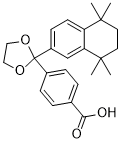
Physicochemical Properties
| Molecular Formula | C24H28O4 |
| Molecular Weight | 380.476727485657 |
| Exact Mass | 380.199 |
| Elemental Analysis | C, 75.76; H, 7.42; O, 16.82 |
| CAS # | 146670-40-8 |
| Related CAS # | 146670-40-8 (SR 11237); 121346-32-5 (SR-33805) |
| PubChem CID | 127019 |
| Appearance | White to off-white solid powder |
| Density | 1.139g/cm3 |
| Boiling Point | 499.9ºC at 760 mmHg |
| Flash Point | 167.1ºC |
| Vapour Pressure | 8.16E-11mmHg at 25°C |
| Index of Refraction | 1.561 |
| LogP | 4.981 |
| Hydrogen Bond Donor Count | 1 |
| Hydrogen Bond Acceptor Count | 4 |
| Rotatable Bond Count | 3 |
| Heavy Atom Count | 28 |
| Complexity | 581 |
| Defined Atom Stereocenter Count | 0 |
| SMILES | O1CCOC1(C1C=CC(C(=O)O)=CC=1)C1C=CC2=C(C=1)C(C)(C)CCC2(C)C |
| InChi Key | ZZUKALQMHNSWTK-UHFFFAOYSA-N |
| InChi Code | InChI=1S/C24H28O4/c1-22(2)11-12-23(3,4)20-15-18(9-10-19(20)22)24(27-13-14-28-24)17-7-5-16(6-8-17)21(25)26/h5-10,15H,11-14H2,1-4H3,(H,25,26) |
| Chemical Name | 4-(2-(5,6,7,8-Tetrahydro-5,5,8,8,-tetramethyl-2-naphthalenyl)-1,3-dioxolan-2-yl)benzoic acid |
| Synonyms | SR 11237; SR11237; SR-11237; BMS 649; BMS-649. |
| HS Tariff Code | 2934.99.9001 |
| Storage |
Powder-20°C 3 years 4°C 2 years In solvent -80°C 6 months -20°C 1 month |
| Shipping Condition | Room temperature (This product is stable at ambient temperature for a few days during ordinary shipping and time spent in Customs) |
Biological Activity
| Targets |
Retinoid X Receptor (RXR) pan-agonist [2] . |
| ln Vitro |
It was discovered that SR11237 was unsuccessful at the retinoic acid receptor but could successfully transactivate the chloramphenicol acetyltransferase reporter gene through RXR using a nuclear receptor co-transfection experiment in COS-1 cells [1]. Culturing newborn mouse tibiae with SR 11237 at a concentration of 5 μM for 4 days resulted in a significant decrease in longitudinal bone growth compared to treatment with 1 μM SR 11237 [2] |
| ln Vivo |
On postpartum days 5 to 15, SR11237 (BMS-649) (25 mg/kg; i.p.; daily) induces irregular ossification and premature growth plate closure [2]. Daily intraperitoneal injection of SR 11237 (25 mg/kg) from postnatal day 5 to 15 in rats resulted in a 30% reduction in body weight in both male and female pups at P16 compared to DMSO-injected controls [2] The same treatment regimen significantly shortened the length of femur, tibia, and radius bones in female rats, and shortened all four measured long bones (humerus, tibia, femur, and radius) in male rats at P16 [2] MicroCT analysis revealed that SR 11237-treated male rats had thinner, osteopenic-looking fore- and hindlimbs, dysmorphic/undercalcified metacarpals and metatarsals, and disrupted secondary ossification centers compared to controls [2] Histological analysis (Safranin O/Fast Green staining) of long bones from SR 11237-treated rats showed severely disturbed growth plate organization, premature closure of the growth plate, and apparent fusion of the primary and secondary ossification centers [2] Immunohistochemistry on tibial sections from SR 11237-treated rats showed reduced numbers of PCNA-positive (proliferating) and P57-positive (pre-hypertrophic) chondrocytes, disorganized SOX9-positive cell distribution surrounding calcified tissue, intense TRAP staining throughout the central epiphysis indicating increased osteoclast activity, and increased TUNEL staining at the osteo-chondral junction [2] |
| Animal Protocol |
Animal/Disease Models: SD (SD (Sprague-Dawley)) rat [2] Doses: 25 mg/kg Route of Administration: intraperitoneal (ip) injection; one time/day on postpartum days 5 to 15 Experimental Results: Caused ossification and bone morphology disorders in rats, including premature growth plate closure and infiltration of ossified tissue through the central epiphysis. Sprague-Dawley rat pups were randomly divided into two groups. One group received daily intraperitoneal injections of SR 11237 at a dose of 25 mg per kg body weight, dissolved in DMSO. The control group received an equal volume of DMSO vehicle. Injections were administered once daily from postnatal day 5 to postnatal day 15. All animals were harvested on postnatal day 16 for analysis [2] For the ex vivo organ culture model, tibiae were harvested from newborn CD1 mice and cultured in serum-free α-MEM medium supplemented with bovine serum albumin, L-glutamine, β-glycerophosphate, ascorbic acid, and penicillin-streptomycin. On culture days 1 and 3, the medium was replaced, and bones were treated with DMSO (control) or SR 11237 at concentrations of 0.1, 1, or 5 μM. Bones were cultured for a total of 4 days [2] |
| References |
[1]. A pleiotropic response is induced in F9 embryonal carcinoma cells and rhino mouse skin by All-trans-retinoic acid, a RAR agonist but not by SR11237, a RXR-selective agonist. J Invest Dermatol. 1994;102(5):676-680. [2]. Exposure to the RXR Agonist SR11237 in Early Life Causes Disturbed Skeletal Morphogenesis in a Rat Model. Int J Mol Sci. 2019;20(20):5198. Published 2019 Oct 20. [3]. H.L. Dupuis. The RXR agonist SR-11237 affects skeletal development. ABSTRACT ONLY| VOLUME 24, SUPPLEMENT 1, S147, APRIL 01, 2016. |
| Additional Infomation |
SR 11237 is described as a selective RXR (Retinoid X Receptor) pan-agonist [2] The study suggests that activation of RXR by SR 11237 during early postnatal development causes irregular ossification, premature growth plate closure, and reduced longitudinal bone growth in rodents. The observed effects may involve driving chondrocytes out of the cell cycle and increasing osteoclast activity and bone formation, leading to fusion of ossification centers [2] The dose of 25 mg/kg used in the rat study is stated to be similar to one previously used in vivo for this compound [2] |
Solubility Data
| Solubility (In Vitro) | DMSO : ~5 mg/mL (~13.14 mM) |
| Solubility (In Vivo) |
Solubility in Formulation 1: ≥ 0.5 mg/mL (1.31 mM) (saturation unknown) in 10% DMSO + 90% Corn Oil (add these co-solvents sequentially from left to right, and one by one), clear solution. For example, if 1 mL of working solution is to be prepared, you can add 100 μL of 5.0 mg/mL clear DMSO stock solution to 900 μL of corn oil and mix evenly. (Please use freshly prepared in vivo formulations for optimal results.) |
| Preparing Stock Solutions | 1 mg | 5 mg | 10 mg | |
| 1 mM | 2.6283 mL | 13.1413 mL | 26.2826 mL | |
| 5 mM | 0.5257 mL | 2.6283 mL | 5.2565 mL | |
| 10 mM | 0.2628 mL | 1.3141 mL | 2.6283 mL |