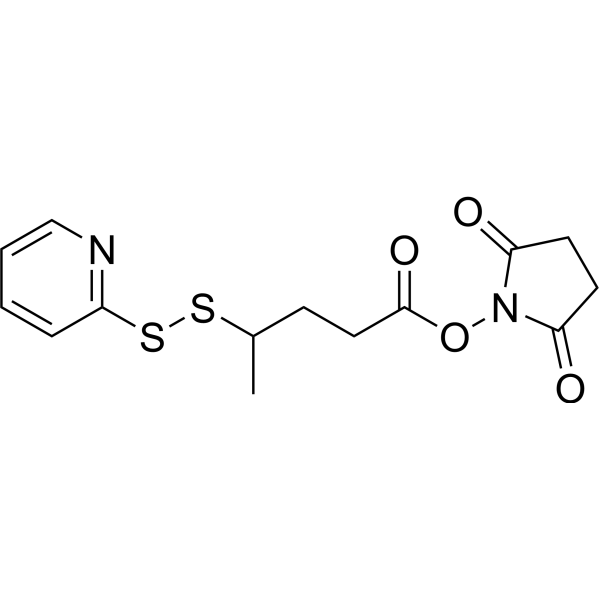
Physicochemical Properties
| Molecular Formula | C14H16N2O4S2 |
| Molecular Weight | 340.417840957642 |
| Exact Mass | 340.055 |
| CAS # | 341498-08-6 |
| PubChem CID | 11588139 |
| Appearance | Off-white to light yellow solid powder |
| LogP | 2.535 |
| Hydrogen Bond Donor Count | 0 |
| Hydrogen Bond Acceptor Count | 7 |
| Rotatable Bond Count | 8 |
| Heavy Atom Count | 22 |
| Complexity | 417 |
| Defined Atom Stereocenter Count | 0 |
| InChi Key | GTBCXYYVWHFQRS-UHFFFAOYSA-N |
| InChi Code | InChI=1S/C14H16N2O4S2/c1-10(21-22-11-4-2-3-9-15-11)5-8-14(19)20-16-12(17)6-7-13(16)18/h2-4,9-10H,5-8H2,1H3 |
| Chemical Name | (2,5-dioxopyrrolidin-1-yl) 4-(pyridin-2-yldisulfanyl)pentanoate |
| HS Tariff Code | 2934.99.9001 |
| Storage |
Powder-20°C 3 years 4°C 2 years In solvent -80°C 6 months -20°C 1 month |
| Shipping Condition | Room temperature (This product is stable at ambient temperature for a few days during ordinary shipping and time spent in Customs) |
Biological Activity
| Targets | Tubulin (IC50 values: 0.23 ± 0.03 nM in MCF-7 cells, 0.31 ± 0.05 nM in SK-BR-3 cells, 0.27 ± 0.04 nM in OVCAR-3 cells, 0.42 ± 0.06 nM in A2780 cells) [1] |
| ln Vitro |
- SPP is a major metabolite of antibody-maytansinoid conjugates, retaining potent antiproliferative activity against various human cancer cell lines. It inhibited the proliferation of breast cancer (MCF-7, SK-BR-3), ovarian cancer (OVCAR-3, A2780), and colorectal cancer (HT-29) cells in a dose-dependent manner (CellTiter-Glo assay), with IC50 values ranging from 0.23 to 0.68 nM [1] - SPP exerted its antitumor effect by binding to tubulin and inhibiting microtubule polymerization. It induced G2/M cell cycle arrest (flow cytometry) and apoptotic cell death (Annexin V-FITC/PI staining) in MCF-7 cells, with apoptosis rate increased from ~3% (control) to ~45% at 1 nM [1] - In vitro tubulin polymerization assay showed that SPP (0.1-10 nM) dose-dependently suppressed tubulin assembly, reducing the maximum polymerization rate by ~60% at 1 nM compared with the control group [1] |
| Cell Assay |
- Antiproliferation assay: Human cancer cells (MCF-7, SK-BR-3, OVCAR-3, A2780, HT-29) were seeded in 96-well plates at a density of 5×10³ cells/well and cultured overnight. SPP was serially diluted (0.01-10 nM) and added to the wells, followed by incubation at 37°C in 5% CO₂ for 72 hours. Cell viability was measured using a CellTiter-Glo luminescent assay, and IC50 values were calculated from dose-response curves [1] - Cell cycle and apoptosis assay: MCF-7 cells were seeded in 6-well plates (2×10⁵ cells/well) and treated with SPP (0.1, 0.5, 1 nM) for 24 hours. For cell cycle analysis, cells were fixed with ethanol, stained with propidium iodide, and analyzed by flow cytometry. For apoptosis detection, cells were stained with Annexin V-FITC and PI, then analyzed by flow cytometry [1] - Tubulin polymerization assay: Purified tubulin was resuspended in polymerization buffer, and SPP (0.1-10 nM) was added. The mixture was incubated at 37°C, and tubulin polymerization was monitored by measuring absorbance at 340 nm every 2 minutes for 60 minutes. The maximum polymerization rate and total polymerization were quantified [1] |
| ADME/Pharmacokinetics |
- SPP was generated as a metabolite via in vitro incubation of antibody-maytansinoid conjugates with human, rat, or dog liver microsomes. The formation rate of SPP was highest in human liver microsomes, with a metabolic clearance of 12.3 ± 1.8 μL/min/mg protein [1] - SPP exhibited good stability in vitro: in phosphate-buffered saline (pH 7.4) at 37°C, its half-life was > 24 hours; in human plasma, it remained stable for at least 8 hours with no significant degradation [1] |
| References |
[1]. Metabolites of antibody-maytansinoid conjugates: characteristics and in vitro potencies. Mol Pharm. 2015 Jun 1;12(6):1762-73. |
| Additional Infomation |
- SPP is a biologically active metabolite of antibody-maytansinoid conjugates (ADCs), a class of targeted anticancer agents [1] - Its core mechanism of action involves binding to the colchicine-binding site on tubulin, inhibiting microtubule polymerization and disrupting the cytoskeleton. This leads to G2/M cell cycle arrest and subsequent apoptotic cell death in cancer cells [1] - SPP retains the potent cytotoxic activity of the parent maytansinoid payload, contributing to the antitumor efficacy of the parent ADC in preclinical models. Its stability in plasma and efficient formation via liver microsomal metabolism support its role as a key active metabolite [1] |
Solubility Data
| Solubility (In Vitro) | DMSO : ~100 mg/mL (~293.75 mM) |
| Solubility (In Vivo) |
Solubility in Formulation 1: ≥ 2.5 mg/mL (7.34 mM) (saturation unknown) in 10% DMSO + 40% PEG300 + 5% Tween80 + 45% Saline (add these co-solvents sequentially from left to right, and one by one), clear solution. For example, if 1 mL of working solution is to be prepared, you can add 100 μL of 25.0 mg/mL clear DMSO stock solution to 400 μL PEG300 and mix evenly; then add 50 μL Tween-80 to the above solution and mix evenly; then add 450 μL normal saline to adjust the volume to 1 mL. Preparation of saline: Dissolve 0.9 g of sodium chloride in 100 mL ddH₂ O to obtain a clear solution. Solubility in Formulation 2: ≥ 2.5 mg/mL (7.34 mM) (saturation unknown) in 10% DMSO + 90% (20% SBE-β-CD in Saline) (add these co-solvents sequentially from left to right, and one by one), clear solution. For example, if 1 mL of working solution is to be prepared, you can add 100 μL of 25.0 mg/mL clear DMSO stock solution to 900 μL of 20% SBE-β-CD physiological saline solution and mix evenly. Preparation of 20% SBE-β-CD in Saline (4°C,1 week): Dissolve 2 g SBE-β-CD in 10 mL saline to obtain a clear solution. Solubility in Formulation 3: ≥ 2.5 mg/mL (7.34 mM) (saturation unknown) in 10% DMSO + 90% Corn Oil (add these co-solvents sequentially from left to right, and one by one), clear solution. For example, if 1 mL of working solution is to be prepared, you can add 100 μL of 25.0 mg/mL clear DMSO stock solution to 900 μL of corn oil and mix evenly. (Please use freshly prepared in vivo formulations for optimal results.) |
| Preparing Stock Solutions | 1 mg | 5 mg | 10 mg | |
| 1 mM | 2.9375 mL | 14.6877 mL | 29.3755 mL | |
| 5 mM | 0.5875 mL | 2.9375 mL | 5.8751 mL | |
| 10 mM | 0.2938 mL | 1.4688 mL | 2.9375 mL |