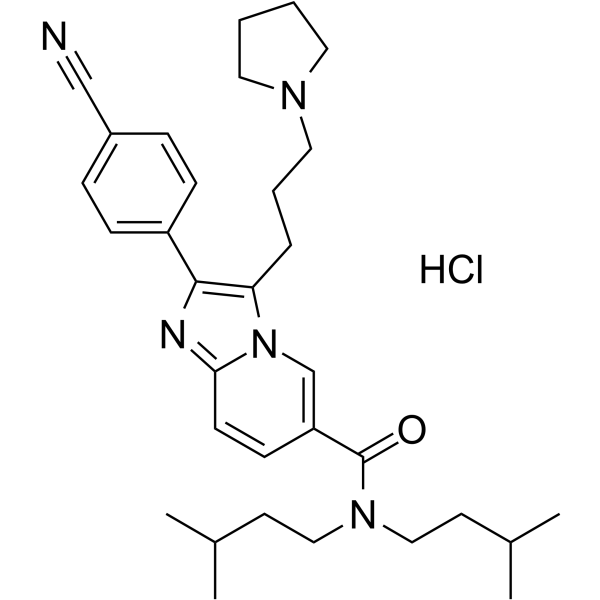
Physicochemical Properties
| Molecular Formula | C32H43N5O.HCL |
| Molecular Weight | 550.17766 |
| Exact Mass | 549.323 |
| CAS # | 1064662-40-3 |
| PubChem CID | 131843715 |
| Appearance | White to off-white solid powder |
| LogP | 7.175 |
| Hydrogen Bond Donor Count | 1 |
| Hydrogen Bond Acceptor Count | 4 |
| Rotatable Bond Count | 12 |
| Heavy Atom Count | 39 |
| Complexity | 764 |
| Defined Atom Stereocenter Count | 0 |
| InChi Key | FBNJDWPWZNPVSC-UHFFFAOYSA-N |
| InChi Code | InChI=1S/C32H43N5O.ClH/c1-24(2)15-20-36(21-16-25(3)4)32(38)28-13-14-30-34-31(27-11-9-26(22-33)10-12-27)29(37(30)23-28)8-7-19-35-17-5-6-18-35;/h9-14,23-25H,5-8,15-21H2,1-4H3;1H |
| Chemical Name | 2-(4-cyanophenyl)-N,N-bis(3-methylbutyl)-3-(3-pyrrolidin-1-ylpropyl)imidazo[1,2-a]pyridine-6-carboxamide;hydrochloride |
| HS Tariff Code | 2934.99.9001 |
| Storage |
Powder-20°C 3 years 4°C 2 years In solvent -80°C 6 months -20°C 1 month Note: Please store this product in a sealed and protected environment, avoid exposure to moisture. |
| Shipping Condition | Room temperature (This product is stable at ambient temperature for a few days during ordinary shipping and time spent in Customs) |
Biological Activity
| ln Vitro | SNT-207707 is more than 200 times more selective than MC-3 and MC-5, and it binds to the MC-4 receptor with an affinity of 8 nM. Compared to MC-3 and MC-5, SNT207858 is a 22 nM MC-4 antagonist that exhibits 170 times more selectivity [1]. |
| ln Vivo | Mice's food intake was markedly increased by a single subcutaneous injection of SNT-207707 (20 mg/kg). The day following tumor implantation, compounds SNT207858 and SNT-207707 were given orally once a day, which significantly reduced tumor-induced weight loss [1]. |
| References |
[1]. Orally available selective melanocortin-4 receptor antagonists stimulate food intake and reduce cancer-induced cachexia in mice. PLoS One. 2009;4(3):e4774. |
Solubility Data
| Solubility (In Vitro) | DMSO : ≥ 250 mg/mL (~454.40 mM) |
| Solubility (In Vivo) |
Solubility in Formulation 1: ≥ 2.08 mg/mL (3.78 mM) (saturation unknown) in 10% DMSO + 40% PEG300 + 5% Tween80 + 45% Saline (add these co-solvents sequentially from left to right, and one by one), clear solution. For example, if 1 mL of working solution is to be prepared, you can add 100 μL of 20.8 mg/mL clear DMSO stock solution to 400 μL PEG300 and mix evenly; then add 50 μL Tween-80 to the above solution and mix evenly; then add 450 μL normal saline to adjust the volume to 1 mL. Preparation of saline: Dissolve 0.9 g of sodium chloride in 100 mL ddH₂ O to obtain a clear solution. Solubility in Formulation 2: ≥ 2.08 mg/mL (3.78 mM) (saturation unknown) in 10% DMSO + 90% (20% SBE-β-CD in Saline) (add these co-solvents sequentially from left to right, and one by one), clear solution. For example, if 1 mL of working solution is to be prepared, you can add 100 μL of 20.8 mg/mL clear DMSO stock solution to 900 μL of 20% SBE-β-CD physiological saline solution and mix evenly. Preparation of 20% SBE-β-CD in Saline (4°C,1 week): Dissolve 2 g SBE-β-CD in 10 mL saline to obtain a clear solution. Solubility in Formulation 3: ≥ 2.08 mg/mL (3.78 mM) (saturation unknown) in 10% DMSO + 90% Corn Oil (add these co-solvents sequentially from left to right, and one by one), clear solution. For example, if 1 mL of working solution is to be prepared, you can add 100 μL of 20.8 mg/mL clear DMSO stock solution to 900 μL of corn oil and mix evenly. (Please use freshly prepared in vivo formulations for optimal results.) |
| Preparing Stock Solutions | 1 mg | 5 mg | 10 mg | |
| 1 mM | 1.8176 mL | 9.0879 mL | 18.1759 mL | |
| 5 mM | 0.3635 mL | 1.8176 mL | 3.6352 mL | |
| 10 mM | 0.1818 mL | 0.9088 mL | 1.8176 mL |