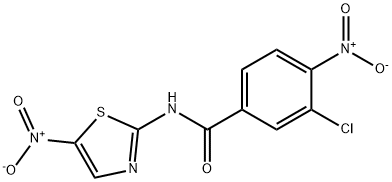
Physicochemical Properties
| Molecular Formula | C10H5CLN4O5S |
| Molecular Weight | 328.68 |
| Exact Mass | 327.967 |
| Elemental Analysis | C, 36.54; H, 1.53; Cl, 10.79; N, 17.05; O, 24.34; S, 9.75 |
| CAS # | 380623-76-7 |
| Related CAS # | 380623-76-7 |
| PubChem CID | 11537217 |
| Appearance | Off-white to light yellow solid powder |
| LogP | 4.295 |
| Hydrogen Bond Donor Count | 1 |
| Hydrogen Bond Acceptor Count | 7 |
| Rotatable Bond Count | 2 |
| Heavy Atom Count | 21 |
| Complexity | 442 |
| Defined Atom Stereocenter Count | 0 |
| SMILES | O=[N+](C1=CN=C(NC(C2C=CC([N+]([O-])=O)=C(Cl)C=2)=O)S1)[O-] |
| InChi Key | XCHLNGBTHLJLFG-UHFFFAOYSA-N |
| InChi Code | InChI=1S/C10H5ClN4O5S/c11-6-3-5(1-2-7(6)14(17)18)9(16)13-10-12-4-8(21-10)15(19)20/h1-4H,(H,12,13,16) |
| Chemical Name | 3-chloro-4-nitro-N-(5-nitro-1,3-thiazol-2-yl)benzamide |
| Synonyms | Activation Inhibitor III; SM-7368; SM7368; SM 7368;NF-kappaB |
| HS Tariff Code | 2934.99.9001 |
| Storage |
Powder-20°C 3 years 4°C 2 years In solvent -80°C 6 months -20°C 1 month |
| Shipping Condition | Room temperature (This product is stable at ambient temperature for a few days during ordinary shipping and time spent in Customs) |
Biological Activity
| Targets | NF-κB; MMP-9; p38 MAP kinase |
| ln Vitro | In the human colon derived crypt like HT-29 and Caco-2 epithelial cell lines, SM-7368 (5 μM) targets downstream of MAPK p38 activation[1]. SM-7368 inhibits TNF--α-induced MMP-9 upregulation in a concentration-dependent manner, reaching its peak activity at 10 μM. MMP-9 mRNA transcript accumulation and protein expression are suppressed by SM-7368 in response to TNFα. TNF-α induced NF-κB activity is severely inhibited by SM-7368, but AP-1 activity is not affected. The TNF-induced invasion of the human fibrosarcoma cell line HT1080 is severely inhibited by SM-7368[2]. TNF-α (20 ng/mL)-induced MMP-9 upregulation is significantly inhibited by SM-7368 (10-25 μM) This upregulation is almost entirely eliminated by 10 μM of SM-7368[2]. |
| References |
[1]. Carbonyl compounds methylglyoxal and glyoxal affect interleukin-8 secretion in intestinal cells by superoxide anion generation and activation of MAPK p38. Mol Nutr Food Res. 2010 Oct;54(10):1458-67. [2]. A small compound that inhibits tumor necrosis factor-alpha-induced matrix metalloproteinase-9 upregulation. Biochem Biophys Res Commun. 2005 Oct 21;336(2):716-22. |
Solubility Data
| Solubility (In Vitro) | DMSO: 66~83.33 mg/mL (200.8~253.52 mM) |
| Solubility (In Vivo) |
Solubility in Formulation 1: ≥ 2.08 mg/mL (6.33 mM) (saturation unknown) in 10% DMSO + 40% PEG300 +5% Tween-80 + 45% Saline (add these co-solvents sequentially from left to right, and one by one), clear solution. For example, if 1 mL of working solution is to be prepared, you can add 100 μL of 20.8 mg/mL clear DMSO stock solution to 400 μL PEG300 and mix evenly; then add 50 μL Tween-80 + to the above solution and mix evenly; then add 450 μL normal saline to adjust the volume to 1 mL. Preparation of saline: Dissolve 0.9 g of sodium chloride in 100 mL ddH₂ O to obtain a clear solution. (Please use freshly prepared in vivo formulations for optimal results.) |
| Preparing Stock Solutions | 1 mg | 5 mg | 10 mg | |
| 1 mM | 3.0425 mL | 15.2124 mL | 30.4247 mL | |
| 5 mM | 0.6085 mL | 3.0425 mL | 6.0849 mL | |
| 10 mM | 0.3042 mL | 1.5212 mL | 3.0425 mL |