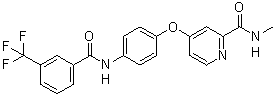
SKLB610 is a novel multi-targeted kinase inhibitor with more potent inhibition of VEGFR2. It has potential anticancer activity by potently suppressing human tumor angiogenesis. Because it effectively inhibits the angiogenesis of human tumors, it may have anticancer effects. At a concentration of 10μM in biochemical kinase tests, it inhibits angiogenesis-related tyrosine kinase VEGFR2, fibroblast growth factor receptor 2 (FGFR2), and platelet-derived growth factor receptor (PDGFR) at rates of 97%, 65%, and 55%, respectively. Following SKLB610 treatment, VEGF-stimulated phosphorylation of VEGFR2 in HUVECs is inhibited in a dose-dependent manner. HUVECs' capillary tube formation is significantly inhibited by SKLB610 in a concentration-dependent manner. It would be worthwhile to look into its potential as an anticancer agent.
Physicochemical Properties
| Molecular Formula | C21H16F3N3O3 | |
| Molecular Weight | 415.37 | |
| Exact Mass | 415.114 | |
| Elemental Analysis | C, 60.72; H, 3.88; F, 13.72; N, 10.12; O, 11.56 | |
| CAS # | 1125780-41-7 | |
| Related CAS # |
|
|
| PubChem CID | 25230662 | |
| Appearance | white solid powder | |
| Density | 1.4±0.1 g/cm3 | |
| Boiling Point | 500.9±50.0 °C at 760 mmHg | |
| Flash Point | 256.8±30.1 °C | |
| Vapour Pressure | 0.0±1.3 mmHg at 25°C | |
| Index of Refraction | 1.595 | |
| LogP | 3.49 | |
| Hydrogen Bond Donor Count | 2 | |
| Hydrogen Bond Acceptor Count | 7 | |
| Rotatable Bond Count | 5 | |
| Heavy Atom Count | 30 | |
| Complexity | 594 | |
| Defined Atom Stereocenter Count | 0 | |
| SMILES | O=C(C1=NC=CC(OC2=CC=C(NC(C3=CC=CC(C(F)(F)F)=C3)=O)C=C2)=C1)NC |
|
| InChi Key | WACDHHMEVMSODJ-UHFFFAOYSA-N | |
| InChi Code | InChI=1S/C21H16F3N3O3/c1-25-20(29)18-12-17(9-10-26-18)30-16-7-5-15(6-8-16)27-19(28)13-3-2-4-14(11-13)21(22,23)24/h2-12H,1H3,(H,25,29)(H,27,28) | |
| Chemical Name | N-methyl-4-[4-[[3-(trifluoromethyl)benzoyl]amino]phenoxy]pyridine-2-carboxamide | |
| Synonyms |
|
|
| HS Tariff Code | 2934.99.9001 | |
| Storage |
Powder-20°C 3 years 4°C 2 years In solvent -80°C 6 months -20°C 1 month |
|
| Shipping Condition | Room temperature (This product is stable at ambient temperature for a few days during ordinary shipping and time spent in Customs) |
Biological Activity
| Targets |
VEGFR2; FGFR2; PDGFR; PDGFR; FGFR2
SKLB610 targets vascular endothelial growth factor receptor 2 (VEGFR2/KDR) (IC50 = 0.05 μM in recombinant VEGFR2 kinase assay) [1] SKLB610 exhibits moderate affinity for VEGFR1 (IC50 = 0.8 μM) and platelet-derived growth factor receptor β (PDGFRβ) (IC50 = 1.2 μM), with no significant activity against EGFR, FGFR1, or c-Met (IC50 > 10 μM) [1] |
| ln Vitro |
In vitro, SKLB610 selectively inhibits the proliferation of VEGF-stimulated human umbilical vein endothelial cells (HUVECs). This proliferation inhibitory effect is linked to a decrease in VEGFR2 and p42/44 mitogen-activated protein kinase (p42/44 MAPK) phosphorylation. The human nonsmall cell lung cancer cell line A549 and the human colorectal cancer cell line HCT116 are the most sensitive to SKLB610 treatment. SKLB610 inhibits the proliferation of a panel of human cancer cells in a concentration-dependent manner. SKLB610 inhibits 55% of PDGFRE activity and 65% of FGFR2 activity at a concentration of 10μM, respectively. SKLB610 selectively inhibits VEGFR2 more than PDGFR2 and FGFR2, as evidenced by its 97% in vitro suppression of VEGFR2 activity at 10μM. When 10μM of SKLB610 is tested against PI3K, EGFR, Aurora-A, CDK2/cyclinE, and CDK6/cyclinD3, no inhibition of enzyme activity is found[1]. In recombinant VEGFR2 kinase activity assay, SKLB610 dose-dependently inhibited kinase activity with an IC50 of 0.05 μM, suppressing ATP binding to the kinase domain [1] - In human hepatocellular carcinoma (HepG2), non-small cell lung cancer (A549), and breast cancer (MCF-7) cell lines, SKLB610 inhibited cell proliferation with IC50 values of 1.3 μM (HepG2), 2.1 μM (A549), and 3.5 μM (MCF-7) after 72-hour treatment (MTT assay) [1] - In HepG2 cells, SKLB610 (1-5 μM) dose-dependently induced apoptosis: 5 μM treatment increased apoptotic rate from 4.2% (vehicle) to 28.6% (Annexin V-FITC/PI staining), accompanied by activation of caspase-3 (2.8-fold increase) and downregulation of Bcl-2 (0.4-fold vs. vehicle) [1] - Western blot analysis showed that SKLB610 (2 μM) inhibited VEGFR2 phosphorylation (p-VEGFR2) by ~75% in HepG2 cells stimulated with VEGF (50 ng/mL), and reduced downstream AKT and ERK1/2 phosphorylation by ~60% and ~55%, respectively [1] - In human umbilical vein endothelial cells (HUVECs), SKLB610 (0.1-5 μM) inhibited VEGF-induced cell migration (transwell assay) with an IC50 of 0.3 μM, and suppressed tube formation by ~80% at 2 μM [1] |
| ln Vivo |
In vivo, established human A549 and HCT116 tumor xenografts grow significantly slower in nude mice when SKLB610 is administered intraperitoneally at a dose of 50 mg/kg/d. This effects are observed without causing toxicity[1]. In nude mice bearing HepG2 human hepatocellular carcinoma xenografts, intraperitoneal administration of SKLB610 (20 mg/kg/day or 40 mg/kg/day for 21 days) dose-dependently inhibited tumor growth: high-dose treatment resulted in a tumor growth inhibition (TGI) rate of 68% and reduced tumor weight from 1.26 ± 0.21 g (vehicle) to 0.40 ± 0.08 g [1] - SKLB610 (40 mg/kg/day for 21 days) reduced microvessel density (MVD) in tumor tissues by ~62% (immunohistochemical staining for CD31) compared to vehicle control [1] - No significant changes in body weight (vehicle: 22.5 ± 1.3 g vs. high-dose: 21.8 ± 1.1 g) or major organ weight (liver, kidney, heart) were observed in treated mice [1] |
| Enzyme Assay |
SKLB610 has an IC50 value of 2.2μM and selectively inhibits proliferation induced by VEGF. SKLB610 has an IC50 value of 4.7μM and a 2-fold selectivity in inhibiting VEGF-induced proliferation in HUVECs as opposed to bFGF-induced proliferation. Following SKLB610 treatment, phosphorylation of VEGFR2 stimulated by VEGF is blocked in HUVECs in a dose-dependent manner. In a concentration-dependent manner, SKLB610 significantly inhibits the formation of capillary tubes in HUVECs. At 2.5 μM, SKLB610 prevents the development of structures resembling vessels. VEGFR2 kinase activity assay: Recombinant human VEGFR2 kinase domain was incubated with reaction buffer containing ATP and a fluorescent peptide substrate. Serial dilutions of SKLB610 (0.001-10 μM) were added to the reaction mixture, which was incubated at 37°C for 60 minutes. The reaction was terminated by adding a stop solution, and fluorescence intensity (excitation 485 nm, emission 535 nm) was measured to assess kinase activity. IC50 values were calculated by nonlinear regression analysis of dose-response curves [1] - Off-target kinase selectivity assay: Recombinant EGFR, FGFR1, PDGFRβ, and c-Met kinases were subjected to the same kinase assay protocol as VEGFR2. SKLB610 (0.001-10 μM) was tested to determine IC50 values for these kinases, confirming selectivity for VEGFR2 [1] |
| Cell Assay |
The proliferation of human umbilical vein endothelial cells (HUVECs) stimulated by VEGF was more selectively inhibited by SKLB610, and this effect was linked to a decrease in the phosphorylation of VEGFR2 and p42/44 mitogen-activated protein kinase (p42/44 MAPK). Cell proliferation assay: HepG2, A549, and MCF-7 cells were seeded in 96-well plates at 5×10³ cells/well. After 24 hours, serial dilutions of SKLB610 (0.1-20 μM) were added, and cells were cultured for another 72 hours. MTT reagent was added, and absorbance at 570 nm was measured to calculate cell viability and IC50 values [1] - Apoptosis assay: HepG2 cells were seeded in 6-well plates (2×10⁵ cells/well) and treated with SKLB610 (1-5 μM) for 48 hours. Cells were harvested, stained with Annexin V-FITC and PI, and analyzed by flow cytometry to determine apoptotic rate. Caspase-3 activity was measured using a colorimetric assay kit [1] - Western blot assay: HepG2 cells were treated with SKLB610 (2 μM) for 24 hours, then stimulated with VEGF (50 ng/mL) for 15 minutes. Cells were lysed in RIPA buffer, and proteins were separated by SDS-PAGE. Membranes were probed with antibodies against p-VEGFR2, VEGFR2, p-AKT, AKT, p-ERK1/2, ERK1/2, Bcl-2, and GAPDH (loading control). Chemiluminescent detection was used to visualize protein bands, and densitometric analysis was performed [1] - HUVEC migration and tube formation assay: HUVECs were seeded in transwell upper chambers (5×10⁴ cells/well) and treated with SKLB610 (0.1-5 μM) for 24 hours; migrated cells were stained and counted. For tube formation, HUVECs were seeded on Matrigel-coated 96-well plates with SKLB610 (2 μM), and tube formation was imaged and quantified after 6 hours [1] |
| Animal Protocol |
Female BALB/c nude mice implanted with HCT116 and A549 cells 50 mg/kg/day IP HepG2 xenograft nude mouse model: Female BALB/c nude mice (4-6 weeks old) were subcutaneously implanted with 5×10⁶ HepG2 cells. When tumors reached a volume of ~100 mm³, mice were randomly divided into vehicle control, SKLB610 20 mg/kg, and 40 mg/kg groups (n=6 per group). The drug was dissolved in DMSO (10%) and diluted with physiological saline (final DMSO concentration ≤5%) and administered by intraperitoneal injection once daily for 21 days. Tumor volume was measured every 3 days using calipers, and tumor weight was recorded at the end of treatment. Tumor tissues were collected for CD31 immunohistochemical staining; major organs (liver, kidney, heart, lung, spleen) were harvested for pathological examination [1] |
| Toxicity/Toxicokinetics |
In vitro cytotoxicity: SKLB610 showed a CC50 of >20 μM in HUVECs and normal liver L02 cells after 72-hour treatment, indicating low cytotoxicity to normal cells [1] - In vivo acute toxicity: Single intraperitoneal administration of SKLB610 up to 100 mg/kg in nude mice did not cause mortality or overt toxicity (lethargy, abnormal behavior) [1] - Chronic toxicity: Repeated intraperitoneal administration of SKLB610 (40 mg/kg/day for 21 days) did not induce significant histopathological changes in liver, kidney, heart, lung, or spleen tissues [1] |
| References |
[1]. Cell Physiol Biochem . 2011;27(5):565-74. |
| Additional Infomation |
SKLB610 is a small-molecule selective inhibitor of vascular endothelial growth factor receptor 2 (VEGFR2), developed for the treatment of solid tumors [1] - The therapeutic mechanism of SKLB610 involves inhibiting VEGFR2 kinase activity, blocking VEGF-mediated downstream signaling pathways (AKT/ERK), thereby suppressing tumor angiogenesis, inducing tumor cell apoptosis, and inhibiting tumor growth [1] - SKLB610 exhibits favorable in vitro and in vivo antitumor activity against hepatocellular carcinoma, with high selectivity for VEGFR2 over other kinases and low toxicity to normal cells/tissues [1] - Preclinical data support SKLB610 as a potential candidate for the treatment of VEGFR2-dependent solid tumors, particularly hepatocellular carcinoma [1] |
Solubility Data
| Solubility (In Vitro) |
|
|||
| Solubility (In Vivo) |
Note: Listed below are some common formulations that may be used to formulate products with low water solubility (e.g. < 1 mg/mL), you may test these formulations using a minute amount of products to avoid loss of samples. Injection Formulations (e.g. IP/IV/IM/SC) Injection Formulation 1: DMSO : Tween 80: Saline = 10 : 5 : 85 (i.e. 100 μL DMSO stock solution → 50 μL Tween 80 → 850 μL Saline) *Preparation of saline: Dissolve 0.9 g of sodium chloride in 100 mL ddH ₂ O to obtain a clear solution. Injection Formulation 2: DMSO : PEG300 :Tween 80 : Saline = 10 : 40 : 5 : 45 (i.e. 100 μL DMSO → 400 μLPEG300 → 50 μL Tween 80 → 450 μL Saline) Injection Formulation 3: DMSO : Corn oil = 10 : 90 (i.e. 100 μL DMSO → 900 μL Corn oil) Example: Take the Injection Formulation 3 (DMSO : Corn oil = 10 : 90) as an example, if 1 mL of 2.5 mg/mL working solution is to be prepared, you can take 100 μL 25 mg/mL DMSO stock solution and add to 900 μL corn oil, mix well to obtain a clear or suspension solution (2.5 mg/mL, ready for use in animals). Injection Formulation 4: DMSO : 20% SBE-β-CD in saline = 10 : 90 [i.e. 100 μL DMSO → 900 μL (20% SBE-β-CD in saline)] *Preparation of 20% SBE-β-CD in Saline (4°C,1 week): Dissolve 2 g SBE-β-CD in 10 mL saline to obtain a clear solution. Injection Formulation 5: 2-Hydroxypropyl-β-cyclodextrin : Saline = 50 : 50 (i.e. 500 μL 2-Hydroxypropyl-β-cyclodextrin → 500 μL Saline) Injection Formulation 6: DMSO : PEG300 : castor oil : Saline = 5 : 10 : 20 : 65 (i.e. 50 μL DMSO → 100 μLPEG300 → 200 μL castor oil → 650 μL Saline) Injection Formulation 7: Ethanol : Cremophor : Saline = 10: 10 : 80 (i.e. 100 μL Ethanol → 100 μL Cremophor → 800 μL Saline) Injection Formulation 8: Dissolve in Cremophor/Ethanol (50 : 50), then diluted by Saline Injection Formulation 9: EtOH : Corn oil = 10 : 90 (i.e. 100 μL EtOH → 900 μL Corn oil) Injection Formulation 10: EtOH : PEG300:Tween 80 : Saline = 10 : 40 : 5 : 45 (i.e. 100 μL EtOH → 400 μLPEG300 → 50 μL Tween 80 → 450 μL Saline) Oral Formulations Oral Formulation 1: Suspend in 0.5% CMC Na (carboxymethylcellulose sodium) Oral Formulation 2: Suspend in 0.5% Carboxymethyl cellulose Example: Take the Oral Formulation 1 (Suspend in 0.5% CMC Na) as an example, if 100 mL of 2.5 mg/mL working solution is to be prepared, you can first prepare 0.5% CMC Na solution by measuring 0.5 g CMC Na and dissolve it in 100 mL ddH2O to obtain a clear solution; then add 250 mg of the product to 100 mL 0.5% CMC Na solution, to make the suspension solution (2.5 mg/mL, ready for use in animals). Oral Formulation 3: Dissolved in PEG400 Oral Formulation 4: Suspend in 0.2% Carboxymethyl cellulose Oral Formulation 5: Dissolve in 0.25% Tween 80 and 0.5% Carboxymethyl cellulose Oral Formulation 6: Mixing with food powders Note: Please be aware that the above formulations are for reference only. InvivoChem strongly recommends customers to read literature methods/protocols carefully before determining which formulation you should use for in vivo studies, as different compounds have different solubility properties and have to be formulated differently. (Please use freshly prepared in vivo formulations for optimal results.) |
| Preparing Stock Solutions | 1 mg | 5 mg | 10 mg | |
| 1 mM | 2.4075 mL | 12.0375 mL | 24.0749 mL | |
| 5 mM | 0.4815 mL | 2.4075 mL | 4.8150 mL | |
| 10 mM | 0.2407 mL | 1.2037 mL | 2.4075 mL |