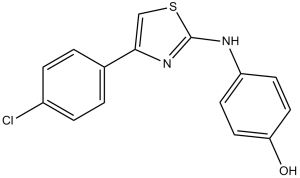
SKI II (also known as SphK-I2; Sphingosine kinase inhibitor II; SK-III) is a potent, highly selective, non-lipid and non-ATP-competitive sphingosine kinase (SphK) inhibitor with potential anticancer activity. It exhibits no inhibitory effects against other closely related kinases like PI3K, PKCα, and ERK2. It inhibits SphK with an IC50 of 0.5 μM. Both in vitro and in vivo, SKI-II suppresses the growth of acute myelogenous leukemia cells. Inhibiting AML cells was more effectively achieved by SKI-II than by the two recognized SphK1 inhibitors, SK1-I and FTY720. Treatment with SKI-II reduced SphK1 activation while simultaneously raising the amount of ceramide precursor sphingosine-1-phosphate (S1P) in AML cells.
Physicochemical Properties
| Molecular Formula | C15H11CLN2OS | |
| Molecular Weight | 302.78 | |
| Exact Mass | 302.028 | |
| Elemental Analysis | C, 59.50; H, 3.66; Cl, 11.71; N, 9.25; O, 5.28; S, 10.59 | |
| CAS # | 312636-16-1 | |
| Related CAS # |
|
|
| PubChem CID | 753704 | |
| Appearance | White to off-white solid powder | |
| Density | 1.4±0.1 g/cm3 | |
| Boiling Point | 507.1±60.0 °C at 760 mmHg | |
| Flash Point | 260.5±32.9 °C | |
| Vapour Pressure | 0.0±1.4 mmHg at 25°C | |
| Index of Refraction | 1.709 | |
| LogP | 3.91 | |
| Hydrogen Bond Donor Count | 2 | |
| Hydrogen Bond Acceptor Count | 4 | |
| Rotatable Bond Count | 3 | |
| Heavy Atom Count | 20 | |
| Complexity | 304 | |
| Defined Atom Stereocenter Count | 0 | |
| SMILES | OC1=CC=C(NC2=NC(C3=CC=C(Cl)C=C3)=CS2)C=C1 |
|
| InChi Key | ZFGXZJKLOFCECI-UHFFFAOYSA-N | |
| InChi Code | InChI=1S/C15H11ClN2OS/c16-11-3-1-10(2-4-11)14-9-20-15(18-14)17-12-5-7-13(19)8-6-12/h1-9,19H,(H,17,18) | |
| Chemical Name | 4-[[4-(4-chlorophenyl)-1,3-thiazol-2-yl]amino]phenol | |
| Synonyms |
|
|
| HS Tariff Code | 2934.99.9001 | |
| Storage |
Powder-20°C 3 years 4°C 2 years In solvent -80°C 6 months -20°C 1 month Note: This product is not stable in solution, please use freshly prepared working solution for optimal results. |
|
| Shipping Condition | Room temperature (This product is stable at ambient temperature for a few days during ordinary shipping and time spent in Customs) |
Biological Activity
| Targets | SK1/2 ( IC50 = 78/45 μM ) | ||
| ln Vitro |
|
||
| ln Vivo | SKI II (50 mg/kg), a syngeneic Balb/c mouse solid tumor model that uses JC mammary adenocarcinoma cells, compared to control groups with no overt toxicity or weight loss, after intraperitoneal or oral administration significantly decreases tumor growth.[2] SKI-II (50 mg/kg ip) endogenously inhibits the generation of S1P, thereby ameliorating antigen-induced bronchial smooth muscle hyperresponsiveness in mice. [4] | ||
| Enzyme Assay | It has been possible to screen for recombinant human SK inhibitors using a medium-throughput assay. In a nutshell, 200 μL of assay buffer (20 mM Tris HCl (pH 7.4), 20% glycerol, 1 mM beta-mercaptoethanol, 1 mM EDTA, 20 mM zinc chloride, 1 mM sodium orthovanadate, 15 mM sodium fluoride, and 0.5 mM 4-deoxypyridoxine) is mixed with 5 μg of purified GST-SK fusion protein. Assays are conducted for 30 minutes at 25°C while being shaken. The test compounds used in the assays are either 5 g/mL or 1% DMSO, which translates to concentrations between 10 and 25 μM. The assay mixture is extracted using a 2:1 ratio of chloroform to methanol after the reactions are stopped with 50 μL of concentrated ammonium hydroxide. Radioactivity is measured as a measure of [3H]]S1P formation using a Beckman LS 3801 Scintillation Counter after the aqueous portion is transferred to scintillation vials. Approximately 10% of the variation occurs within an assay, while 20% occurs between assays. | ||
| Cell Assay | T24, MCF-7, MCF-7/VP, and NCI/ADR cells are seeded at approximately 15% confluency into 96-well tissue culture plates. Cells are treated with different inhibitor concentrations after a 24-hour period. Using the sulforhodamine B assay, cell survival is measured after a further 48 hours. | ||
| Animal Protocol |
|
||
| References |
[1]. Cancer Res . 2003 Sep 15;63(18):5962-9. [2]. J Pharmacol Exp Ther . 2006 Aug;318(2):596-603. [3]. Asian Pac J Cancer Prev . 2012;13(2):625-31. [4]. J Pharmacol Sci . 2010;114(3):304-10. |
||
| Additional Infomation | 4-[[4-(4-chlorophenyl)-2-thiazolyl]amino]phenol is a substituted aniline. |
Solubility Data
| Solubility (In Vitro) |
|
|||
| Solubility (In Vivo) |
Solubility in Formulation 1: ≥ 2.75 mg/mL (9.08 mM) (saturation unknown) in 10% DMSO + 40% PEG300 + 5% Tween80 + 45% Saline (add these co-solvents sequentially from left to right, and one by one), clear solution. For example, if 1 mL of working solution is to be prepared, you can add 100 μL of 27.5 mg/mL clear DMSO stock solution to 400 μL PEG300 and mix evenly; then add 50 μL Tween-80 to the above solution and mix evenly; then add 450 μL normal saline to adjust the volume to 1 mL. Preparation of saline: Dissolve 0.9 g of sodium chloride in 100 mL ddH₂ O to obtain a clear solution. Solubility in Formulation 2: ≥ 2.75 mg/mL (9.08 mM) (saturation unknown) in 10% DMSO + 90% (20% SBE-β-CD in Saline) (add these co-solvents sequentially from left to right, and one by one), clear solution. For example, if 1 mL of working solution is to be prepared, you can add 100 μL of 27.5 mg/mL clear DMSO stock solution to 900 μL of 20% SBE-β-CD physiological saline solution and mix evenly. Preparation of 20% SBE-β-CD in Saline (4°C,1 week): Dissolve 2 g SBE-β-CD in 10 mL saline to obtain a clear solution. Solubility in Formulation 3: 30% PEG400+0.5% Tween80+5% Propylene glycol : 20 mg/mL (Please use freshly prepared in vivo formulations for optimal results.) |
| Preparing Stock Solutions | 1 mg | 5 mg | 10 mg | |
| 1 mM | 3.3027 mL | 16.5136 mL | 33.0273 mL | |
| 5 mM | 0.6605 mL | 3.3027 mL | 6.6055 mL | |
| 10 mM | 0.3303 mL | 1.6514 mL | 3.3027 mL |