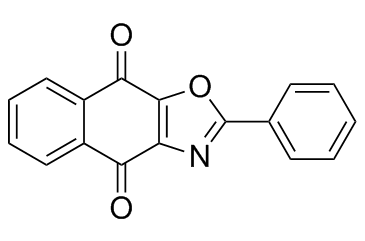
SJB2-043, a C527 analog, is a novel and potent inhibitor of USP1/UAF1 (ubiquitin-specific protease 1/Usp1-associated Factor 1) complex with IC50 of 544 nM. It inhibited the Ub-VS labeling of a limited number of endogenous DUB enzymes and inhibited the labeling of USP1 with Ub-VS in a dose dependent manner.
Physicochemical Properties
| Molecular Formula | C17H9NO3 |
| Molecular Weight | 275.26 |
| Exact Mass | 275.058 |
| Elemental Analysis | C, 74.18; H, 3.30; N, 5.09; O, 17.44 |
| CAS # | 63388-44-3 |
| Related CAS # | 63388-44-3; |
| PubChem CID | 509070 |
| Appearance | Green to dark green solid powder |
| Density | 1.4±0.1 g/cm3 |
| Boiling Point | 495.0±48.0 °C at 760 mmHg |
| Flash Point | 253.2±29.6 °C |
| Vapour Pressure | 0.0±1.3 mmHg at 25°C |
| Index of Refraction | 1.656 |
| LogP | 4.6 |
| Hydrogen Bond Donor Count | 0 |
| Hydrogen Bond Acceptor Count | 4 |
| Rotatable Bond Count | 1 |
| Heavy Atom Count | 21 |
| Complexity | 443 |
| Defined Atom Stereocenter Count | 0 |
| SMILES | O1C(C2C([H])=C([H])C([H])=C([H])C=2[H])=NC2C(C3=C([H])C([H])=C([H])C([H])=C3C(C1=2)=O)=O |
| InChi Key | CMYQQADDUUDCCA-UHFFFAOYSA-N |
| InChi Code | InChI=1S/C17H9NO3/c19-14-11-8-4-5-9-12(11)15(20)16-13(14)18-17(21-16)10-6-2-1-3-7-10/h1-9H |
| Chemical Name | 2-Phenyl-naphth[2,3-d]oxazole-4,9-dione |
| Synonyms | SJB2-043 SJB2 043 SJB2043 |
| HS Tariff Code | 2934.99.03.00 |
| Storage |
Powder-20°C 3 years 4°C 2 years In solvent -80°C 6 months -20°C 1 month |
| Shipping Condition | Room temperature (This product is stable at ambient temperature for a few days during ordinary shipping and time spent in Customs) |
Biological Activity
| Targets | USP1/UAF1(IC50= 544 nM) |
| ln Vitro | At a micromolar drug concentration, SJB2-043 causes a dose-dependent decrease in the levels of ubiquitin-specific protease 1 (USP1) and concurrent degradation of the inhibitor of DNA-binding-1 (ID1) protein in K562 cells. In K562 cells, SJB2-043 also results in a reduction in the amounts of other ID proteins, specifically ID2 and ID3. With an EC50 of roughly 1.07 μM, SJB2-043 reduces the number of viable K562 cells in a dose-dependent manner. Moreover, K562 cells undergo dose-dependent apoptosis when exposed to SJB2-043[1]. |
| Enzyme Assay | Utilizing ubiquitin-AMC (Ub-7-amido-4methylcoumarin) as the substrate, the in vitro enzymatic assays are carried out in a reaction buffer that also contains 20 mM HEPES-KOH (pH 7.8), 20 mM NaCl, 0.1 mg/mL ovalbumin, 0.5 mM EDTA, and 10 mM dithiothreitol. The FluoStar Galaxy Fluorometer is used to measure the fluorescence. The proteins are incubated with Ub-vinylsulfone (VS) at a final concentration of 0.5 μM for 45 minutes at 30°C in the Ub-vinylsulfone (VS) assay. This is followed by the immunoblotting analysis[1]. |
| Cell Assay | Leukemic cell lines are cultured in RPMI 1640 medium with penicillin/streptomycin and 10% fetal bovine serum added. Hela and U2OS cells are cultured in DMEM that has been enhanced with penicillin/streptomycin and 10% fetal bovine serum. The USP1 inhibitor C527 and its derivatives, such as SJB2-043, are synthesized, and high-performance liquid chromatography is used to confirm the purity. Samples from primary human AML patients are obtained from the DFCI leukemia program in accordance with approved protocols. For 24-72 hours, cells are treated with DMSO or USP1 inhibitors (such as SJB2-043) in the proper medium. The MTT assay, Cell TiterGlo reagent, or Trypan blue staining are used to calculate the viable cell counts.Using flow cytometry and Annexin V and 7AAD staining, the apoptotic cells are identified. The cells are resuspended in 45 μL of PBS plus 5 μL of Benzidine stain solution (0.2% in 0.5 M glacial acetic acid, 3% H2O2) after being twice washed with PBS for the staining process. By using light microscopy, the benzidine-positive cells are found after 45 minutes of incubation at room temperature[1]. |
| References |
[1]. Small molecule inhibitors of USP1 target ID1 degradation in leukemic cells. Mol Cancer Ther. 2013 Dec;12(12):2651-62. |
Solubility Data
| Solubility (In Vitro) | DMSO : 1.5~ 3.33 mg/mL ( 5.44~12.10 mM ) |
| Solubility (In Vivo) |
Note: Listed below are some common formulations that may be used to formulate products with low water solubility (e.g. < 1 mg/mL), you may test these formulations using a minute amount of products to avoid loss of samples. Injection Formulations (e.g. IP/IV/IM/SC) Injection Formulation 1: DMSO : Tween 80: Saline = 10 : 5 : 85 (i.e. 100 μL DMSO stock solution → 50 μL Tween 80 → 850 μL Saline) *Preparation of saline: Dissolve 0.9 g of sodium chloride in 100 mL ddH ₂ O to obtain a clear solution. Injection Formulation 2: DMSO : PEG300 :Tween 80 : Saline = 10 : 40 : 5 : 45 (i.e. 100 μL DMSO → 400 μLPEG300 → 50 μL Tween 80 → 450 μL Saline) Injection Formulation 3: DMSO : Corn oil = 10 : 90 (i.e. 100 μL DMSO → 900 μL Corn oil) Example: Take the Injection Formulation 3 (DMSO : Corn oil = 10 : 90) as an example, if 1 mL of 2.5 mg/mL working solution is to be prepared, you can take 100 μL 25 mg/mL DMSO stock solution and add to 900 μL corn oil, mix well to obtain a clear or suspension solution (2.5 mg/mL, ready for use in animals). Injection Formulation 4: DMSO : 20% SBE-β-CD in saline = 10 : 90 [i.e. 100 μL DMSO → 900 μL (20% SBE-β-CD in saline)] *Preparation of 20% SBE-β-CD in Saline (4°C,1 week): Dissolve 2 g SBE-β-CD in 10 mL saline to obtain a clear solution. Injection Formulation 5: 2-Hydroxypropyl-β-cyclodextrin : Saline = 50 : 50 (i.e. 500 μL 2-Hydroxypropyl-β-cyclodextrin → 500 μL Saline) Injection Formulation 6: DMSO : PEG300 : castor oil : Saline = 5 : 10 : 20 : 65 (i.e. 50 μL DMSO → 100 μLPEG300 → 200 μL castor oil → 650 μL Saline) Injection Formulation 7: Ethanol : Cremophor : Saline = 10: 10 : 80 (i.e. 100 μL Ethanol → 100 μL Cremophor → 800 μL Saline) Injection Formulation 8: Dissolve in Cremophor/Ethanol (50 : 50), then diluted by Saline Injection Formulation 9: EtOH : Corn oil = 10 : 90 (i.e. 100 μL EtOH → 900 μL Corn oil) Injection Formulation 10: EtOH : PEG300:Tween 80 : Saline = 10 : 40 : 5 : 45 (i.e. 100 μL EtOH → 400 μLPEG300 → 50 μL Tween 80 → 450 μL Saline) Oral Formulations Oral Formulation 1: Suspend in 0.5% CMC Na (carboxymethylcellulose sodium) Oral Formulation 2: Suspend in 0.5% Carboxymethyl cellulose Example: Take the Oral Formulation 1 (Suspend in 0.5% CMC Na) as an example, if 100 mL of 2.5 mg/mL working solution is to be prepared, you can first prepare 0.5% CMC Na solution by measuring 0.5 g CMC Na and dissolve it in 100 mL ddH2O to obtain a clear solution; then add 250 mg of the product to 100 mL 0.5% CMC Na solution, to make the suspension solution (2.5 mg/mL, ready for use in animals). Oral Formulation 3: Dissolved in PEG400 Oral Formulation 4: Suspend in 0.2% Carboxymethyl cellulose Oral Formulation 5: Dissolve in 0.25% Tween 80 and 0.5% Carboxymethyl cellulose Oral Formulation 6: Mixing with food powders Note: Please be aware that the above formulations are for reference only. InvivoChem strongly recommends customers to read literature methods/protocols carefully before determining which formulation you should use for in vivo studies, as different compounds have different solubility properties and have to be formulated differently. (Please use freshly prepared in vivo formulations for optimal results.) |
| Preparing Stock Solutions | 1 mg | 5 mg | 10 mg | |
| 1 mM | 3.6329 mL | 18.1646 mL | 36.3293 mL | |
| 5 mM | 0.7266 mL | 3.6329 mL | 7.2659 mL | |
| 10 mM | 0.3633 mL | 1.8165 mL | 3.6329 mL |