Physicochemical Properties
| Molecular Formula | C28H27N3O3 |
| Molecular Weight | 453.53 |
| Exact Mass | 453.205 |
| CAS # | 521985-36-4 |
| Related CAS # | SIS3;521984-48-5 |
| PubChem CID | 10138988 |
| Appearance | Light yellow to yellow solid powder |
| Density | 1.21±0.1 g/cm3(Predicted) |
| Boiling Point | 721.8±60.0 °C(Predicted) |
| LogP | 4.3 |
| Hydrogen Bond Donor Count | 0 |
| Hydrogen Bond Acceptor Count | 4 |
| Rotatable Bond Count | 5 |
| Heavy Atom Count | 34 |
| Complexity | 724 |
| Defined Atom Stereocenter Count | 0 |
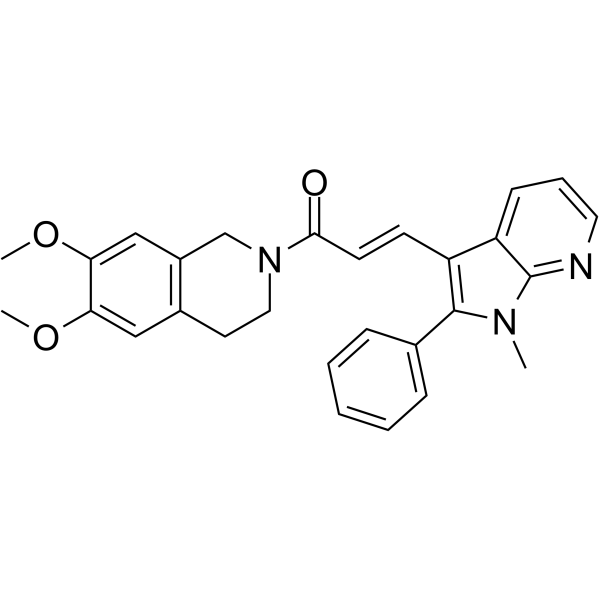
| SMILES | CN1C(=C(C2=C1N=CC=C2)/C=C/C(=O)N3CCC4=CC(=C(C=C4C3)OC)OC)C5=CC=CC=C5 |
| InChi Key | IJYPHMXWKKKHGT-VAWYXSNFSA-N |
| InChi Code | InChI=1S/C28H27N3O3/c1-30-27(19-8-5-4-6-9-19)22(23-10-7-14-29-28(23)30)11-12-26(32)31-15-13-20-16-24(33-2)25(34-3)17-21(20)18-31/h4-12,14,16-17H,13,15,18H2,1-3H3/b12-11+ |
| Chemical Name | (E)-1-(6,7-dimethoxy-3,4-dihydro-1H-isoquinolin-2-yl)-3-(1-methyl-2-phenylpyrrolo[2,3-b]pyridin-3-yl)prop-2-en-1-one |
| HS Tariff Code | 2934.99.9001 |
| Storage |
Powder-20°C 3 years 4°C 2 years In solvent -80°C 6 months -20°C 1 month |
| Shipping Condition | Room temperature (This product is stable at ambient temperature for a few days during ordinary shipping and time spent in Customs) |
Biological Activity
| Targets | Smad3, ALK-5[1] |
| ln Vitro | The connection between Smad3 and Smad4 as well as the phosphorylation of Smad3 caused by TGF-beta1 are reduced by SIS3 free base[1]. |
| Cell Assay |
Western Blot Analysis[1] Cell Types: Human dermal fibroblasts Tested Concentrations: 0.3, 1, 3, 10 μM Incubation Duration:For 1 hour Experimental Results: Attenuated the TGF-beta1-induced phosphorylation of Smad3 and interaction of Smad3 with Smad4. |
| References |
[1]. Characterization of SIS3, a novel specific inhibitor of Smad3, and its effect on transforming growth factor-beta1-induced extracellular matrix expression. Mol Pharmacol. 2006 Feb;69(2):597-607. Epub 2005 Nov 15. |
| Additional Infomation | SIS3 free base is an enamide resulting from the formal condensation of the amino group of 6,7-dimethoxy-1,2,3,4-tetrahydroisoquinoline with the carboxy group of (2E)-3-(1-methyl-2-phenyl-1H-pyrrolo[2,3-b]pyridin-3-yl)acrylic acid. It has a role as a Smad3 inhibitor. It is a member of isoquinolines, a pyrrolopyridine, a monocarboxylic acid amide, an aromatic ether, an enamide and a tertiary carboxamide. It is a conjugate base of a SIS3 free base(1+). |
Solubility Data
| Solubility (In Vitro) | DMSO: 100 mg/mL (220.49 mM) |
| Solubility (In Vivo) |
Solubility in Formulation 1: ≥ 2.5 mg/mL (5.51 mM) (saturation unknown) in 10% DMSO + 40% PEG300 +5% Tween-80 + 45% Saline (add these co-solvents sequentially from left to right, and one by one), clear solution. For example, if 1 mL of working solution is to be prepared, you can add 100 μL of 25.0 mg/mL clear DMSO stock solution to 400 μL PEG300 and mix evenly; then add 50 μL Tween-80 + to the above solution and mix evenly; then add 450 μL normal saline to adjust the volume to 1 mL. Preparation of saline: Dissolve 0.9 g of sodium chloride in 100 mL ddH₂ O to obtain a clear solution. (Please use freshly prepared in vivo formulations for optimal results.) |
| Preparing Stock Solutions | 1 mg | 5 mg | 10 mg | |
| 1 mM | 2.2049 mL | 11.0246 mL | 22.0493 mL | |
| 5 mM | 0.4410 mL | 2.2049 mL | 4.4099 mL | |
| 10 mM | 0.2205 mL | 1.1025 mL | 2.2049 mL |