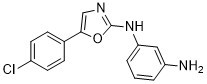
SIRT7 inhibitor 97491 is a novel SIRT7 inhibitor with antitumor activity. It reduces the deacetylase activity of SIRT7 with an IC50 of 325 nM.
Physicochemical Properties
| Molecular Formula | C15H12CLN3O |
| Molecular Weight | 285.728281974792 |
| Exact Mass | 285.066 |
| CAS # | 1807758-81-1 |
| PubChem CID | 146018038 |
| Appearance | Off-white to light yellow solid powder |
| LogP | 3.8 |
| Hydrogen Bond Donor Count | 2 |
| Hydrogen Bond Acceptor Count | 4 |
| Rotatable Bond Count | 3 |
| Heavy Atom Count | 20 |
| Complexity | 310 |
| Defined Atom Stereocenter Count | 0 |
| SMILES | ClC1C=CC(=CC=1)C1=CN=C(NC2C=CC=C(C=2)N)O1 |
| InChi Key | RMRVZWMKRCLSFX-UHFFFAOYSA-N |
| InChi Code | InChI=1S/C15H12ClN3O/c16-11-6-4-10(5-7-11)14-9-18-15(20-14)19-13-3-1-2-12(17)8-13/h1-9H,17H2,(H,18,19) |
| Chemical Name | 3-N-[5-(4-chlorophenyl)-1,3-oxazol-2-yl]benzene-1,3-diamine |
| HS Tariff Code | 2934.99.9001 |
| Storage |
Powder-20°C 3 years 4°C 2 years In solvent -80°C 6 months -20°C 1 month Note: This product requires protection from light (avoid light exposure) during transportation and storage. |
| Shipping Condition | Room temperature (This product is stable at ambient temperature for a few days during ordinary shipping and time spent in Customs) |
Biological Activity
| Targets |
|
|
| ln Vitro | The SIRT7 inhibitor 97491 (1–10 μM) inhibits MES-SA cell growth without harming HEK293 cells [1]. | |
| ln Vivo | Tumor growth in xenograft mice is inhibited by SIRT7 inhibitor 97491 (2 mg/kg; intraperitoneally; for 3 weeks, excluding weekends) [1]. | |
| Cell Assay |
Cell Proliferation Assay[1] Cell Types: Human uterine sarcoma MES-SA cells Tested Concentrations: 1, 5, 10 μM Incubation Duration: 72 hrs (hours) Experimental Results: Led to more than 50% decrease in cell proliferation at concentrations of 5 and 10 μM. Cell Cytotoxicity Assay[1] Cell Types: Human embryonic kidney cell line HEK293 cells Tested Concentrations: 1, 5, 10 μM Incubation Duration: 24 hrs (hours) Experimental Results: HEK293 cells were almost unaffected. |
|
| Animal Protocol |
Animal/Disease Models: Balb/c nude mice (18-20 g; 6-8 weeks old) with MES-SA cells[1] Doses: 2 mg/kg Route of Administration: Intraperitoneally injected; for 3 weeks, except on weekends. Experimental Results: Inhibited cancer growth in vivo. |
|
| References |
[1]. Identification of a Novel SIRT7 Inhibitor as Anticancer Drug Candidate. Biochem Biophys Res Commun. 2019 Jan 8;508(2):451-457. |
Solubility Data
| Solubility (In Vitro) | DMSO : ~500 mg/mL (~1749.90 mM) |
| Solubility (In Vivo) |
Solubility in Formulation 1: ≥ 4.17 mg/mL (14.59 mM) (saturation unknown) in 10% DMSO + 90% Corn Oil (add these co-solvents sequentially from left to right, and one by one), clear solution. For example, if 1 mL of working solution is to be prepared, you can add 100 μL of 41.7 mg/mL clear DMSO stock solution to 900 μL of corn oil and mix evenly. Solubility in Formulation 2: 10 mg/mL (35.00 mM) in 50% PEG300 50% Saline (add these co-solvents sequentially from left to right, and one by one), suspension solution; with ultrasonication. Preparation of saline: Dissolve 0.9 g of sodium chloride in 100 mL ddH₂ O to obtain a clear solution. (Please use freshly prepared in vivo formulations for optimal results.) |
| Preparing Stock Solutions | 1 mg | 5 mg | 10 mg | |
| 1 mM | 3.4998 mL | 17.4990 mL | 34.9981 mL | |
| 5 mM | 0.7000 mL | 3.4998 mL | 6.9996 mL | |
| 10 mM | 0.3500 mL | 1.7499 mL | 3.4998 mL |