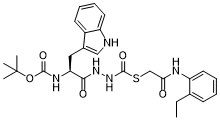
SID 26681509 is a highly potent, reversible, competitive, and specific inhibitor of human cathepsin L with an IC50 of 56 nM. SID 26681509 inhibits in vitro propagation of malaria parasite Plasmodium falciparum and inhibits Leishmania major with IC50s of 15.4 μM and 12.5 μM, respectively. SID 26681509 shows no inhibitory activity against cathepsin G.
Physicochemical Properties
| Molecular Formula | C₂₇H₃₃N₅O₅S |
| Molecular Weight | 539.646425008774 |
| Exact Mass | 539.22 |
| CAS # | 958772-66-2 |
| Related CAS # | SID 26681509 quarterhydrate |
| PubChem CID | 16725315 |
| Appearance | White to off-white solid powder |
| LogP | 6.177 |
| Hydrogen Bond Donor Count | 5 |
| Hydrogen Bond Acceptor Count | 6 |
| Rotatable Bond Count | 11 |
| Heavy Atom Count | 38 |
| Complexity | 835 |
| Defined Atom Stereocenter Count | 1 |
| SMILES | C(C1=CNC2C=CC=CC1=2)[C@H](NC(=O)OC(C)(C)C)C(=O)NNC(=O)SCC(=O)NC1C=CC=CC=1CC |
| InChi Key | OTIWAYTTYNFEKL-QFIPXVFZSA-N |
| InChi Code | InChI=1S/C27H33N5O5S/c1-5-17-10-6-8-12-20(17)29-23(33)16-38-26(36)32-31-24(34)22(30-25(35)37-27(2,3)4)14-18-15-28-21-13-9-7-11-19(18)21/h6-13,15,22,28H,5,14,16H2,1-4H3,(H,29,33)(H,30,35)(H,31,34)(H,32,36)/t22-/m0/s1 |
| Chemical Name | S-(2-((2-ethylphenyl)amino)-2-oxoethyl) 2-((tert-butoxycarbonyl)-L-tryptophyl)hydrazine-1-carbothioate |
| Synonyms | SID-26681509 SID26681509 SID 26681509 |
| HS Tariff Code | 2934.99.9001 |
| Storage |
Powder-20°C 3 years 4°C 2 years In solvent -80°C 6 months -20°C 1 month |
| Shipping Condition | Room temperature (This product is stable at ambient temperature for a few days during ordinary shipping and time spent in Customs) |
Biological Activity
| ln Vitro | After four hours of preincubation with cathepsin L, SID 26681509's IC50 of 1.0 nM increased in potency. It was discovered that SID 26681509 is a slowly reversible and slowly binding competitive inhibitor. The inhibitory rate constants, determined by single-step reversibility transient kinetic analysis, are kon = 24,000 M-1s-1 and koff = 2.2 × 10⁻⁵ s-1 (Ki = 0.89 nM). Using the papain/CLIK-148 experimentally obtained X-ray crystal structure, molecular docking investigations were carried out [1]. After an hour, SID 26681509 was shown to inhibit papain and cathepsins B, K, S, and V, with IC50 values ranging from 618 nM to 8.442 μM. The inhibitory action of SID 26681509 against the serine protease cathepsin G is nonexistent[1]. At 0.5 μM, SID 26681509 suppresses the activity of cathepsin V. Without affecting cell viability, SID 26681509 (1–30 μM) dose-dependently inhibits TNF-α production caused by high mobility group box 1 (HMGB1) [2]. |
| ln Vivo | SID 26681509 therapy significantly enhances the survival rate of sepsis animal models and lowers liver injury following warm hepatic ischemia/reperfusion (I/R) model [2]. |
| References |
[1]. Shah PP, et al. Kinetic characterization and molecular docking of a novel, potent, and selective slow-binding inhibitor of human cathepsin L. Mol Pharmacol. 2008 Jul;74(1):34-41. [2]. Pribis JP, et al. The HIV Protease Inhibitor Saquinavir Inhibits HMGB1-Driven Inflammation by Targeting the Interaction of Cathepsin V with TLR4/MyD88. Mol Med. 2015 Dec;21(1):749-757. |
| Additional Infomation | SID 26681509 is a carbohydrazide that is L-tryptophan in which the amino and carboxy groups are substituted by tert-butoxycarbonyl and 2-({[2-(2-ethylanilino)-2-oxoethyl]sulfanyl}carbonyl)hydrazinyl groups, respectively. It is a potent and reversible inhibitor of human cathepsin L (IC50 = 56 nM). It has a role as a cathepsin L (EC 3.4.22.15) inhibitor and an antiplasmodial drug. It is a secondary carboxamide, a L-tryptophan derivative, a tert-butyl ester, a thioester and a carbohydrazide. |
Solubility Data
| Solubility (In Vitro) | DMSO : ~50 mg/mL (~92.65 mM) |
| Solubility (In Vivo) |
Solubility in Formulation 1: ≥ 1.25 mg/mL (2.32 mM) (saturation unknown) in 10% DMSO + 40% PEG300 + 5% Tween80 + 45% Saline (add these co-solvents sequentially from left to right, and one by one), clear solution. For example, if 1 mL of working solution is to be prepared, you can add 100 μL of 12.5 mg/mL clear DMSO stock solution to 400 μL PEG300 and mix evenly; then add 50 μL Tween-80 to the above solution and mix evenly; then add 450 μL normal saline to adjust the volume to 1 mL. Preparation of saline: Dissolve 0.9 g of sodium chloride in 100 mL ddH₂ O to obtain a clear solution. Solubility in Formulation 2: ≥ 1.25 mg/mL (2.32 mM) (saturation unknown) in 10% DMSO + 90% (20% SBE-β-CD in Saline) (add these co-solvents sequentially from left to right, and one by one), clear solution. For example, if 1 mL of working solution is to be prepared, you can add 100 μL of 12.5 mg/mL clear DMSO stock solution to 900 μL of 20% SBE-β-CD physiological saline solution and mix evenly. Preparation of 20% SBE-β-CD in Saline (4°C,1 week): Dissolve 2 g SBE-β-CD in 10 mL saline to obtain a clear solution. Solubility in Formulation 3: ≥ 1.25 mg/mL (2.32 mM) (saturation unknown) in 10% DMSO + 90% Corn Oil (add these co-solvents sequentially from left to right, and one by one), clear solution. For example, if 1 mL of working solution is to be prepared, you can add 100 μL of 12.5 mg/mL clear DMSO stock solution to 900 μL of corn oil and mix evenly. (Please use freshly prepared in vivo formulations for optimal results.) |
| Preparing Stock Solutions | 1 mg | 5 mg | 10 mg | |
| 1 mM | 1.8531 mL | 9.2653 mL | 18.5305 mL | |
| 5 mM | 0.3706 mL | 1.8531 mL | 3.7061 mL | |
| 10 mM | 0.1853 mL | 0.9265 mL | 1.8531 mL |