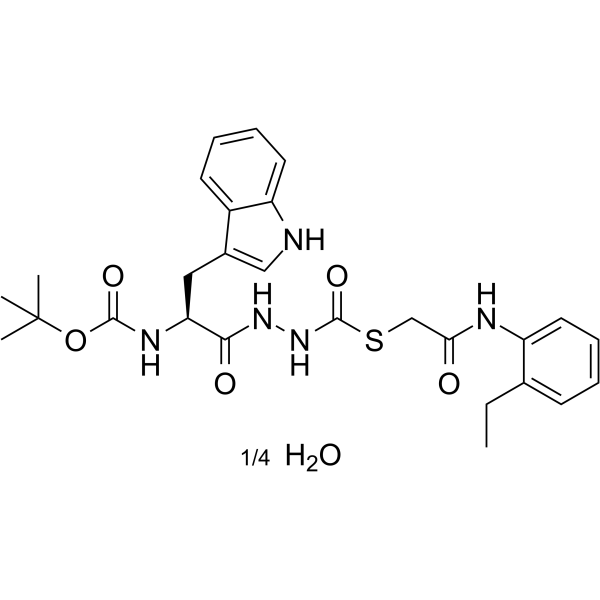
Physicochemical Properties
| Molecular Formula | C27H33N5O5S.1/4H2O |
| Molecular Weight | 544.16 |
| Related CAS # | SID 26681509;958772-66-2 |
| Appearance | White to off-white solid powder |
| HS Tariff Code | 2934.99.9001 |
| Storage |
Powder-20°C 3 years 4°C 2 years In solvent -80°C 6 months -20°C 1 month |
| Shipping Condition | Room temperature (This product is stable at ambient temperature for a few days during ordinary shipping and time spent in Customs) |
Biological Activity
| Targets | Plasmodium |
| ln Vitro | SID 26681509 gains potency and exhibits an IC50 of 1.0 nM following a 4-hour preincubation with cathepsin L. The findings indicate that SID 26681509 functions as a slowly reversible and slowly binding competitive inhibitor. For single-step reversibility, inhibition rate constants were determined using a transient kinetic analysis to be kon = 24,000 M-1s-1 and koff = 2.2 × 10⁻⁵ s-1 (Ki = 0.89 nM). Utilizing the experimentally-derived X-ray crystal structure of papin/CLIK-148, molecular docking investigations are conducted [1]. After an hour, the IC50 values of SID 26681509 were found to range from 618 nM to 8.442 μM, indicating its inhibition of papin and cathepsins B, K, S, and V. When it comes to the serine protease cathepsin G, SID 26681509 has no inhibitory activity[1]. With an IC50 value of 0.5 μM, 26681509 inhibits the activity of cathepsin V. SID 26681509 (1-30 μM) dose-dependently inhibits TNF-α production generated by high-mobility group box 1 (HMGB1) without compromising cell viability[2]. |
| ln Vivo | Treatment with SID 26681509 dramatically increases survival in mice sepsis models and decreases liver damage during warm hepatic ischemia/reperfusion (I/R) models[2]. |
| References |
[1]. Kinetic characterization and molecular docking of a novel, potent, and selective slow-binding inhibitor of human cathepsin L. Mol Pharmacol. 2008 Jul;74(1):34-41. [2]. The HIV Protease Inhibitor Saquinavir Inhibits HMGB1-Driven Inflammation by Targeting the Interaction of Cathepsin V with TLR4/MyD88. Mol Med. 2015 Dec;21(1):749-757. |
Solubility Data
| Solubility (In Vitro) |
DMSO :~50 mg/mL (~91.88 mM) Ethanol :~5 mg/mL (~9.19 mM) |
| Solubility (In Vivo) |
Solubility in Formulation 1: ≥ 1.67 mg/mL (3.07 mM) (saturation unknown) in 10% DMSO + 40% PEG300 +5% Tween-80 + 45% Saline (add these co-solvents sequentially from left to right, and one by one), clear solution. For example, if 1 mL of working solution is to be prepared, you can add 100 μL of 16.7 mg/mL clear DMSO stock solution to 400 μL PEG300 and mix evenly; then add 50 μL Tween-80 + to the above solution and mix evenly; then add 450 μL normal saline to adjust the volume to 1 mL. Preparation of saline: Dissolve 0.9 g of sodium chloride in 100 mL ddH₂ O to obtain a clear solution. (Please use freshly prepared in vivo formulations for optimal results.) |
| Preparing Stock Solutions | 1 mg | 5 mg | 10 mg | |
| 1 mM | 1.8377 mL | 9.1885 mL | 18.3769 mL | |
| 5 mM | 0.3675 mL | 1.8377 mL | 3.6754 mL | |
| 10 mM | 0.1838 mL | 0.9188 mL | 1.8377 mL |