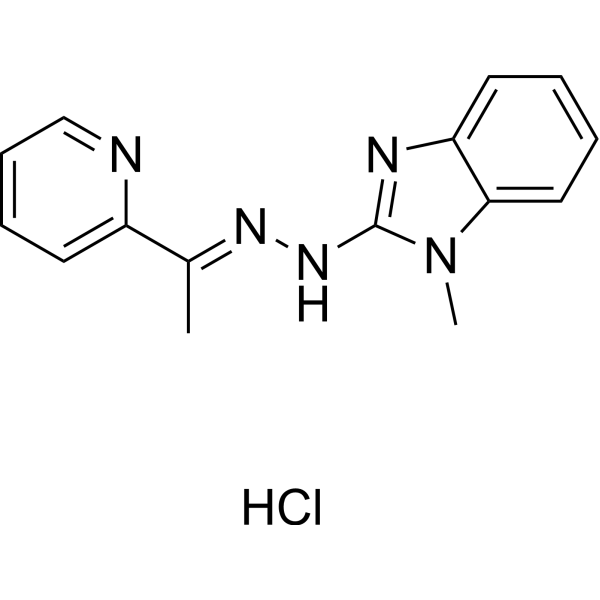
Physicochemical Properties
| Molecular Formula | C15H16CLN5 |
| Molecular Weight | 301.774041175842 |
| Exact Mass | 301.109 |
| CAS # | 1992052-49-9 |
| PubChem CID | 121513909 |
| Appearance | Pink to red solid powder |
| Hydrogen Bond Donor Count | 2 |
| Hydrogen Bond Acceptor Count | 4 |
| Rotatable Bond Count | 3 |
| Heavy Atom Count | 21 |
| Complexity | 356 |
| Defined Atom Stereocenter Count | 0 |
| SMILES | C/C(=N/NC1=NC2=CC=CC=C2N1C)/C3=CC=CC=N3.Cl |
| InChi Key | CDYJHORKRVKALB-VVTVMFAVSA-N |
| InChi Code | InChI=1S/C15H15N5.ClH/c1-11(12-7-5-6-10-16-12)18-19-15-17-13-8-3-4-9-14(13)20(15)2;/h3-10H,1-2H3,(H,17,19);1H/b18-11-; |
| Chemical Name | 1-methyl-N-[(Z)-1-pyridin-2-ylethylideneamino]benzimidazol-2-amine;hydrochloride |
| Synonyms | SI2 HCl; SI 2 HCl |
| HS Tariff Code | 2934.99.9001 |
| Storage |
Powder-20°C 3 years 4°C 2 years In solvent -80°C 6 months -20°C 1 month Note: Please store this product in a sealed and protected environment, avoid exposure to moisture. |
| Shipping Condition | Room temperature (This product is stable at ambient temperature for a few days during ordinary shipping and time spent in Customs) |
Biological Activity
| ln Vitro | Through a direct physical response to SRC-3, SI-2 hydrochloride specifically decreases the protein concentration and regulatory function of intracellular SRC-3 [1]. SI-2 hydrochloride has IC50 values in the low nanomolar range and specifically promotes apoptosis of breast cancer cells. MDAMB-468 cell motility, proliferation, and tumor metastasis are all decreased by SI-2 hydrochloride (100 nM) [1]. Determination of cell viability [1]. (3–20 nM), yet it has no effect on regular cell viability[1]. |
| ln Vivo | SI-2 hydrochloride exhibits negligible chronic toxicity to major organs based on histological study and minimal acute cardiac toxicity according to the hERG channel blocking test [1]. One kind of drug molecule that meets all of Lipinski's requirements is SI-2 hydrochloride. [1] |
| Cell Assay |
Cell viability determination[1]. (3 -20 nM), but does not affect normal cell viability[1]. Cell Types: MDA-MB-468 cells. Tested Concentrations: 100 nM. Incubation Duration: 12 hrs (hours). Experimental Results: Significant reduction in cancer cell motility. Western Blot Analysis[1]. Cell Types: MDAMB-468 cells. Tested Concentrations: 0-200 nM. Incubation Duration: 24 hrs (hours). Experimental Results: SRC-3 protein levels were Dramatically diminished. SRC-3 mRNA levels were not diminished. Western Blot Analysis[1]. Cell Types: cancer cells. Tested Concentrations: 0-200 nM. Incubation Duration: 24 hrs (hours). Experimental Results: Causes PARP cleavage. |
| Animal Protocol |
Animal/Disease Models: MDA-MB-468 breast cancer mouse model [1]. Doses: 2 mg/kg. Dosing: twice (two times) daily for 5 weeks (vehicle, PBS). Experimental Results: Dramatically inhibited tumor growth. SRC-3 levels in SI-2-treated tumor tissues were Dramatically lower than those in PBS-treated controls. Animal/Disease Models: CD1 mouse[1]. Doses: 20 mg/kg (pharmacokinetic/PK/PK analysis). Route of Administration: Administer intraperitoneally (ip) (ip) once. Experimental Results: T1/2=1 hour, Cmax is 3.0μM, and the time to reach the maximum plasma concentration tmax is 0.25 hrs (hrs (hours)). SI-2 degrades only slightly (less than 5%) within 6 hrs (hrs (hours)) at pH 1.6 and 3.0 and is stable in buffers at pH ≥ 5. |
| References | [1]. Song X, et al. Development of potent small-molecule inhibitors to drug the undruggable steroid receptor coactivator-3. Proc Natl Acad Sci U S A. 2016 May 3;113(18):4970-5. |
Solubility Data
| Solubility (In Vitro) | DMSO : ~5 mg/mL (~16.57 mM) |
| Solubility (In Vivo) |
Note: Listed below are some common formulations that may be used to formulate products with low water solubility (e.g. < 1 mg/mL), you may test these formulations using a minute amount of products to avoid loss of samples. Injection Formulations (e.g. IP/IV/IM/SC) Injection Formulation 1: DMSO : Tween 80: Saline = 10 : 5 : 85 (i.e. 100 μL DMSO stock solution → 50 μL Tween 80 → 850 μL Saline) *Preparation of saline: Dissolve 0.9 g of sodium chloride in 100 mL ddH ₂ O to obtain a clear solution. Injection Formulation 2: DMSO : PEG300 :Tween 80 : Saline = 10 : 40 : 5 : 45 (i.e. 100 μL DMSO → 400 μLPEG300 → 50 μL Tween 80 → 450 μL Saline) Injection Formulation 3: DMSO : Corn oil = 10 : 90 (i.e. 100 μL DMSO → 900 μL Corn oil) Example: Take the Injection Formulation 3 (DMSO : Corn oil = 10 : 90) as an example, if 1 mL of 2.5 mg/mL working solution is to be prepared, you can take 100 μL 25 mg/mL DMSO stock solution and add to 900 μL corn oil, mix well to obtain a clear or suspension solution (2.5 mg/mL, ready for use in animals). Injection Formulation 4: DMSO : 20% SBE-β-CD in saline = 10 : 90 [i.e. 100 μL DMSO → 900 μL (20% SBE-β-CD in saline)] *Preparation of 20% SBE-β-CD in Saline (4°C,1 week): Dissolve 2 g SBE-β-CD in 10 mL saline to obtain a clear solution. Injection Formulation 5: 2-Hydroxypropyl-β-cyclodextrin : Saline = 50 : 50 (i.e. 500 μL 2-Hydroxypropyl-β-cyclodextrin → 500 μL Saline) Injection Formulation 6: DMSO : PEG300 : castor oil : Saline = 5 : 10 : 20 : 65 (i.e. 50 μL DMSO → 100 μLPEG300 → 200 μL castor oil → 650 μL Saline) Injection Formulation 7: Ethanol : Cremophor : Saline = 10: 10 : 80 (i.e. 100 μL Ethanol → 100 μL Cremophor → 800 μL Saline) Injection Formulation 8: Dissolve in Cremophor/Ethanol (50 : 50), then diluted by Saline Injection Formulation 9: EtOH : Corn oil = 10 : 90 (i.e. 100 μL EtOH → 900 μL Corn oil) Injection Formulation 10: EtOH : PEG300:Tween 80 : Saline = 10 : 40 : 5 : 45 (i.e. 100 μL EtOH → 400 μLPEG300 → 50 μL Tween 80 → 450 μL Saline) Oral Formulations Oral Formulation 1: Suspend in 0.5% CMC Na (carboxymethylcellulose sodium) Oral Formulation 2: Suspend in 0.5% Carboxymethyl cellulose Example: Take the Oral Formulation 1 (Suspend in 0.5% CMC Na) as an example, if 100 mL of 2.5 mg/mL working solution is to be prepared, you can first prepare 0.5% CMC Na solution by measuring 0.5 g CMC Na and dissolve it in 100 mL ddH2O to obtain a clear solution; then add 250 mg of the product to 100 mL 0.5% CMC Na solution, to make the suspension solution (2.5 mg/mL, ready for use in animals). Oral Formulation 3: Dissolved in PEG400 Oral Formulation 4: Suspend in 0.2% Carboxymethyl cellulose Oral Formulation 5: Dissolve in 0.25% Tween 80 and 0.5% Carboxymethyl cellulose Oral Formulation 6: Mixing with food powders Note: Please be aware that the above formulations are for reference only. InvivoChem strongly recommends customers to read literature methods/protocols carefully before determining which formulation you should use for in vivo studies, as different compounds have different solubility properties and have to be formulated differently. (Please use freshly prepared in vivo formulations for optimal results.) |
| Preparing Stock Solutions | 1 mg | 5 mg | 10 mg | |
| 1 mM | 3.3138 mL | 16.5689 mL | 33.1378 mL | |
| 5 mM | 0.6628 mL | 3.3138 mL | 6.6276 mL | |
| 10 mM | 0.3314 mL | 1.6569 mL | 3.3138 mL |