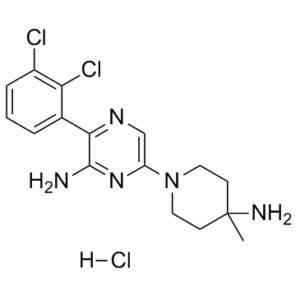
SHP099 HCl, the HCl salt of SHP-099, is an orally bioavailable, and allosteric SHP2 inhibitor with antitumor and anti-inflammatory effects. The inhibitor has an IC50 of 70 nM and inhibits SHP2 [Src homology-2 domain containing protein tyrosine phosphatase-2]. The PTPN11 gene encodes SHP2, a nonreceptor protein tyrosine phosphatase (PTP) that is involved in cell growth and differentiation through the MAPK signaling pathway. Additionally, SHP2 is said to be crucial to the PD-1/PD-L1 pathway, which causes programmed cell death. SHP099 functions as an allosteric modulator (inhibitor) of SHP2, stabilizing the autoinhibited conformation. The binding location in a previously unidentified allosteric binding pocket was identified by X-ray crystallography.
Physicochemical Properties
| Molecular Formula | C16H19CL2N5.HCL | |
| Molecular Weight | 388.72 | |
| Exact Mass | 387.078 | |
| Elemental Analysis | C, 49.44; H, 5.19; Cl, 27.36; N, 18.02 | |
| CAS # | 1801747-11-4 | |
| Related CAS # | SHP099;1801747-42-1;SHP099 monohydrochloride;2200214-93-1 | |
| PubChem CID | 121241170 | |
| Appearance | Yellow solid powder | |
| Hydrogen Bond Donor Count | 3 | |
| Hydrogen Bond Acceptor Count | 5 | |
| Rotatable Bond Count | 2 | |
| Heavy Atom Count | 24 | |
| Complexity | 402 | |
| Defined Atom Stereocenter Count | 0 | |
| SMILES | ClC1C(=C([H])C([H])=C([H])C=1C1C(N([H])[H])=NC(=C([H])N=1)N1C([H])([H])C([H])([H])C(C([H])([H])[H])(C([H])([H])C1([H])[H])N([H])[H])Cl.Cl[H] |
|
| InChi Key | KHQHYRFUYAXWOQ-UHFFFAOYSA-N | |
| InChi Code | InChI=1S/C16H19Cl2N5.ClH/c1-16(20)5-7-23(8-6-16)12-9-21-14(15(19)22-12)10-3-2-4-11(17)13(10)18;/h2-4,9H,5-8,20H2,1H3,(H2,19,22);1H | |
| Chemical Name | 6-(4-amino-4-methylpiperidin-1-yl)-3-(2,3-dichlorophenyl)pyrazin-2-amine;hydrochloride | |
| Synonyms |
|
|
| HS Tariff Code | 2934.99.9001 | |
| Storage |
Powder-20°C 3 years 4°C 2 years In solvent -80°C 6 months -20°C 1 month |
|
| Shipping Condition | Room temperature (This product is stable at ambient temperature for a few days during ordinary shipping and time spent in Customs) |
Biological Activity
| Targets |
SHP-2 (IC50 = 0.07 μM)
Protein Tyrosine Phosphatase, Non-Receptor Type 11 (SHP2/PTPN11) (binds to the allosteric pocket at the interface of N-terminal SH2, C-terminal SH2, and PTP domains, stabilizing the autoinhibited conformation) [1] Protein Tyrosine Phosphatase, Non-Receptor Type 11 (SHP2/PTPN11) (IC50 = 0.071 μM, binds to the interface of N-terminal SH2, C-terminal SH2, and PTP domains to exert allosteric inhibition) [2] |
| ln Vitro |
SHP099 exhibits a 1.4 μM IC50 in the KYSE-520 model, which inhibits cell proliferation. There is no biochemical inhibitory activity visible in the phosphatase or kinase panels, indicating that the aminopyrazine series (SHP099) is highly selective for SHP2. Additionally, SHP099 exhibits high permeability with no discernible efflux in Caco-2 cells and high solubility (>0.5 mM in pH 6.8 buffer)[1]. SHP099 maintains SHP2 in a conformation that is auto-inhibited. In vitro proliferation of receptor-tyrosine-kinase-driven human cancer cells is inhibited by SHP099 through suppression of RAS-ERK signaling. Preclinical safety pharmacology panel representing 49 common adverse drug reaction targets shows that SHP099 has only modest activity against 5HT3. Due to its high degree of target selectivity, SHP099 exhibits no activity against SHP1, which is the closest homologue of SHP2 and shares 61% of its amino acid sequence identity. For SHP2-dependent MDA-MB-468 and KYSE520 cells, it inhibits p-ERK with an IC50 of approximately 0.25 μM; however, A2058 cells are not affected. On the p-AKT levels in the same cells, no change is seen. By directly inhibiting SHP2 on its target, SHP099 prevents MAPK signaling and cell proliferation in RTK-dependent cells[2]. 1. SHP099 HCl (referred to as SHP099 in the literature) acts as an allosteric modulator of SHP2. Through high-throughput screening, it was identified as a progressable chemical entity for SHP2 inhibition. X-ray crystallography confirmed that it binds to a previously undisclosed allosteric pocket of SHP2, and structure-based drug design optimized its interactions with SHP2, leading to the characterization of several new protein-ligand interactions that enhance its inhibitory potency. It shows high selectivity for SHP2 and is orally bioavailable in subsequent evaluations [1] 2. SHP099 HCl (referred to as SHP099 in the literature) exhibits high potency against SHP2 with an IC50 of 0.071 μM. It concurrently binds to the interface of the N-terminal SH2, C-terminal SH2, and PTP domains of SHP2, stabilizing the protein in an autoinhibited conformation to inhibit SHP2 activity via an allosteric mechanism. In receptor-tyrosine-kinase (RTK)-driven human cancer cell lines, it suppresses the activation of the RAS–ERK signaling pathway, thereby significantly inhibiting cancer cell proliferation [2] |
| ln Vivo |
SHP099 exhibits a bioavailability of 46% F and an acceptable oral exposure of 5 mg/kg PO and 565 μM/h. With dose-dependent pathway inhibition and antitumor activity demonstrated in xenograft models, SHP099 is a powerful, selective, highly soluble, orally bioavailable, and effective SHP2 inhibitor[1]. SHP099 taken orally is well tolerated and exhibits dose-dependent anti-tumor activity in the KYSE520 xenograft model[2]. 1. SHP099 HCl (referred to as SHP099 in the literature) demonstrates efficacy in mouse tumor xenograft models. When administered to nude mice bearing RTK-driven human cancer cell xenografts, it inhibits tumor growth by suppressing the RAS–ERK signaling pathway in tumor tissues, confirming its in vivo antitumor activity [2] |
| Enzyme Assay |
Biochemical assay. The binding of bis-tyrosylphorphorylated peptides to SHP2's Src Homology 2 (SH2) domains causes allosteric activation of the protein. The release of SHP2's auto-inhibitory interface during the latter activation step makes the SHP2 PTP active and ready for substrate recognition and reaction catalysis. The surrogate substrate DiFMUP was used in a prompt fluorescence assay format to track the catalytic activity of SHP2. Phosphatase reactions were carried out in a 384-well black polystyrene plate with a flat bottom, low flange, and non-binding surface (Corning, Cat# 3575) at room temperature. A final reaction volume of 25 μL was used, and the assay buffer conditions were as follows: pH 7.2, 75 mM NaCl, 75 mM KCl, 1 mM EDTA, 0.05% P-20, and 5 mM DTT are all present in 60 mM HEPES. Using an assay where 0.5 nM of SHP2 was incubated with 0.5 μM of peptide IRS1_pY1172(dPEG8)pY1222 (sequence:H2NLN(pY)IDLDLV(dPEG8)LST(pY)ASINFQK-amide), the inhibitory effect of the tested compounds (concentrations ranging from 0.003 – 100 μM) was observed. The reaction was incubated at 25 oC for 30 minutes (200 μM for 2-593, 100 μM for 1-525 construct) after the surrogate substrate DiFMUP (Invitrogen, cat# D6567, 200 μM) was added. The next step involved adding 5 μL of a 160 μM bpV(Phen) solution (Enzo Life Sciences cat# ALX-270-204) to quench the reaction. At excitation and emission wavelengths of 340 nm and 450 nm, respectively, the fluorescence signal was observed using a microplate reader (Envision, Perki-Elmer). Normalized IC50 regression curve fitting with control-based normalization was used to analyze the inhibitor dose response curves. 1. High-throughput screening assay: A large library of small molecules was screened to identify compounds that can inhibit SHP2 activity. Assays were performed using recombinant SHP2 protein, and the phosphatase activity of SHP2 was measured using a suitable substrate. Compounds that reduced SHP2 phosphatase activity were selected as hit compounds, and SHP099 HCl (SHP099) was identified as a potential candidate from these hits [1] 2. X-ray crystallography assay for binding site identification: Recombinant SHP2 protein was incubated with SHP099 HCl (SHP099) to form a protein-ligand complex. The complex was then crystallized, and X-ray diffraction data were collected. Structural analysis of the diffraction data revealed the binding location of SHP099 HCl at the interface of the N-terminal SH2, C-terminal SH2, and PTP domains of SHP2, confirming the existence of the allosteric binding pocket [1] 3. SHP2 phosphatase activity inhibition assay: Recombinant SHP2 protein was mixed with different concentrations of SHP099 HCl (SHP099) and a specific phosphopeptide substrate. The reaction was initiated under optimized buffer conditions, and the amount of dephosphorylated product was measured using a detection method (e.g., fluorescence or absorbance-based assay) to calculate the phosphatase activity of SHP2. The IC50 value of SHP099 HCl against SHP2 was determined to be 0.071 μM by fitting the dose-response curve of activity inhibition [2] |
| Cell Assay |
In a 96-well plate culture, KYSE-520 cells (30,000 cells/well) are grown overnight and then treated with SHP2 inhibitors for two hours at 37 °C at concentrations of 20, 6.6, 2.2, 0.74, 0.24, 0.08, and 0.027 μM. 30 μL of the lysis buffer included with the SureFire p-ERK assay kit is added to end the incubations. 1. RTK-driven cancer cell proliferation assay: Human cancer cell lines with activated RTK signaling (e.g., lung cancer or breast cancer cell lines with RTK mutations) were seeded in culture plates. After adherence, the cells were treated with different concentrations of SHP099 HCl (SHP099) and cultured for a specific period (e.g., 48–72 hours). Cell viability was measured using a cell counting kit or colorimetric assay (e.g., MTT assay), and the inhibitory effect of SHP099 HCl on cell proliferation was evaluated by calculating the growth inhibition rate at each concentration [2] 2. Western blot analysis for signaling pathway detection: RTK-driven cancer cells treated with SHP099 HCl (SHP099) were lysed to extract total proteins. The protein lysates were separated by sodium dodecyl sulfate-polyacrylamide gel electrophoresis (SDS-PAGE) and transferred to a membrane. The membrane was incubated with primary antibodies against key proteins in the RAS–ERK signaling pathway (e.g., phosphorylated ERK, total ERK) and secondary antibodies. Chemiluminescent detection was used to quantify the expression levels of phosphorylated proteins, confirming that SHP099 HCl suppresses the activation of the RAS–ERK pathway [2] |
| Animal Protocol |
10, 30, or 100 mg/kg qd by oral gavage. Female nude mice were inoculated subcutaneously (3 x 10⁶ cells) in a suspension containing 50% phenol red-free matrigel (BD Biosciences) in Hank’s balanced salt solution with parental KYSE-520 cells. 1. Mouse tumor xenograft model establishment and treatment: Nude mice (both male and female) were subcutaneously injected with RTK-driven human cancer cells to establish tumor xenograft models. When tumors reached a specific volume (e.g., 100–200 mm³), the mice were randomly divided into treatment and control groups. SHP099 HCl (SHP099) was formulated in a suitable vehicle (e.g., aqueous solution with solubilizers or organic solvent mixtures, specific formulation not detailed) and administered orally at a predetermined frequency (e.g., once or twice daily, specific frequency not detailed). Tumor volume and mouse body weight were measured regularly (e.g., every 2–3 days) for the duration of the experiment (e.g., 2–3 weeks). At the end of the experiment, tumors were excised for further analysis (e.g., western blot to detect RAS–ERK pathway activity) [2] |
| ADME/Pharmacokinetics |
1. SHP099 HCl (referred to as SHP099 in the literature) is characterized as orally bioavailable. However, specific ADME parameters such as absorption rate, distribution volume, metabolism pathways, excretion route, half-life (t1/2), Cmax (maximum plasma concentration), and AUC (area under the plasma concentration-time curve) are not provided [1] 2. SHP099 HCl (referred to as SHP099 in the literature) exhibits oral bioavailability, which was confirmed in in vivo studies. [2] |
| References |
[1]. J Med Chem . 2016 Sep 8;59(17):7773-82. [2]. Nature . 2016 Jul 7;535(7610):148-52. |
| Additional Infomation |
1. SHP2, encoded by the PTPN11 gene, is a nonreceptor protein tyrosine phosphatase involved in cell growth and differentiation via the MAPK signaling pathway and plays a role in the programmed cell death (PD-1/PD-L1) pathway. As an oncoprotein associated with multiple cancers and a potential immunomodulator, targeting SHP2 is of significant therapeutic interest. SHP099 HCl (SHP099) was developed through high-throughput screening and structure-based drug design, representing a potent and selective allosteric inhibitor of SHP2 [1] 2. SHP2 is the first reported oncogenic tyrosine phosphatase; activating mutations of SHP2 are associated with developmental disorders (e.g., Noonan syndrome) and multiple cancers (leukemia, lung cancer, breast cancer, neuroblastoma). It regulates cell survival and proliferation mainly via the RAS–ERK pathway and mediates the PD-1/BTLA immune checkpoint pathways. SHP099 HCl (SHP099) inhibits SHP2 activity to suppress tumor cell growth, validating pharmacological inhibition of SHP2 as a promising therapeutic strategy for cancer treatment [2] |
Solubility Data
| Solubility (In Vitro) |
|
|||
| Solubility (In Vivo) |
Note: Listed below are some common formulations that may be used to formulate products with low water solubility (e.g. < 1 mg/mL), you may test these formulations using a minute amount of products to avoid loss of samples. Injection Formulations (e.g. IP/IV/IM/SC) Injection Formulation 1: DMSO : Tween 80: Saline = 10 : 5 : 85 (i.e. 100 μL DMSO stock solution → 50 μL Tween 80 → 850 μL Saline) *Preparation of saline: Dissolve 0.9 g of sodium chloride in 100 mL ddH ₂ O to obtain a clear solution. Injection Formulation 2: DMSO : PEG300 :Tween 80 : Saline = 10 : 40 : 5 : 45 (i.e. 100 μL DMSO → 400 μLPEG300 → 50 μL Tween 80 → 450 μL Saline) Injection Formulation 3: DMSO : Corn oil = 10 : 90 (i.e. 100 μL DMSO → 900 μL Corn oil) Example: Take the Injection Formulation 3 (DMSO : Corn oil = 10 : 90) as an example, if 1 mL of 2.5 mg/mL working solution is to be prepared, you can take 100 μL 25 mg/mL DMSO stock solution and add to 900 μL corn oil, mix well to obtain a clear or suspension solution (2.5 mg/mL, ready for use in animals). Injection Formulation 4: DMSO : 20% SBE-β-CD in saline = 10 : 90 [i.e. 100 μL DMSO → 900 μL (20% SBE-β-CD in saline)] *Preparation of 20% SBE-β-CD in Saline (4°C,1 week): Dissolve 2 g SBE-β-CD in 10 mL saline to obtain a clear solution. Injection Formulation 5: 2-Hydroxypropyl-β-cyclodextrin : Saline = 50 : 50 (i.e. 500 μL 2-Hydroxypropyl-β-cyclodextrin → 500 μL Saline) Injection Formulation 6: DMSO : PEG300 : castor oil : Saline = 5 : 10 : 20 : 65 (i.e. 50 μL DMSO → 100 μLPEG300 → 200 μL castor oil → 650 μL Saline) Injection Formulation 7: Ethanol : Cremophor : Saline = 10: 10 : 80 (i.e. 100 μL Ethanol → 100 μL Cremophor → 800 μL Saline) Injection Formulation 8: Dissolve in Cremophor/Ethanol (50 : 50), then diluted by Saline Injection Formulation 9: EtOH : Corn oil = 10 : 90 (i.e. 100 μL EtOH → 900 μL Corn oil) Injection Formulation 10: EtOH : PEG300:Tween 80 : Saline = 10 : 40 : 5 : 45 (i.e. 100 μL EtOH → 400 μLPEG300 → 50 μL Tween 80 → 450 μL Saline) Oral Formulations Oral Formulation 1: Suspend in 0.5% CMC Na (carboxymethylcellulose sodium) Oral Formulation 2: Suspend in 0.5% Carboxymethyl cellulose Example: Take the Oral Formulation 1 (Suspend in 0.5% CMC Na) as an example, if 100 mL of 2.5 mg/mL working solution is to be prepared, you can first prepare 0.5% CMC Na solution by measuring 0.5 g CMC Na and dissolve it in 100 mL ddH2O to obtain a clear solution; then add 250 mg of the product to 100 mL 0.5% CMC Na solution, to make the suspension solution (2.5 mg/mL, ready for use in animals). Oral Formulation 3: Dissolved in PEG400 Oral Formulation 4: Suspend in 0.2% Carboxymethyl cellulose Oral Formulation 5: Dissolve in 0.25% Tween 80 and 0.5% Carboxymethyl cellulose Oral Formulation 6: Mixing with food powders Note: Please be aware that the above formulations are for reference only. InvivoChem strongly recommends customers to read literature methods/protocols carefully before determining which formulation you should use for in vivo studies, as different compounds have different solubility properties and have to be formulated differently. (Please use freshly prepared in vivo formulations for optimal results.) |
| Preparing Stock Solutions | 1 mg | 5 mg | 10 mg | |
| 1 mM | 2.5725 mL | 12.8627 mL | 25.7255 mL | |
| 5 mM | 0.5145 mL | 2.5725 mL | 5.1451 mL | |
| 10 mM | 0.2573 mL | 1.2863 mL | 2.5725 mL |