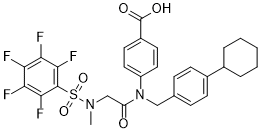
SH-4-54 (SH 454; SH4-54; SH454; SH-454) is a novel and potent STAT inhibitor with potential antineoplastic activity. It inhibits STAT3/5 with KD values of 300 nM and 464 nM, respectively. SH-4-54 shows potent anti-proliferative activity in vitro against glioblastoma brain cancer stem cells (BTSCs) and effectively suppresses STAT3 phosphorylation and its downstream transcriptional targets at low nanomolar concentrations.
Physicochemical Properties
| Molecular Formula | C29H27F5N2O5S | |
| Molecular Weight | 610.59 | |
| Exact Mass | 610.156 | |
| CAS # | 1456632-40-8 | |
| Related CAS # |
|
|
| PubChem CID | 72188643 | |
| Appearance | White to off-white solid powder | |
| Density | 1.431±0.06 g/cm3 | |
| Boiling Point | 717.2±70.0 °C at 760 mmHg | |
| Flash Point | 387.5±35.7 °C | |
| Vapour Pressure | 0.0±2.4 mmHg at 25°C | |
| Index of Refraction | 1.590 | |
| LogP | 7.64 | |
| Hydrogen Bond Donor Count | 1 | |
| Hydrogen Bond Acceptor Count | 11 | |
| Rotatable Bond Count | 9 | |
| Heavy Atom Count | 42 | |
| Complexity | 1010 | |
| Defined Atom Stereocenter Count | 0 | |
| InChi Key | VFPYGNNOSJWBHF-UHFFFAOYSA-N | |
| InChi Code | InChI=1S/C29H27F5N2O5S/c1-35(42(40,41)28-26(33)24(31)23(30)25(32)27(28)34)16-22(37)36(21-13-11-20(12-14-21)29(38)39)15-17-7-9-19(10-8-17)18-5-3-2-4-6-18/h7-14,18H,2-6,15-16H2,1H3,(H,38,39) | |
| Chemical Name | 4-(N-(4-cyclohexylbenzyl)-2-((2,3,4,5,6-pentafluoro-N-methylphenyl)sulfonamido)acetamido)benzoic acid | |
| Synonyms |
|
|
| HS Tariff Code | 2934.99.9001 | |
| Storage |
Powder-20°C 3 years 4°C 2 years In solvent -80°C 6 months -20°C 1 month |
|
| Shipping Condition | Room temperature (This product is stable at ambient temperature for a few days during ordinary shipping and time spent in Customs) |
Biological Activity
| Targets |
SH-4-54 targets the Src homology 2 (SH2) domain of signal transducer and activator of transcription 3 (STAT3), with an IC50 of 1.2 μM for inhibiting STAT3 dimerization and an EC50 of 0.8 μM for blocking STAT3 phosphorylation (Tyr705) [1] |
| ln Vitro |
At low nM concentrations, SH-4-54 efficiently inhibits STAT3 phosphorylation and its downstream transcriptional targets while also killing glioblastoma brain cancer stem cells (BTSCs). At therapeutic dosages, SH-4-54 effectively reduces pSTAT3 with nanomolar IC50s, blocking STAT3's downstream targets. It also exhibits no toxicity in human fetal astrocytes and demonstrates exceptional cytotoxicity in human BTSCs[1]. SH-4-54 (0.5-5 μM) dose-dependently inhibited proliferation of human glioblastoma stem cells (GSCs, lines GBM1, GBM4, GBM8) with IC50 values of 1.5 μM, 1.8 μM, and 1.6 μM respectively [1] SH-4-54 (2 μM) induced apoptosis in GSCs: apoptotic rate increased by 45% (Annexin V/PI staining), caspase-3/-7 activity enhanced by 3.2-fold, and anti-apoptotic protein Survivin downregulated by 0.4-fold [1] SH-4-54 (1-3 μM) suppressed STAT3 phosphorylation (Tyr705) and nuclear translocation in GSCs by 68-82%, reducing STAT3 target genes (c-Myc, Cyclin D1, VEGF) mRNA levels by 55-70% [1] SH-4-54 (2 μM) inhibited colony formation of GSCs by 75% compared to the control group, and reduced sphere formation capacity (sphere number decreased by 65%) [1] SH-4-54 (up to 5 μM) showed no significant cytotoxicity to normal human astrocytes (cell viability >85%) [1] |
| ln Vivo |
In vivo, SH-4-54 inhibits pSTAT3 and demonstrates blood-brain barrier permeability, which together potently regulate the growth of glioma tumors. SH-4-54 reduces pSTAT3 expression in treated mice's tumor cells, highlighting the effectiveness of STAT3 inhibitors in treating BTSCs and confirming their therapeutic efficacy for use in GBM clinical applications. Treatable tumors seem to undergo more apoptosis and less proliferation when exposed to SH-4-54[1]. SH-4-54 (5 mg/kg, i.p., twice weekly for 4 weeks) inhibited tumor growth in nude mice bearing GBM1 glioblastoma xenografts: tumor volume reduced by 68% and tumor weight decreased by 65% compared to the vehicle group [1] SH-4-54 (5 mg/kg, i.p.) prolonged the median survival of xenograft mice from 28 days (vehicle) to 45 days, and reduced STAT3 phosphorylation (72%) and Survivin expression (58%) in tumor tissues [1] SH-4-54 treatment reduced the frequency of CD133+ GSCs in xenograft tumors by 62%, as detected by flow cytometry [1] |
| Enzyme Assay |
Fluorescence polarization assay: A fluorescently labeled phosphopeptide corresponding to the STAT3 SH2 domain-binding sequence was incubated with recombinant STAT3 SH2 domain and serial concentrations of SH-4-54 (0.1-10 μM) in binding buffer at room temperature for 30 minutes. Fluorescence polarization signal was measured, and IC50 for SH2 domain binding was calculated by fitting dose-response curves [1] STAT3 dimerization assay: Recombinant full-length STAT3 protein was incubated with SH-4-54 (0.5-5 μM) in dimerization buffer at 37°C for 1 hour. Dimer formation was detected by non-denaturing polyacrylamide gel electrophoresis, and inhibition rate was quantified by densitometric analysis [1] |
| Cell Assay |
GSCs (GBM1, GBM4, GBM8) were isolated from human glioblastoma tissues and seeded in 96-well plates (5×10^3 cells/well) in serum-free sphere-forming medium. Cells were treated with SH-4-54 (0.5-5 μM) for 72 hours, and cell viability was assessed by MTT assay to calculate IC50 values [1] GSCs were seeded in 6-well plates (1×10^5 cells/well) and treated with SH-4-54 (1-3 μM) for 24 hours. Cells were lysed for western blot analysis of phosphorylated STAT3 (Tyr705), total STAT3, Survivin, and cleaved caspase-3. Nuclear and cytoplasmic fractions were separated to detect STAT3 nuclear translocation [1] For colony formation assay: GSCs were seeded in 6-well plates (1×10^3 cells/well) with SH-4-54 (2 μM) and cultured for 14 days. Colonies were fixed, stained with crystal violet, and counted under a microscope [1] GSCs were treated with SH-4-54 (2 μM) for 24 hours, stained with Annexin V-FITC/PI, and apoptotic cells were analyzed by flow cytometry. Caspase-3/-7 activity was measured using a luminescent assay kit [1] Total RNA was extracted from SH-4-54-treated GSCs, and qPCR was performed to detect mRNA levels of c-Myc, Cyclin D1, and VEGF (GAPDH as reference gene) [1] |
| Animal Protocol |
Suspended in 50% polyethylene glycol 300 in water; 10 mg/kg; i.p. injection NOD-SCID bearing ed with BT73 glioma xenografts Nude mice (6-8 weeks old) were intracranially injected with GBM1 glioblastoma stem cells (1×10^5 cells/mouse) to establish orthotopic xenograft models. Seven days after cell injection, mice were randomly divided into vehicle and SH-4-54 groups (n=8 per group). SH-4-54 was dissolved in DMSO and normal saline (DMSO final concentration <0.5%) and administered via intraperitoneal injection at 5 mg/kg twice weekly for 4 weeks. Tumor volume was measured by MRI at 2 and 4 weeks post-treatment. Mice were monitored for survival time, and tumor tissues were harvested for western blot (STAT3 phosphorylation, Survivin) and flow cytometry (CD133+ GSCs) analysis [1] |
| Toxicity/Toxicokinetics |
In nude mice treated with SH-4-54 (5 mg/kg, i.p., for 4 weeks), no significant weight loss or abnormal clinical signs (e.g., lethargy, neurological deficits) were observed [1] Serum levels of liver function markers (ALT, AST) and kidney function markers (BUN, Cr) in SH-4-54-treated mice were within the normal range, with no significant difference from the vehicle group [1] SH-4-54 (up to 5 μM in vitro) did not affect the viability of normal human astrocytes (cell viability remained >85%) [1] |
| References |
[1]. Potent Targeting of the STAT3 Protein in Brain Cancer Stem Cells: A Promising Route for Treating Glioblastoma. ACS Med Chem Lett. 2013 Sep 8;4(11):1102-1107. |
| Additional Infomation |
SH-4-54 is a potent and selective small-molecule inhibitor targeting the SH2 domain of STAT3 [1] SH-4-54 exerts antitumor effects by specifically binding to STAT3 SH2 domain, blocking STAT3 dimerization and phosphorylation, thereby inhibiting the transcription of STAT3-dependent pro-survival and pro-proliferative genes in glioblastoma stem cells [1] SH-4-54 selectively targets glioblastoma stem cells (GSCs), which are responsible for tumor initiation, progression, and recurrence, making it a promising therapeutic agent for glioblastoma [1] SH-4-54 crosses the blood-brain barrier, as evidenced by its efficacy in intracranial glioblastoma xenografts [1] |
Solubility Data
| Solubility (In Vitro) |
|
|||
| Solubility (In Vivo) |
Solubility in Formulation 1: ≥ 2.5 mg/mL (4.09 mM) (saturation unknown) in 10% DMSO + 40% PEG300 + 5% Tween80 + 45% Saline (add these co-solvents sequentially from left to right, and one by one), clear solution. For example, if 1 mL of working solution is to be prepared, you can add 100 μL of 25.0 mg/mL clear DMSO stock solution to 400 μL PEG300 and mix evenly; then add 50 μL Tween-80 to the above solution and mix evenly; then add 450 μL normal saline to adjust the volume to 1 mL. Preparation of saline: Dissolve 0.9 g of sodium chloride in 100 mL ddH₂ O to obtain a clear solution. Solubility in Formulation 2: ≥ 2.5 mg/mL (4.09 mM) (saturation unknown) in 10% DMSO + 90% Corn Oil (add these co-solvents sequentially from left to right, and one by one), clear solution. For example, if 1 mL of working solution is to be prepared, you can add 100 μL of 25.0 mg/mL clear DMSO stock solution to 900 μL of corn oil and mix evenly. (Please use freshly prepared in vivo formulations for optimal results.) |
| Preparing Stock Solutions | 1 mg | 5 mg | 10 mg | |
| 1 mM | 1.6378 mL | 8.1888 mL | 16.3776 mL | |
| 5 mM | 0.3276 mL | 1.6378 mL | 3.2755 mL | |
| 10 mM | 0.1638 mL | 0.8189 mL | 1.6378 mL |