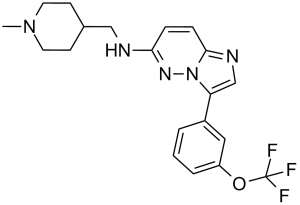
SGI-1776 is a novel, potent and ATP-competitive pan-inhibitor of the serine/threonine family of Pim kinase (an enzyme regulating cell survival) with potential antitumor activity. It inhibits Pim with an IC50 of 7 nM in a cell-free assay, and is 50- and 10-fold more selective for Pim2 and Pim3. Through extensive biomedical characterization, SGI-1776 exhibits specificity to the three isoforms of the Pim family, including Pim-1, Pim-2, and Pim-3. SGI-1776 was in phase I clinical trials for the treatment of refractory prostate cancer and non-Hodgkin's lymphoma. However, the study was terminated in November 2010.
Physicochemical Properties
| Molecular Formula | C20H22F3N5O | |
| Molecular Weight | 405.42 | |
| Exact Mass | 405.177 | |
| CAS # | 1025065-69-3 | |
| Related CAS # |
|
|
| PubChem CID | 24795070 | |
| Appearance | White to yellow solid powder | |
| Density | 1.4±0.1 g/cm3 | |
| Index of Refraction | 1.613 | |
| LogP | 3.36 | |
| Hydrogen Bond Donor Count | 1 | |
| Hydrogen Bond Acceptor Count | 8 | |
| Rotatable Bond Count | 5 | |
| Heavy Atom Count | 29 | |
| Complexity | 529 | |
| Defined Atom Stereocenter Count | 0 | |
| InChi Key | SXLKQFDJPFXMGV-UHFFFAOYSA-N | |
| InChi Code | InChI=1S/C20H22F3N5O/c1-27-10-8-14(9-11-27)12-24-18-6-7-19-25-13-17(28(19)26-18)15-2-4-16(5-3-15)29-20(21,22)23/h2-7,13-14H,8-12H2,1H3,(H,24,26) | |
| Chemical Name | N-((1-methylpiperidin-4-yl)methyl)-3-(4-(trifluoromethoxy)phenyl)imidazo[1,2-b]pyridazin-6-amine. | |
| Synonyms | SGI1776; SGI-1776; SGI 1776. | |
| HS Tariff Code | 2934.99.9001 | |
| Storage |
Powder-20°C 3 years 4°C 2 years In solvent -80°C 6 months -20°C 1 month |
|
| Shipping Condition | Room temperature (This product is stable at ambient temperature for a few days during ordinary shipping and time spent in Customs) |
Biological Activity
| ln Vitro | In SACC cells, Pim-1 kinase activity and Pim-1 protein expression are inhibited by SGI-1776 free base (2.5, 5 μM). In SACC-83 and SACC-LM cells, SGI-1776 free base (2.5, 5 μM) triggers cell cycle arrest and decreases cell growth [1]. SACC-83 and SACC-LM cells' ability to migrate and invade is inhibited by SGI-1776 free base (5 μM) [1]. Caspase-3 is activated by SGI-1776 free base (0, 2.5, or 5 μM), which causes apoptosis [1]. Adipocyte count is unaffected by the inhibition of TG production and lipid accumulation by SGI-1776 free base (5 µM) [2]. Adipogenesis is inhibited by SGI-1776 free base (5 µM), particularly in the early phases of differentiation. SGI-1776 free base (5 µM) downregulates FAS, leptin, and RANTES during adipocyte development and decreases the expression of C/EBP-α and PPAR-γ as well as the phosphorylation level of STAT-3. Adipocytes express distinct proteins and/or mRNAs [2]. With an IC50 of (5.2±0.6) µM, the free base of SGI-1776 exhibited notable dose-dependent action on HO-8910 cells. In vitro, SGI-1776 free base's inhibitory action rose noticeably from 1.25 µM to 20 µM[3]. The HO-8910 cells' migration and invasion are inhibited by SGI-1776 free base in a dose-dependent manner, with the rate of inhibition peaking at 5 μM [3]. In HO-8910 cells, SGI-1776 free base (2.5, 5 and 10 µM) dose-dependently decreases Pim-1 kinase activity. Furthermore, SGI-1776 free base dramatically reduces cell viability, halting cells in the G1 phase and preventing migration and invasion in addition to downregulating Pim-1 expression [3]. | ||
| ln Vivo | SGI-1776 free base (75, 200 mg/kg, oral) showed dose-dependent, strong antitumor activity in a mouse MV-4-11 xenograft model [4]. | ||
| Animal Protocol |
|
||
| References |
[1]. Biochemical changes of salivary gland adenoid cystic carcinoma cells induced by SGI-1776. Exp Cell Res. 2017 Mar 15;352(2):403-411. [2]. The novel anti-adipogenic effect and mechanisms of action of SGI-1776, a Pim-specific inhibitor, in 3T3-L1 adipocytes. Int J Mol Med. 2016 Jan;37(1):157-64. [3]. SGI-1776, an imidazo pyridazine compound, inhibits the proliferation of ovarian cancer cells by inactivating Pim-1. Zhong Nan Da Xue Xue Bao Yi Xue Ban. 2014 Jul;39(7):649-57. [4]. Mechanisms of cytotoxicity to Pim kinase inhibitor, SGI-1776, in acute myeloid leukemia. Blood, 2011, 118(3), 693-702. |
||
| Additional Infomation |
N-[(1-methyl-4-piperidinyl)methyl]-3-[3-(trifluoromethoxy)phenyl]-6-imidazo[1,2-b]pyridazinamine is a member of imidazoles. SGI-1776 has been used in trials studying the treatment of Prostate Cancer, Non-Hodgkins Lymphoma, and Relapsed/Refractory Leukemias. PIM Kinase Inhibitor SGI-1776 is a small-molecule pan-PIM protein kinase inhibitor with potential antineoplastic activity. PIM kinase inhibitor SGI-1776 binds to and inhibits the activities of PIM-1, -2 and -3 serine/threonine kinases, which may result in the interruption of the G1/S phase cell cycle transition, the expression of pro-apoptotic Bcl2 proteins and tumor cell apoptosis. PIM kinases play key roles in cell cycle progression and apoptosis inhibition and may be overexpressed in various malignancies. |
Solubility Data
| Solubility (In Vitro) |
|
|||
| Solubility (In Vivo) |
Solubility in Formulation 1: ≥ 2.08 mg/mL (5.13 mM) (saturation unknown) in 10% DMSO + 40% PEG300 + 5% Tween80 + 45% Saline (add these co-solvents sequentially from left to right, and one by one), clear solution. For example, if 1 mL of working solution is to be prepared, you can add 100 μL of 20.8 mg/mL clear DMSO stock solution to 400 μL PEG300 and mix evenly; then add 50 μL Tween-80 to the above solution and mix evenly; then add 450 μL normal saline to adjust the volume to 1 mL. Preparation of saline: Dissolve 0.9 g of sodium chloride in 100 mL ddH₂ O to obtain a clear solution. Solubility in Formulation 2: ≥ 2.08 mg/mL (5.13 mM) (saturation unknown) in 10% DMSO + 90% (20% SBE-β-CD in Saline) (add these co-solvents sequentially from left to right, and one by one), clear solution. For example, if 1 mL of working solution is to be prepared, you can add 100 μL of 20.8 mg/mL clear DMSO stock solution to 900 μL of 20% SBE-β-CD physiological saline solution and mix evenly. Preparation of 20% SBE-β-CD in Saline (4°C,1 week): Dissolve 2 g SBE-β-CD in 10 mL saline to obtain a clear solution. Solubility in Formulation 3: ≥ 2.08 mg/mL (5.13 mM) (saturation unknown) in 10% DMSO + 90% Corn Oil (add these co-solvents sequentially from left to right, and one by one), clear solution. For example, if 1 mL of working solution is to be prepared, you can add 100 μL of 20.8 mg/mL clear DMSO stock solution to 900 μL of corn oil and mix evenly. Solubility in Formulation 4: 30% propylene glycol, 5% Tween 80, 65% D5W:30mg/mL (Please use freshly prepared in vivo formulations for optimal results.) |
| Preparing Stock Solutions | 1 mg | 5 mg | 10 mg | |
| 1 mM | 2.4666 mL | 12.3329 mL | 24.6658 mL | |
| 5 mM | 0.4933 mL | 2.4666 mL | 4.9332 mL | |
| 10 mM | 0.2467 mL | 1.2333 mL | 2.4666 mL |