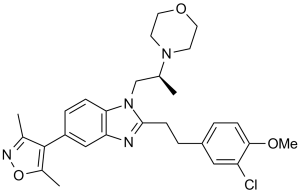
SGC-CBP30 is a novel, potent and selective inhibitor of CREBBP (CBP/KAT3A) and its paralogue EP300 (KAT3B) with the potential to be used in neurodegenerative diseases (e.g. Alzheimer's disease). CREBBP/EP300 are the lysine acetyltransferases (KATs) that are essential for human development. It inhibits CREBBP and EP300 bromodomains with IC50s of 21 nM and 38 nM in cell-free assays, respectively. CREBBP (CBP) and EP300 are general transcriptional co-activators. CREBBP has also been associated with Amyotrophic Lateral Sclerosis (ALS) or Lou GehrigÂ’s disease, a neurodegenerative disease with progressive degeneration of motor neurons in the brain and spinal cord, Alzheimer's disease and poly glutamine repeat diseases such as Spinal and Bulbar Muscular Atrophy and HuntingtonÂ's disease.
Physicochemical Properties
| Molecular Formula | C28H33CLN4O3 | |
| Molecular Weight | 509.04 | |
| Exact Mass | 508.224 | |
| CAS # | 1613695-14-9 | |
| Related CAS # |
|
|
| PubChem CID | 72201027 | |
| Appearance | Off-white to yellow solid powder | |
| Density | 1.3±0.1 g/cm3 | |
| Boiling Point | 678.0±55.0 °C at 760 mmHg | |
| Flash Point | 363.8±31.5 °C | |
| Vapour Pressure | 0.0±2.1 mmHg at 25°C | |
| Index of Refraction | 1.629 | |
| LogP | 5.29 | |
| Hydrogen Bond Donor Count | 0 | |
| Hydrogen Bond Acceptor Count | 6 | |
| Rotatable Bond Count | 8 | |
| Heavy Atom Count | 36 | |
| Complexity | 698 | |
| Defined Atom Stereocenter Count | 1 | |
| SMILES | CC1=C(C(=NO1)C)C2=CC3=C(C=C2)N(C(=N3)CCC4=CC(=C(C=C4)OC)Cl)C[C@H](C)N5CCOCC5 |
|
| InChi Key | GEPYBHCJBORHCE-SFHVURJKSA-N | |
| InChi Code | InChI=1S/C28H33ClN4O3/c1-18(32-11-13-35-14-12-32)17-33-25-8-7-22(28-19(2)31-36-20(28)3)16-24(25)30-27(33)10-6-21-5-9-26(34-4)23(29)15-21/h5,7-9,15-16,18H,6,10-14,17H2,1-4H3/t18-/m0/s1 | |
| Chemical Name | (S)-4-(1-(2-(3-chloro-4-methoxyphenethyl)-5-(3,5-dimethylisoxazol-4-yl)-1H-benzo[d]imidazol-1-yl)propan-2-yl)morpholine | |
| Synonyms | SGC-CBP 30; SGC-CBP-30; SGC-CBP30. | |
| HS Tariff Code | 2934.99.9001 | |
| Storage |
Powder-20°C 3 years 4°C 2 years In solvent -80°C 6 months -20°C 1 month |
|
| Shipping Condition | Room temperature (This product is stable at ambient temperature for a few days during ordinary shipping and time spent in Customs) |
Biological Activity
| ln Vitro | In ankylosing spondylitis and psoriatic arthritis situations, SGC-CBP30 suppresses IL-17A release by Th17 cells. Transcriptional profiling of human T cells following SGC-CBP30 treatment demonstrated more restricted effects on gene expression than that reported with the pan-BET (bromodomain and ecto-terminal protein family) bromodomain inhibitor JQ1[1] . |
| ln Vivo | Treatment with SGC-CBP30 somewhat reduced the alveolar bronchial fibrosis caused by NSC-125066. Alveolar bronchial fibrosis is greatly reduced by SGC-CBP30 with CQ-061. The combination of SGC-CBP30 0 and CQ-061 suppressed the activation of IL-4 and IFN-γ in the NSC-125066-induced IPF mouse model to near normal levels, according to an ELISA of the cytokines IL-4 and IFN-γ in BALF [2]. |
| Animal Protocol |
Animal/Disease Models: SD (Sprague-Dawley) rats (aged 3-4 weeks) injected with NSC-125066[2] Doses: 25 mg/kg Route of Administration: Oral administration; daily; for 14 days Experimental Results: Slightly alleviated alveolar bronchial fibrosis induced by NSC-125066. |
| References |
[1]. CBP30, a selective CBP/p300 bromodomain inhibitor, suppresses human Th17 responses. Proc Natl Acad Sci U S A. 2015 Aug 25;112(34):10768-73. [2]. Tao J, Inhibition of EP300 and DDR1 synergistically alleviates pulmonary fibrosis in vitro and in vivo. Biomed Pharmacother. 2018 Oct;106:1727-1733. [3]. Discovery and optimization of small-molecule ligands for the CBP/p300 bromodomains. J Am Chem Soc. 2014 Jul 2;136(26):9308-19. |
Solubility Data
| Solubility (In Vitro) |
|
|||
| Solubility (In Vivo) |
Solubility in Formulation 1: ≥ 2.5 mg/mL (4.91 mM) (saturation unknown) in 10% DMSO + 40% PEG300 + 5% Tween80 + 45% Saline (add these co-solvents sequentially from left to right, and one by one), clear solution. For example, if 1 mL of working solution is to be prepared, you can add 100 μL of 25.0 mg/mL clear DMSO stock solution to 400 μL PEG300 and mix evenly; then add 50 μL Tween-80 to the above solution and mix evenly; then add 450 μL normal saline to adjust the volume to 1 mL. Preparation of saline: Dissolve 0.9 g of sodium chloride in 100 mL ddH₂ O to obtain a clear solution. Solubility in Formulation 2: ≥ 2.5 mg/mL (4.91 mM) (saturation unknown) in 10% DMSO + 90% Corn Oil (add these co-solvents sequentially from left to right, and one by one), clear solution. For example, if 1 mL of working solution is to be prepared, you can add 100 μL of 25.0 mg/mL clear DMSO stock solution to 900 μL of corn oil and mix evenly. Solubility in Formulation 3: 2% DMSO+30% PEG 300+5% Tween 80+ddH2O:5 mg/mL (Please use freshly prepared in vivo formulations for optimal results.) |
| Preparing Stock Solutions | 1 mg | 5 mg | 10 mg | |
| 1 mM | 1.9645 mL | 9.8224 mL | 19.6448 mL | |
| 5 mM | 0.3929 mL | 1.9645 mL | 3.9290 mL | |
| 10 mM | 0.1964 mL | 0.9822 mL | 1.9645 mL |