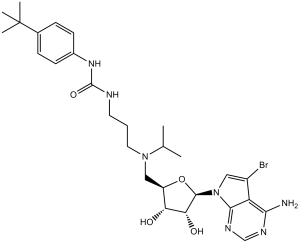
SGC 0946 (SGC-0946; SGC0946) is a potent and selective inhibitor of DOT1L (DOT1 Like Histone Lysine Methyltransferase) with antineoplastic activity. It inhibits DOT1L with an IC50 of 0.3 nM in a cell-free assay.
Physicochemical Properties
| Molecular Formula | C28H40BRN7O4 | |
| Molecular Weight | 618.57 | |
| Exact Mass | 617.232 | |
| CAS # | 1561178-17-3 | |
| Related CAS # |
|
|
| PubChem CID | 56962337 | |
| Appearance | White to yellow solid powder | |
| Density | 1.5±0.1 g/cm3 | |
| Boiling Point | 771.5±60.0 °C at 760 mmHg | |
| Flash Point | 420.4±32.9 °C | |
| Vapour Pressure | 0.0±2.8 mmHg at 25°C | |
| Index of Refraction | 1.662 | |
| LogP | 4.72 | |
| Hydrogen Bond Donor Count | 5 | |
| Hydrogen Bond Acceptor Count | 8 | |
| Rotatable Bond Count | 10 | |
| Heavy Atom Count | 40 | |
| Complexity | 825 | |
| Defined Atom Stereocenter Count | 4 | |
| SMILES | CC(C)N(CCCNC(=O)NC1=CC=C(C=C1)C(C)(C)C)C[C@@H]2[C@H]([C@H]([C@@H](O2)N3C=C(C4=C(N=CN=C43)N)Br)O)O |
|
| InChi Key | UZLAJVZJBSZSJL-VBHAUSMQSA-N | |
| InChi Code | InChI=1S/C28H40BrN7O4/c1-16(2)12-18-6-8-19(9-7-18)34-28(39)31-10-5-11-35(17(3)4)14-21-23(37)24(38)27(40-21)36-13-20(29)22-25(30)32-15-33-26(22)36/h6-9,13,15-17,21,23-24,27,37-38H,5,10-12,14H2,1-4H3,(H2,30,32,33)(H2,31,34,39)/t21-,23-,24-,27-/m1/s1 | |
| Chemical Name | 1-(3-((((2R,3S,4R,5R)-5-(4-amino-5-bromo-7H-pyrrolo[2,3-d]pyrimidin-7-yl)-3,4-dihydroxytetrahydrofuran-2-yl)methyl)(isopropyl)amino)propyl)-3-(4-isobutylphenyl)urea | |
| Synonyms |
|
|
| HS Tariff Code | 2934.99.9001 | |
| Storage |
Powder-20°C 3 years 4°C 2 years In solvent -80°C 6 months -20°C 1 month |
|
| Shipping Condition | Room temperature (This product is stable at ambient temperature for a few days during ordinary shipping and time spent in Customs) |
Biological Activity
| ln Vitro | In A431 cells, SGC0946 (0-100 μM; 4 days) inhibits DOT1L with an IC50 of 2.65 nM[1]. In an experimental leukaemia model produced from human cord blood cells (transformed with the MLL-AF9 fusion oncogene), SGC0946 (1, 5 μM; 14 days) exhibits selective loss of cell viability[1]. SGC0946 (1 μM; 3-7 days) displays time- and dose-dependent decreases in the H3K79me2 mark in the Molm13 MLL cell line that possesses the MLL/ AF9 translocation[1]. SGC0946 (1 μM, 7 days) efficiently inhibits MLL target genes, HOXA9 and Meis1[1]. SGC0946 (0.2, 2, or 20 μM; 12 days) lowers proliferation and survival of ovarian cancer cells by reducing DOT1L enzymatic activity[2]. SGC0946 (10 μM; 12 days) promotes G1 phase arrest by inhibiting DOT1L in SK-OV-3 and TOV21G cells[2]. |
| ln Vivo | SGC0946 (10 mg/kg; ip; twice weekly for 6 weeks) inhibits DOT1L enzymatic activity, H3K79me2, CDK6, and cyclin D3 levels in the tumors, and significantly slows the progression of tumors in a mouse orthotopic xenograft ovarian cancer model[2]. |
| Cell Assay |
Cell Viability Assay[1] Cell Types: A431 cells Tested Concentrations: 0-100 µM Incubation Duration: 4 days Experimental Results: demonstrated potent inhibitory activity against DOT1L with IC50 of 2.65 nM in A431 cells. Cell Viability Assay[1] Cell Types: Human cord blood cells (transformed with the MLL-AF9 fusion oncogene). Tested Concentrations: 1, 5 µM Incubation Duration: 14 days Experimental Results: Killed human cord blood cells transformed with an MLL-AF9 fusion oncogene. Western Blot Analysis[1] Cell Types: Molm13 MLL cells Tested Concentrations: 1 µM Incubation Duration: 3-7 days Experimental Results: decreased H3K79me2 in Molm13 MLL cells in a time- and dose-dependent manner, and a complete inhibition demonstrated at day 7. Cell Proliferation Assay[2] Cell Types: SK-OV-3 and TOV21G cells Tested Concentrations: 0.2, 2, or 20 μM Incubation Duration: 12 days Experimental Results: Inhibited the growth of both SK-OV-3 and TOV21G cells in a dose- and time-dependent manner. decreased the colony of both SK-OV-3 and TOV21G cells. Cell Cycle Analysis[2] Cell Types: SK-OV-3 and TOV21G cells Tested Concentrations: 1 |
| Animal Protocol |
Animal/Disease Models: Female NOD-SCID (severe combined immunodeficient) mouse (4weeks old; mouse orthotopic xenograft ovarian cancer model)[2]. Doses: 10 mg/kg Route of Administration: intraperitoneal (ip)injection; twice a week for 6 weeks. Experimental Results: Dramatically suppressed growth of tumor (size and weight of tumor masses smaller than the untreated group). Inhibited DOT1L enzymatic activity and diminished H3K79me2, CDK6, and cyclin D3 levels in the tumors. |
| References |
[1]. Catalytic site remodelling of the DOT1L methyltransferase by selective inhibitors. Nat Commun. 2012;3:1288. [2]. Prognostic and therapeutic value of disruptor of telomeric silencing-1-like (DOT1L) expression in patients with ovarian cancer. J Hematol Oncol. 2017 Jan 23;10(1):29. [3]. Inhibition of histone H3K79 methylation selectively inhibits proliferation, self-renewal and metastatic potential of breast cancer. Oncotarget. 2014 Nov 15;5(21):10665-77. |
Solubility Data
| Solubility (In Vitro) |
|
|||
| Solubility (In Vivo) |
Solubility in Formulation 1: ≥ 2.08 mg/mL (3.36 mM) (saturation unknown) in 10% DMSO + 40% PEG300 + 5% Tween80 + 45% Saline (add these co-solvents sequentially from left to right, and one by one), clear solution. For example, if 1 mL of working solution is to be prepared, you can add 100 μL of 20.8 mg/mL clear DMSO stock solution to 400 μL PEG300 and mix evenly; then add 50 μL Tween-80 to the above solution and mix evenly; then add 450 μL normal saline to adjust the volume to 1 mL. Preparation of saline: Dissolve 0.9 g of sodium chloride in 100 mL ddH₂ O to obtain a clear solution. Solubility in Formulation 2: ≥ 2.08 mg/mL (3.36 mM) (saturation unknown) in 10% DMSO + 90% (20% SBE-β-CD in Saline) (add these co-solvents sequentially from left to right, and one by one), clear solution. For example, if 1 mL of working solution is to be prepared, you can add 100 μL of 20.8 mg/mL clear DMSO stock solution to 900 μL of 20% SBE-β-CD physiological saline solution and mix evenly. Preparation of 20% SBE-β-CD in Saline (4°C,1 week): Dissolve 2 g SBE-β-CD in 10 mL saline to obtain a clear solution. Solubility in Formulation 3: ≥ 2.08 mg/mL (3.36 mM) (saturation unknown) in 10% DMSO + 90% Corn Oil (add these co-solvents sequentially from left to right, and one by one), clear solution. For example, if 1 mL of working solution is to be prepared, you can add 100 μL of 20.8 mg/mL clear DMSO stock solution to 900 μL of corn oil and mix evenly. (Please use freshly prepared in vivo formulations for optimal results.) |
| Preparing Stock Solutions | 1 mg | 5 mg | 10 mg | |
| 1 mM | 1.6166 mL | 8.0832 mL | 16.1663 mL | |
| 5 mM | 0.3233 mL | 1.6166 mL | 3.2333 mL | |
| 10 mM | 0.1617 mL | 0.8083 mL | 1.6166 mL |