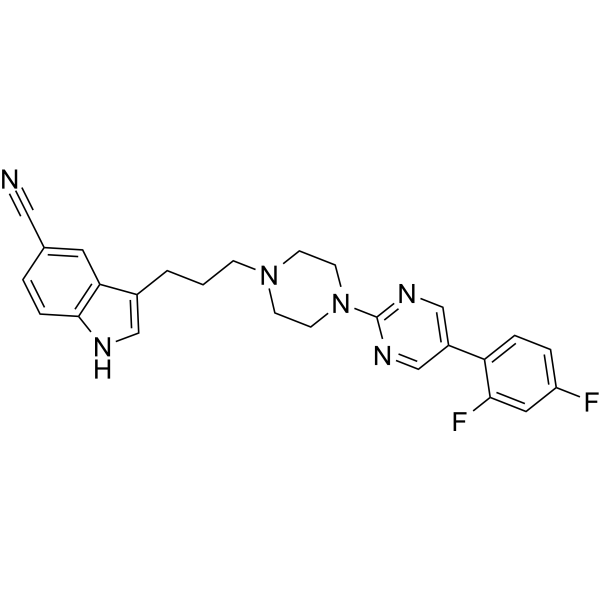
Physicochemical Properties
| Molecular Formula | C26H24F2N6 |
| Molecular Weight | 458.505771636963 |
| Exact Mass | 458.203 |
| CAS # | 2055228-33-4 |
| PubChem CID | 124121272 |
| Appearance | White to off-white solid powder |
| LogP | 4.5 |
| Hydrogen Bond Donor Count | 1 |
| Hydrogen Bond Acceptor Count | 7 |
| Rotatable Bond Count | 6 |
| Heavy Atom Count | 34 |
| Complexity | 699 |
| Defined Atom Stereocenter Count | 0 |
| SMILES | N1C2=C(C=C(C#N)C=C2)C(CCCN2CCN(C3=NC=C(C4=CC=C(F)C=C4F)C=N3)CC2)=C1 |
| InChi Key | MONCKXMZFAXBAZ-UHFFFAOYSA-N |
| InChi Code | InChI=1S/C26H24F2N6/c27-21-4-5-22(24(28)13-21)20-16-31-26(32-17-20)34-10-8-33(9-11-34)7-1-2-19-15-30-25-6-3-18(14-29)12-23(19)25/h3-6,12-13,15-17,30H,1-2,7-11H2 |
| Chemical Name | 3-[3-[4-[5-(2,4-difluorophenyl)pyrimidin-2-yl]piperazin-1-yl]propyl]-1H-indole-5-carbonitrile |
| HS Tariff Code | 2934.99.9001 |
| Storage |
Powder-20°C 3 years 4°C 2 years In solvent -80°C 6 months -20°C 1 month |
| Shipping Condition | Room temperature (This product is stable at ambient temperature for a few days during ordinary shipping and time spent in Customs) |
Biological Activity
| Targets | IC50: 0.58 nM (SERT)[1] |
| ln Vivo | In rats and dogs, SERT-IN-2 (DH4) (2.5 mg/kg, 5 mg/kg; intravenous or oral; single dosage) has high oral bioavailability and plasma exposure [1]. The blood-brain barrier can be crossed by SERT-IN-2 (10 mg/kg; intraperitoneal injection; single dosage) in SD rats [1]. In the rat hypothalamus, SERT-IN-2 (1–10 mg/kg; i.p.; single dosage) effectively counteracts p-chloroamphetamine (PCA)-induced serotonin depletion by inhibiting serotonin uptake [1]. Rats treated with SERT-IN-2 (1–10 mg/kg; intravenous injection; three times prior to the test) exhibit antidepressant effects, and the number of immobilities in the forced swim test (FST) decreases dose-dependently [1]. Pharmacokinetic analysis[1] Rat IV 1 193 1340 7.53 6.41 11.6 / PO 2.5 180 2790 7.28 / 83.28 Dog IV 1 520 2820 4.39 3.4 5.14 / PO 5 794 7540 16.4 / / 53.5 Route Dose (mg/kg) Cmax (ng/mL) AUC(0-t) (ng·h/mL) T1/2 (h) Vss (L/kg) Cl (L/h/kg) F (%) |
| References |
[1]. Deciphering Nonbioavailable Substructures Improves the Bioavailability of Antidepressants by Serotonin Transporter. J Med Chem. 2023 Jan 12;66(1):371-383. |
Solubility Data
| Solubility (In Vitro) | DMSO: 200 mg/mL (436.20 mM) |
| Solubility (In Vivo) |
Solubility in Formulation 1: ≥ 5 mg/mL (10.90 mM) (saturation unknown) in 10% DMSO + 40% PEG300 + 5% Tween80 + 45% Saline (add these co-solvents sequentially from left to right, and one by one), clear solution. For example, if 1 mL of working solution is to be prepared, you can add 100 μL of 50.0 mg/mL clear DMSO stock solution to 400 μL PEG300 and mix evenly; then add 50 μL Tween-80 to the above solution and mix evenly; then add 450 μL normal saline to adjust the volume to 1 mL. Preparation of saline: Dissolve 0.9 g of sodium chloride in 100 mL ddH₂ O to obtain a clear solution. Solubility in Formulation 2: ≥ 5 mg/mL (10.90 mM) (saturation unknown) in 10% DMSO + 90% Corn Oil (add these co-solvents sequentially from left to right, and one by one), clear solution. For example, if 1 mL of working solution is to be prepared, you can add 100 μL of 50.0 mg/mL clear DMSO stock solution to 900 μL of corn oil and mix evenly. (Please use freshly prepared in vivo formulations for optimal results.) |
| Preparing Stock Solutions | 1 mg | 5 mg | 10 mg | |
| 1 mM | 2.1810 mL | 10.9049 mL | 21.8098 mL | |
| 5 mM | 0.4362 mL | 2.1810 mL | 4.3620 mL | |
| 10 mM | 0.2181 mL | 1.0905 mL | 2.1810 mL |