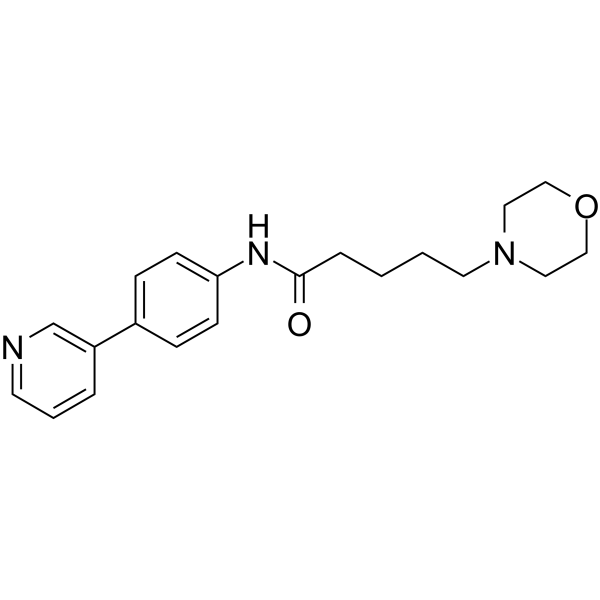
SEN 12333(also known as WAY-31753), is a novel,potent and selective agonist of the alpha(7) nAChR (EC50 = 1.6 μM, Ki = 260 nM at rat α7 nAChRs).
Physicochemical Properties
| Molecular Formula | C20H25N3O2 |
| Molecular Weight | 339.439 |
| Exact Mass | 339.195 |
| Elemental Analysis | C, 70.77; H, 7.42; N, 12.38; O, 9.43 |
| CAS # | 874450-44-9 |
| PubChem CID | 45484303 |
| Appearance | White to light yellow solid powder |
| LogP | 3.2 |
| Hydrogen Bond Donor Count | 1 |
| Hydrogen Bond Acceptor Count | 4 |
| Rotatable Bond Count | 7 |
| Heavy Atom Count | 25 |
| Complexity | 390 |
| Defined Atom Stereocenter Count | 0 |
| SMILES | O=C(CCCCN1CCOCC1)NC1C=CC(C2C=CC=NC=2)=CC=1 |
| InChi Key | XCHIZTUBUXZESJ-UHFFFAOYSA-N |
| InChi Code | InChI=1S/C20H25N3O2/c24-20(5-1-2-11-23-12-14-25-15-13-23)22-19-8-6-17(7-9-19)18-4-3-10-21-16-18/h3-4,6-10,16H,1-2,5,11-15H2,(H,22,24) |
| Chemical Name | N-[4-(3-pyridinyl)phenyl]-4-morpholinepentanamide |
| Synonyms | WAY31753 WAY-31753 WAY 31753 SEN-12333SEN 12333 SEN12333 |
| HS Tariff Code | 2934.99.9001 |
| Storage |
Powder-20°C 3 years 4°C 2 years In solvent -80°C 6 months -20°C 1 month |
| Shipping Condition | Room temperature (This product is stable at ambient temperature for a few days during ordinary shipping and time spent in Customs) |
Biological Activity
| Targets |
α7 nicotinic acetylcholine receptor (α7 nAChR) (Ki: 1.8 nM for human α7 nAChR binding; EC50: 3.2 nM for rat α7 nAChR-mediated calcium influx) [2] - No significant binding to other nAChR subtypes (α4β2, α3β4, α1βγδ) with Ki > 1000 nM [2] |
| ln Vitro |
Similar to acetylcholine (EC50= 12 μM), SEN12333 activated peak currents and maximum total charge in whole-cell patch-clamp recordings. SEN12333 demonstrates a weak agonist activity (IC50=8.5 μM) on human ganglion α3 nAChR and a functional antagonistic effect (IC50=103 nM) on histamine H3 receptors [1]. α7 nAChR binding and activation SEN-12333 showed high affinity for human and rat α7 nAChR. In radioligand binding assays, it displaced [³H]-α-bungarotoxin with a Ki of 1.8 nM (human) and 2.5 nM (rat). In calcium influx assays using SH-SY5Y cells expressing rat α7 nAChR, it induced dose-dependent calcium mobilization with an EC50 of 3.2 nM, and the maximum response was 85% of the full agonist acetylcholine [2] - Neuroprotective activity against amyloid-β (Aβ) toxicity In primary rat cortical neurons treated with Aβ₁₋₄₂ (20 μM) to induce neurotoxicity, SEN-12333 (0.1–10 nM) dose-dependently increased cell viability. At 1 nM, it improved cell survival by 47% (MTT assay) and reduced lactate dehydrogenase (LDH) release by 42% compared to Aβ-treated controls. It also inhibited Aβ-induced caspase-3 activation (reduced by 53% at 1 nM) and reactive oxygen species (ROS) production (reduced by 49% at 1 nM) [2] - Modulation of neurotrophic factor expression Treatment of primary rat hippocampal neurons with SEN-12333 (0.5–5 nM) for 24 hours upregulated mRNA expression of brain-derived neurotrophic factor (BDNF) by 2.3-fold (5 nM) and nerve growth factor (NGF) by 1.8-fold (5 nM) (qPCR analysis). Western blot confirmed increased BDNF and NGF protein levels by 2.1-fold and 1.7-fold respectively at 5 nM [2] |
| ln Vivo |
In the setting of spontaneous amnesia and cognitive interference induced by glutamatergic or cholinergic mechanisms, SEN12333 (ip; 3 mg/kg) enhances episodic memory in rats in a novel object recognition task. Additionally, SEN12333 stops deficits in passive avoidance tasks caused by scopolamine [1]. Procognitive activity in scopolamine-induced amnesia mice Male ICR mice were intraperitoneally (i.p.) injected with scopolamine (1 mg/kg) to induce cognitive impairment, followed by SEN-12333 (0.1, 0.3, 1 mg/kg, i.p.) 30 minutes later. In the Morris water maze test, the 1 mg/kg dose significantly reduced escape latency by 58% (training days 3–5) and increased time spent in the target quadrant by 63% (probe test) compared to scopolamine alone. In the passive avoidance test, it prolonged step-through latency by 2.7-fold (1 mg/kg) [2] - Neuroprotective activity in Aβ₁₋₄₂-infused rat model Rats were intracerebroventricularly (i.c.v.) infused with Aβ₁₋₄₂ (10 μg) to induce neurodegeneration, then treated with SEN-12333 (0.3 mg/kg, oral gavage) once daily for 21 days. The treatment reduced hippocampal neuronal loss by 56% (Nissl staining) and increased BDNF protein levels by 2.4-fold in the hippocampus. It also improved spatial memory in the radial arm maze test (reduced working memory errors by 61%) [2] - Anti-inflammatory activity in CNS In Aβ-infused rats, SEN-12333 (0.3 mg/kg, oral) reduced hippocampal levels of pro-inflammatory cytokines TNF-α by 58% and IL-6 by 53% (ELISA). Immunohistochemistry showed decreased microglial activation (Iba-1-positive cells reduced by 51%) and astrocytosis (GFAP-positive cells reduced by 46%) in the hippocampus [2] |
| Enzyme Assay |
α7 nAChR radioligand binding assay Membrane preparations from human/rat brain tissues or SH-SY5Y cells expressing α7 nAChR were incubated with SEN-12333 (0.001–100 nM) and [³H]-α-bungarotoxin (a selective α7 nAChR ligand) at 25°C for 90 minutes. Unbound ligand was removed by filtration, and radioactivity of the bound fraction was measured with a scintillation counter. Ki values were calculated from competition binding curves [2] - Calcium influx assay for α7 nAChR activation SH-SY5Y cells stably expressing rat α7 nAChR were loaded with a calcium-sensitive fluorescent dye for 30 minutes at 37°C. SEN-12333 (0.001–100 nM) was added, and fluorescent intensity was measured in real-time to monitor calcium mobilization. EC50 values were derived from dose-response curves of peak fluorescence intensity [2] - nAChR subtype selectivity assay Membrane preparations expressing other nAChR subtypes (α4β2, α3β4, α1βγδ) were used in radioligand binding assays with subtype-specific [³H]-ligands. SEN-12333 (1 μM) was tested for displacement of the ligands, and selectivity was determined by comparing Ki values across subtypes [2] |
| Cell Assay |
Aβ-induced neurotoxicity protection assay Primary rat cortical neurons were isolated and seeded in 96-well plates (1×10⁴ cells/well) and cultured for 7 days. Cells were pretreated with SEN-12333 (0.1–10 nM) for 2 hours, then exposed to Aβ₁₋₄₂ (20 μM) for 24 hours. Cell viability was measured by MTT assay, LDH release by colorimetric assay, ROS production by DCFH-DA staining, and caspase-3 activity by fluorometric assay [2] - Neurotrophic factor expression assay Primary rat hippocampal neurons were seeded in 6-well plates (5×10⁵ cells/well) and cultured for 5 days. SEN-12333 (0.5–5 nM) was added, and cells were incubated for 24 hours. Total RNA was extracted for qPCR analysis of BDNF and NGF mRNA expression. For western blot, cells were lysed, proteins separated by SDS-PAGE, and probed with BDNF, NGF, and β-actin antibodies [2] |
| Animal Protocol |
Scopolamine-induced amnesia mouse model Male ICR mice (20–25 g, 6–8 weeks old) were acclimated for 7 days. Scopolamine (1 mg/kg) was injected i.p. to induce amnesia. SEN-12333 was dissolved in saline and administered i.p. at 0.1, 0.3, 1 mg/kg 30 minutes after scopolamine. The Morris water maze test was conducted over 5 training days (escape latency measured) and a probe test (time in target quadrant measured). The passive avoidance test was performed 24 hours after training (step-through latency measured) [2] - Aβ₁₋₄₂-infused rat model Male Sprague-Dawley rats (250–300 g) were anesthetized and implanted with a cannula for i.c.v. infusion. Aβ₁₋₄₂ (10 μg in 5 μL saline) was infused over 5 minutes. Starting 3 days post-infusion, SEN-12333 (0.3 mg/kg) was suspended in 0.5% carboxymethylcellulose sodium (CMC-Na) and administered by oral gavage once daily for 21 days. The radial arm maze test was used to assess spatial memory. At study end, rats were euthanized, and hippocampal tissues were collected for Nissl staining, cytokine measurement, and western blot [2] |
| ADME/Pharmacokinetics |
Oral bioavailability:43% in rats (0.3 mg/kg oral dose) [2] - Plasma half-life (t1/2):5.3 hours in rats (oral); 4.8 hours in mice (i.p.) [2] - Brain penetration:Brain-to-plasma concentration ratio of 0.8 at 1 hour post-oral administration (0.3 mg/kg in rats), indicating effective CNS penetration [2] - Plasma protein binding rate:87.2% (in vitro human plasma) [2] - Metabolism:Minimally metabolized in the liver; main metabolite is a glucuronide conjugate (accounting for 32% of plasma radioactivity at 4 hours post-dose) [2] |
| Toxicity/Toxicokinetics |
Acute toxicity:No mortality or obvious toxic signs (convulsions, respiratory depression, motor impairment) in mice after single i.p. dose up to 30 mg/kg or rats after single oral dose up to 100 mg/kg [2] - Chronic toxicity:In 28-day repeat-dose study (rats: 0.1, 0.3, 1 mg/kg oral daily), no significant changes in body weight, hematological parameters, or liver/kidney function markers (ALT, AST, BUN, creatinine) were observed. Histological examination of brain, liver, kidney, heart, and lungs showed no drug-related lesions [2] - Nicotine-like side effects:No significant increase in locomotor activity or stereotyped behaviors (chewing, grooming) at therapeutic doses (0.1–1 mg/kg). It did not induce hypotension or bradycardia in anesthetized rats (0.3–3 mg/kg, i.v.) [2] |
| References |
[1]. The Recent Development of α7 Nicotinic Acetylcholine Receptor (nAChR) Ligands as Therapeutic Candidates for the Treatment of Central Nervous System (CNS) Diseases.Curr Pharm Des. 2016;22(14):2134-51. [2]. Procognitive and neuroprotective activity of a novel alpha7 nicotinic acetylcholine receptor agonist for treatment of neurodegenerative and cognitive disorders. J Pharmacol Exp Ther. 2009 May;329(2):459-68. |
| Additional Infomation |
Mechanism of action:SEN-12333 is a selective, partial agonist of α7 nAChR. It binds to α7 nAChR, inducing receptor activation and calcium influx, which triggers downstream signaling pathways (PI3K/Akt, MAPK/ERK) to promote neurotrophic factor expression (BDNF, NGF), inhibit apoptosis, reduce oxidative stress and neuroinflammation, thereby exerting neuroprotective and procognitive effects [2] - Therapeutic potential:Indicated for the treatment of central nervous system (CNS) diseases associated with cognitive impairment and neurodegeneration, including Alzheimer's disease, schizophrenia-related cognitive deficit, and age-related memory decline [1, 2] - Selectivity advantage:Highly selective for α7 nAChR over other nAChR subtypes and neurotransmitter receptors (e.g., muscarinic, dopamine, serotonin receptors), minimizing off-target effects such as cardiovascular or addictive liabilities [2] - Clinical development status:Classified as a therapeutic candidate for CNS disorders, with preclinical data supporting its efficacy and safety profile for further clinical evaluation [1] |
Solubility Data
| Solubility (In Vitro) | DMSO : ~100 mg/mL (~294.61 mM) |
| Solubility (In Vivo) |
Solubility in Formulation 1: ≥ 2.5 mg/mL (7.37 mM) (saturation unknown) in 10% DMSO + 40% PEG300 +5% Tween-80 + 45% Saline (add these co-solvents sequentially from left to right, and one by one), clear solution. For example, if 1 mL of working solution is to be prepared, you can add 100 μL of 25.0 mg/mL clear DMSO stock solution to 400 μL PEG300 and mix evenly; then add 50 μL Tween-80 + to the above solution and mix evenly; then add 450 μL normal saline to adjust the volume to 1 mL. Preparation of saline: Dissolve 0.9 g of sodium chloride in 100 mL ddH₂ O to obtain a clear solution. (Please use freshly prepared in vivo formulations for optimal results.) |
| Preparing Stock Solutions | 1 mg | 5 mg | 10 mg | |
| 1 mM | 2.9460 mL | 14.7301 mL | 29.4603 mL | |
| 5 mM | 0.5892 mL | 2.9460 mL | 5.8921 mL | |
| 10 mM | 0.2946 mL | 1.4730 mL | 2.9460 mL |