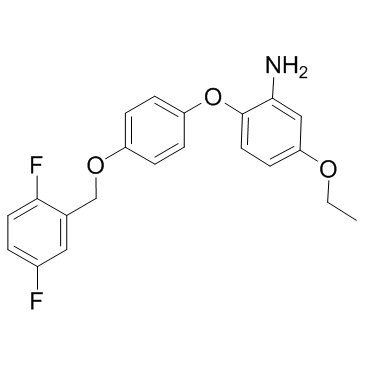
SEA0400 is a Na+/Ca2+ exchanger 1 inhibitor. SEA0400 prevents dopaminergic neurotoxicity in an MPTP mouse model of Parkinson's disease. SEA0400 reduces calcium overload induced by ischemia and reperfusion in mouse ventricular myocytes. SEA0400 attenuates sodium nitroprusside-induced apoptosis in cultured rat microglia.
Physicochemical Properties
| Molecular Formula | C21H19F2NO3 | |
| Molecular Weight | 371.13 | |
| Exact Mass | 371.133 | |
| CAS # | 223104-29-8 | |
| Related CAS # |
|
|
| PubChem CID | 644100 | |
| Appearance | White to khaki solid powder | |
| Density | 1.3±0.1 g/cm3 | |
| Boiling Point | 485.0±45.0 °C at 760 mmHg | |
| Flash Point | 247.1±28.7 °C | |
| Vapour Pressure | 0.0±1.2 mmHg at 25°C | |
| Index of Refraction | 1.587 | |
| LogP | 3.63 | |
| Hydrogen Bond Donor Count | 1 | |
| Hydrogen Bond Acceptor Count | 6 | |
| Rotatable Bond Count | 7 | |
| Heavy Atom Count | 27 | |
| Complexity | 434 | |
| Defined Atom Stereocenter Count | 0 | |
| InChi Key | YSUBLPUJDOWYDP-UHFFFAOYSA-N | |
| InChi Code | InChI=1S/C21H19F2NO3/c1-2-25-18-8-10-21(20(24)12-18)27-17-6-4-16(5-7-17)26-13-14-11-15(22)3-9-19(14)23/h3-12H,2,13,24H2,1H3 | |
| Chemical Name | 2-[4-[(2,5-difluorophenyl)methoxy]phenoxy]-5-ethoxyaniline | |
| Synonyms |
|
|
| HS Tariff Code | 2934.99.9001 | |
| Storage |
Powder-20°C 3 years 4°C 2 years In solvent -80°C 6 months -20°C 1 month |
|
| Shipping Condition | Room temperature (This product is stable at ambient temperature for a few days during ordinary shipping and time spent in Customs) |
Biological Activity
| Targets |
SEA0400 is a novel and selective inhibitor of the Na⁺-Ca²⁺ exchanger (NCX); no IC50, Ki, or EC50 values for this target were described in the literature. [1] SEA0400 specifically targets the Na⁺-Ca²⁺ exchanger (NCX) to exert neuroprotective effects; no IC50, Ki, or EC50 values for this target were described in the literature. [2][3] |
| ln Vitro |
SEA0400 prevents astrocytes, microglia, and cultured neurons from absorbing 45Ca2+ in a Na+-dependent manner. SEA0400's IC50 values for neurons, astrocytes, and microglia are 33 nM, 5.0 nM, and 8.3 nM, respectively[1]. In an extracellular Ca2+-dependent manner, SEA0400 inhibits the effects of sodium nitroprusside (SNP) on phosphorylation of ERK and p38 MAPK as well as the generation of reactive oxygen species (ROS)[2]. 1. Attenuation of cerebral ischemia-reperfusion injury in rat cortical neurons: [1] Primary rat cortical neurons were subjected to oxygen-glucose deprivation (OGD) for 60 minutes followed by reperfusion. Pretreatment with SEA0400 (1, 3, 10 μM) dose-dependently increased neuronal survival rate (assessed by MTT assay) and reduced lactate dehydrogenase (LDH) release (a marker of membrane damage). At 10 μM, SEA0400 significantly inhibited OGD/reperfusion-induced intracellular Ca²⁺ overload (measured by fura-2 AM fluorescence) and suppressed neuronal apoptosis (detected by Hoechst 33342 staining). 2. Protection against nitric oxide (NO)-induced cytotoxicity in SH-SY5Y cells: [2] SH-SY5Y cells were treated with the NO donor sodium nitroprusside (SNP, 1 mM) to induce cytotoxicity. Co-treatment with SEA0400 (0.1, 1, 10 μM) dose-dependently improved cell viability (MTT assay) and reduced apoptotic cell death (Annexin V-FITC/PI double staining). SEA0400 (10 μM) inhibited SNP-induced intracellular Ca²⁺ elevation (fura-2 AM fluorescence) and reactive oxygen species (ROS) overproduction (DCFH-DA fluorescence). It also reversed SNP-mediated downregulation of Bcl-2 and upregulation of Bax and Cleaved-Caspase 3 (Western blot analysis). 3. Inhibition of NCX activity in synaptic plasma membranes: [1] Synaptic plasma membranes were isolated from rat brain. SEA0400 (1-100 μM) dose-dependently inhibited Na⁺-dependent Ca²⁺ uptake (measured by radioactive ⁴⁵Ca²⁺ incorporation), confirming its direct inhibitory effect on NCX function. |
| ln Vivo |
In rats under anesthesia, SEA0400 (3 mg/kg + 3 mg/kg/h for 2 h, iv) reduces the infarct volume in the cerebral cortex and striatum but has no effect on the mean regional cortical blood flow[1]. When MPTP is administered to C57BL/6J mice, SEA0400 shields them from the dopaminergic neurotoxicity that is measured by motor deficits, tyrosine hydroxylase immunoreactivity in the substantia nigra and striatum, and dopamine levels in the midbrain and striatum[3]. 1. Attenuation of cerebral reperfusion injury in rat middle cerebral artery occlusion (MCAO) model: [1] - Male Wistar rats were subjected to MCAO for 90 minutes followed by reperfusion. - Intravenous injection of SEA0400 (0.3, 1, 3 mg/kg) 5 minutes before reperfusion dose-dependently reduced the infarct volume (assessed by TTC staining) at 24 hours post-reperfusion. The 3 mg/kg dose reduced infarct volume by approximately 40% compared to the vehicle group. - SEA0400 (3 mg/kg) also improved neurological deficit scores (evaluated by motor function tests) and reduced brain edema (measured by wet/dry weight ratio). - Mechanistically, SEA0400 inhibited post-reperfusion cerebral blood flow (CBF) reduction and suppressed Ca²⁺ accumulation in the ischemic cortex (measured by inductively coupled plasma atomic emission spectrometry). 2. Protection against dopaminergic neurotoxicity in MPTP-induced Parkinson's disease (PD) mouse model: [3] - Male C57BL/6 mice were treated with MPTP hydrochloride (20 mg/kg, intraperitoneal injection) once daily for 4 consecutive days to induce PD-like pathology. - Oral administration of SEA0400 (3, 10 mg/kg) once daily for 7 days (starting 1 day before MPTP injection) dose-dependently preserved tyrosine hydroxylase (TH)-positive neurons in the substantia nigra pars compacta (SNpc) (unbiased stereological counting) and TH-positive fiber density in the striatum (immunohistochemical staining). - SEA0400 (10 mg/kg) improved motor function deficits in MPTP-treated mice, as evidenced by increased locomotor activity (open field test) and reduced akinesia (cylinder test). - It also inhibited MPTP-induced microglial activation (Iba1 immunohistochemistry) and neuroinflammation (reduced TNF-α and IL-1β mRNA levels in the SNpc, detected by real-time PCR). |
| Enzyme Assay |
1. Na⁺-Ca²⁺ exchanger (NCX) activity assay using synaptic plasma membranes: [1] Synaptic plasma membranes were isolated from rat brain tissue via differential centrifugation. The assay buffer contained specified concentrations of Na⁺ and Ca²⁺, and radioactive ⁴⁵Ca²⁺ was used as a tracer. Different concentrations of SEA0400 were pre-incubated with the membrane preparations for 10 minutes at 37°C. The reaction was initiated by adding ⁴⁵Ca²⁺ and terminated after a specified time by adding an ice-cold stop buffer containing excess EGTA. The membranes were collected by filtration, and the radioactivity of the bound ⁴⁵Ca²⁺ was measured using a scintillation counter. The inhibitory rate of NCX activity was calculated based on the radioactivity values, and the dose-response curve was plotted to evaluate the inhibitory potency of SEA0400. |
| Cell Assay |
1. OGD/reperfusion-induced cortical neuron injury and protection assay: [1] Primary cortical neurons were isolated from embryonic rats and cultured for 7-10 days. Neurons were divided into control group, OGD/reperfusion group, and SEA0400 pretreatment group (1, 3, 10 μM). OGD was induced by incubating neurons in glucose-free medium under hypoxic conditions (5% CO₂, 95% N₂) for 60 minutes, followed by reperfusion in normal medium under normoxic conditions for 24 hours. After treatment, cell viability was measured by MTT assay; LDH release was detected using an LDH assay kit; intracellular Ca²⁺ concentration was determined by fura-2 AM fluorescence imaging; neuronal apoptosis was evaluated by Hoechst 33342 staining (observing nuclear condensation/fragmentation). 2. NO-induced SH-SY5Y cell injury and protection assay: [2] SH-SY5Y cells were seeded in multi-well plates and cultured to confluence. Cells were divided into control group, SNP-treated group (1 mM, 24 hours), and SEA0400 co-treatment group (0.1, 1, 10 μM). After incubation, cell viability was assessed by MTT assay; apoptotic cells were detected by Annexin V-FITC/PI double staining and flow cytometry; intracellular Ca²⁺ level was measured by fura-2 AM fluorescence; ROS production was detected by DCFH-DA fluorescence; protein expression levels of Bcl-2, Bax, and Cleaved-Caspase 3 were analyzed by Western blot. 3. NCX expression verification in neurons: [1] Cultured cortical neurons were fixed with paraformaldehyde, permeabilized with Triton X-100, and blocked with bovine serum albumin (BSA). Immunofluorescence staining was performed using a primary antibody against NCX and a fluorophore-conjugated secondary antibody. Nuclei were stained with DAPI. The expression and localization of NCX in neurons were observed under a fluorescence microscope to confirm the target presence. [1] |
| Animal Protocol |
1. Rat MCAO model of cerebral ischemia-reperfusion injury and drug administration: [1] - Animals: Male Wistar rats (250-300 g) were used. - MCAO model induction: Focal cerebral ischemia was induced by intraluminal occlusion of the middle cerebral artery using a nylon monofilament. After 90 minutes of occlusion, the monofilament was withdrawn to initiate reperfusion. - Drug administration: SEA0400 was dissolved in a suitable solvent (e.g., DMSO) and diluted with physiological saline. It was administered via intravenous injection at doses of 0.3, 1, or 3 mg/kg 5 minutes before reperfusion. The vehicle control group received the same volume of solvent. - Sample collection and detection: Rats were sacrificed 24 hours after reperfusion. Brains were removed for TTC staining to measure infarct volume; brain edema was assessed by wet/dry weight ratio; cerebral blood flow (CBF) was monitored using a laser Doppler flowmeter during ischemia and reperfusion; Ca²⁺ concentration in the ischemic cortex was determined by inductively coupled plasma atomic emission spectrometry; neurological deficit scores were evaluated using a standard scoring system (0-4 points, with higher scores indicating more severe deficits). 2. MPTP-induced PD mouse model and drug administration: [3] - Animals: Male C57BL/6 mice (8-10 weeks old) were used. - PD model induction: MPTP hydrochloride (20 mg/kg) was administered via intraperitoneal injection once daily for 4 consecutive days. - Drug administration: SEA0400 was suspended in a suitable vehicle (e.g., 0.5% carboxymethylcellulose sodium) and administered via oral gavage at doses of 3 or 10 mg/kg once daily for 7 days (starting 1 day before the first MPTP injection). The vehicle control group received the same volume of vehicle. - Sample collection and detection: Mice were sacrificed 7 days after the last MPTP injection. Brains were removed, and the SNpc and striatum were dissected. Immunohistochemical staining for TH was performed to quantify TH-positive neurons in the SNpc (unbiased stereology) and TH fiber density in the striatum; real-time PCR was used to detect TNF-α and IL-1β mRNA levels in the SNpc; motor function was evaluated by open field test (locomotor activity) and cylinder test (akinesia assessment) before sacrifice. [3] |
| References |
[1]. SEA0400, a novel and selective inhibitor of the Na+-Ca2+ exchanger, attenuates reperfusion injury in the in vitro and in vivo cerebral ischemic models. J Pharmacol Exp Ther. 2001 Jul;298(1):249-56. [2]. The specific Na(+)/Ca(2+) exchange inhibitor SEA0400 prevents nitric oxide-induced cytotoxicity in SH-SY5Y cells. Neurochem Int. 2011 Aug;59(1):51-8. [3]. SEA0400, a specific Na+/Ca2+ exchange inhibitor, prevents dopaminergic neurotoxicity in an MPTP mouse model of Parkinson's disease. Neuropharmacology. 2011 Dec;61(8):1441-51. |
| Additional Infomation |
1. Background: The Na⁺-Ca²⁺ exchanger (NCX) is a membrane protein that regulates intracellular Ca²⁺ homeostasis by mediating bidirectional Na⁺-Ca²⁺ exchange. Dysregulated NCX activity leads to intracellular Ca²⁺ overload, which is implicated in ischemia-reperfusion injury, neurodegenerative diseases (e.g., Parkinson's disease), and NO-induced cytotoxicity. [1][2][3] 2. Drug properties: SEA0400 is a novel, selective, and potent inhibitor of NCX, with no significant affinity for other ion channels (e.g., L-type Ca²⁺ channels, Na⁺ channels) or receptors at therapeutic concentrations. [1] 3. Mechanism of action: SEA0400 exerts neuroprotective effects by selectively inhibiting NCX activity, thereby preventing intracellular Ca²⁺ overload, reducing ROS production, suppressing apoptotic signaling pathways (e.g., Bcl-2/Bax/Caspase 3), and inhibiting neuroinflammation (reducing pro-inflammatory cytokine expression). [1][2][3] 4. Therapeutic potential: Preclinical studies demonstrate that SEA0400 has therapeutic potential for the treatment of cerebral ischemia-reperfusion injury, Parkinson's disease, and other neurodegenerative diseases associated with Ca²⁺ dyshomeostasis and neuroinflammation. [1][2][3] |
Solubility Data
| Solubility (In Vitro) |
|
|||
| Solubility (In Vivo) |
Solubility in Formulation 1: 2.5 mg/mL (6.73 mM) in 10% DMSO + 40% PEG300 + 5% Tween80 + 45% Saline (add these co-solvents sequentially from left to right, and one by one), suspension solution; with sonication. For example, if 1 mL of working solution is to be prepared, you can add 100 μL of 25.0 mg/mL clear DMSO stock solution to 400 μL PEG300 and mix evenly; then add 50 μL Tween-80 to the above solution and mix evenly; then add 450 μL normal saline to adjust the volume to 1 mL. Preparation of saline: Dissolve 0.9 g of sodium chloride in 100 mL ddH₂ O to obtain a clear solution. Solubility in Formulation 2: ≥ 2.5 mg/mL (6.73 mM) (saturation unknown) in 10% DMSO + 90% Corn Oil (add these co-solvents sequentially from left to right, and one by one), clear solution. For example, if 1 mL of working solution is to be prepared, you can add 100 μL of 25.0 mg/mL clear DMSO stock solution to 900 μL of corn oil and mix evenly. (Please use freshly prepared in vivo formulations for optimal results.) |
| Preparing Stock Solutions | 1 mg | 5 mg | 10 mg | |
| 1 mM | 2.6945 mL | 13.4724 mL | 26.9447 mL | |
| 5 mM | 0.5389 mL | 2.6945 mL | 5.3889 mL | |
| 10 mM | 0.2694 mL | 1.3472 mL | 2.6945 mL |