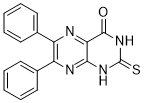
Physicochemical Properties
| Molecular Formula | C18H12N4OS |
| Molecular Weight | 332.38 |
| Exact Mass | 332.073 |
| Elemental Analysis | C, 65.05; H, 3.64; N, 16.86; O, 4.81; S, 9.65 |
| CAS # | 14892-97-8 |
| Related CAS # | 14892-97-8 |
| PubChem CID | 10688007 |
| Appearance | Light yellow to yellow solid powder |
| Melting Point | 209 °C |
| LogP | 3.748 |
| Hydrogen Bond Donor Count | 2 |
| Hydrogen Bond Acceptor Count | 4 |
| Rotatable Bond Count | 2 |
| Heavy Atom Count | 24 |
| Complexity | 487 |
| Defined Atom Stereocenter Count | 0 |
| SMILES | S=C1N([H])C(C2=C(N1[H])N=C(C1C([H])=C([H])C([H])=C([H])C=1[H])C(C1C([H])=C([H])C([H])=C([H])C=1[H])=N2)=O |
| InChi Key | GSRTWXVBHGOUBU-UHFFFAOYSA-N |
| InChi Code | InChI=1S/C18H12N4OS/c23-17-15-16(21-18(24)22-17)20-14(12-9-5-2-6-10-12)13(19-15)11-7-3-1-4-8-11/h1-10H,(H2,20,21,22,23,24) |
| Chemical Name | 6,7-diphenyl-2-sulfanylidene-1H-pteridin-4-one |
| Synonyms | SCR-7 pyrazine; SCR7 pyrazine; SCR 7 pyrazine |
| HS Tariff Code | 2933598000 |
| Storage |
Powder-20°C 3 years 4°C 2 years In solvent -80°C 6 months -20°C 1 month |
| Shipping Condition | Room temperature (This product is stable at ambient temperature for a few days during ordinary shipping and time spent in Customs) |
Biological Activity
| Targets | DNA Ligase IV; CRISPR/Cas9 |
| ln Vitro |
SCR7 pyrazine (20-100 μM; 24 hours; MCF7 cells) treatment causes unrepaired double-strand breaks (DSBs) to accumulate in cells by interfering with NHEJ[1]. SCR7 pyrazine treatment results in a dose-dependent reduction in cell proliferation, with IC50 values for MCF7, A549, HeLa, T47D, A2780, HT1080, and Nalm6 cells, respectively, of 40 μM, 34 μM, 44 μM, 8.5 μM, 120 μM, 10 μM, and 50 μM[1]. SCR7 pyrazine (20, 40 μM) treatment of MCF7 cells results in increased phosphorylation of ATM and activates p53, while decreasing MDM2, BCL2, and activating proapoptotic proteins, PUMA and BAX. Furthermore, there is a dose-dependent increase in the cleavage of the shorter fragments of MCL1, PARP1, Caspase 3, and Caspase 9[1]. |
| ln Vivo | SCR7 pyrazine (10 mg/kg; intraperitoneal injection; six doses; BALB/c mice) treatment lengthens life expectancy and significantly reduces tumors caused by breast adenocarcinoma[1]. |
| Cell Assay |
Cell Line: MCF7 cells Concentration: 20 μM, 40 μM, 100 μM Incubation Time: 24 hours Result: Showed an increase in levels of gH2AX foci and protein. |
| Animal Protocol |
BALB/c mice injected with breast adenocarcinoma cells 10 mg/kg Intraperitoneal injection; on alternate days (0, 2, 4, 6, 8, and 10) |
| References |
[1]. An inhibitor of nonhomologous end-joining abrogates double-strand break repair and impedes cancer progression. Cell. 2012 Dec 21;151(7):1474-87. [2]. Increasing the Efficiency of CRISPR/Cas9-mediated Precise Genome Editing of HSV-1 Virus in Human Cells. Sci Rep. 2016 Oct 7;6:34531. |
Solubility Data
| Solubility (In Vitro) |
DMSO: ~66 mg/mL (~198.6 mM) Ethanol: ~23 mg/mL (~69.2 mM) |
| Solubility (In Vivo) |
Solubility in Formulation 1: ≥ 2.5 mg/mL (7.52 mM) (saturation unknown) in 10% DMSO + 40% PEG300 + 5% Tween80 + 45% Saline (add these co-solvents sequentially from left to right, and one by one), clear solution. For example, if 1 mL of working solution is to be prepared, you can add 100 μL of 25.0 mg/mL clear DMSO stock solution to 400 μL PEG300 and mix evenly; then add 50 μL Tween-80 to the above solution and mix evenly; then add 450 μL normal saline to adjust the volume to 1 mL. Preparation of saline: Dissolve 0.9 g of sodium chloride in 100 mL ddH₂ O to obtain a clear solution. Solubility in Formulation 2: ≥ 2.5 mg/mL (7.52 mM) (saturation unknown) in 10% DMSO + 90% (20% SBE-β-CD in Saline) (add these co-solvents sequentially from left to right, and one by one), clear solution. For example, if 1 mL of working solution is to be prepared, you can add 100 μL of 25.0 mg/mL clear DMSO stock solution to 900 μL of 20% SBE-β-CD physiological saline solution and mix evenly. Preparation of 20% SBE-β-CD in Saline (4°C,1 week): Dissolve 2 g SBE-β-CD in 10 mL saline to obtain a clear solution. (Please use freshly prepared in vivo formulations for optimal results.) |
| Preparing Stock Solutions | 1 mg | 5 mg | 10 mg | |
| 1 mM | 3.0086 mL | 15.0430 mL | 30.0860 mL | |
| 5 mM | 0.6017 mL | 3.0086 mL | 6.0172 mL | |
| 10 mM | 0.3009 mL | 1.5043 mL | 3.0086 mL |