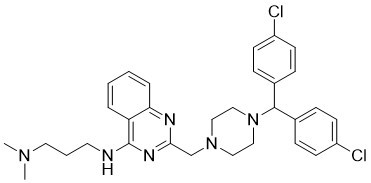
Physicochemical Properties
| Molecular Formula | C31H36CL2N6 |
| Molecular Weight | 563.571 |
| Exact Mass | 562.238 |
| Elemental Analysis | C, 66.07; H, 6.44; Cl, 12.58; N, 14.91 |
| CAS # | 922150-11-6 |
| Related CAS # | 922150-11-6 |
| PubChem CID | 12001922 |
| Appearance | Off-white to light yellow solid powder |
| LogP | 6.156 |
| Hydrogen Bond Donor Count | 1 |
| Hydrogen Bond Acceptor Count | 6 |
| Rotatable Bond Count | 10 |
| Heavy Atom Count | 39 |
| Complexity | 681 |
| Defined Atom Stereocenter Count | 0 |
| SMILES | ClC1C=CC(C(N2CCN(CC3N=C(NCCCN(C)C)C4C(=CC=CC=4)N=3)CC2)C2C=CC(Cl)=CC=2)=CC=1 |
| InChi Key | NCAJLQDPTZBGJV-UHFFFAOYSA-N |
| InChi Code | InChI=1S/C31H36Cl2N6/c1-37(2)17-5-16-34-31-27-6-3-4-7-28(27)35-29(36-31)22-38-18-20-39(21-19-38)30(23-8-12-25(32)13-9-23)24-10-14-26(33)15-11-24/h3-4,6-15,30H,5,16-22H2,1-2H3,(H,34,35,36) |
| Chemical Name | N-[2-[[4-[bis(4-chlorophenyl)methyl]piperazin-1-yl]methyl]quinazolin-4-yl]-N',N'-dimethylpropane-1,3-diamine |
| Synonyms | SCH-529074; SCH529074; SCH 529074 |
| HS Tariff Code | 2934.99.9001 |
| Storage |
Powder-20°C 3 years 4°C 2 years In solvent -80°C 6 months -20°C 1 month |
| Shipping Condition | Room temperature (This product is stable at ambient temperature for a few days during ordinary shipping and time spent in Customs) |
Biological Activity
| Targets | p53 DBD (Ki = 1-2 μM) |
| ln Vitro | In p53 mutant cells (H157, H1975, and H322), SCH529074 (2-4 μM; 24 hours) significantly reduced cell viability, to 20–25%, and in the p53 WT cell line A549, to 68 % 4 μM. In NSCLC cells (H157, A549, HCT116, and HCT116 p53-/-), SCH 529074 (2 and 4 μM) induces G0/G1 phase when compared to control cells treated with low concentration (2 μM) (59). 72%, 66%, 57%, and 57%[1]. H1975 cells are exposed to SCH 529074 (2-4 μM) for 24 hours, which causes both early and late fluorescence. Similar to how SCH 529074 at 2 and 4 μM greatly boosted early and late cells in A549 cells, it also considerably enhanced H157 cells. This is supported by the fact that SCH 529074 at 4 μM significantly promoted early and late cells in HCT116 cells in arc cells, as well as early cells in HCT116 p53-/- cells [1]. SCH 529074 (2–6 μM; 24 hours) raises p21 and PUMA protein levels in wireline |
| ln Vivo | At dosages of 50 and 30 mg/kg, respectively, of the lung cancer medication SCH529074, tumor development was reduced by 79% and 43% over the course of four weeks, beginning on day three and ending on day thirty-one. In human DLD-1 colorectal cancer xenografts, the degree of inhibition corresponds with the compound's switch sensitivity (0.26-0.55 μM at 30 mg/kg, 0.39-0.79 μM at 50 mg/kg, final 2 post- |
| Cell Assay |
cell viability assay [1] Cell Types: p53 mutant cells (H157, H1975, and H322) and p53 WT cell line A549 Tested Concentrations: 4 or 6 μM, regardless of their p53 status [1]. 2μM; 4 μM Incubation Duration: 24 hrs (hours) Experimental Results: Inhibition of cancer WT and mutant cell viability. Cell cycle analysis[1] Cell Types: H1975, H157, A549, HCT116, HCT116 p53-/- Cell Tested Concentrations: 2 µM, 4 µM, 6 µM Incubation Duration: 24 hrs (hours) Experimental Results: Induced cells in all NSCLC cell lines evaluated apoptotic, regardless of their p53 mutation status. Western Blot Analysis[1] Cell Types: H1975, H322, H157, A549, HCT116, HCT116 p53-/- Tested Concentrations: 2 µM, 4 µM, 6 µM Incubation Duration: 24 hrs (hours) Experimental Results: Increased PUMA and p21 protein expression. |
| Animal Protocol |
Animal/Disease Models: Female nude mice, 5-7 weeks old, were inoculated subcutaneously (sc) (sc) with DLD-1 human colorectal cancer cells [2]. Doses: 30 or 50 mg/kg. Route of Administration: oral; -12 hrs (hrs (hours))) [2]. twice (two times) daily; 4 weeks; starting on day 3 through day 31 Experimental Results: Inhibition of tumor growth |
| References |
[1]. Growth Inhibitory Role of the p53 Activator SCH 529074 in non‑small Cell Lung Cancer Cells Expressing Mutant p53. Oncol Rep. 2020 Jun;43(6):2073-2082. [2]. SCH529074, a Small Molecule Activator of Mutant p53, Which Binds p53 DNA Binding Domain (DBD), Restores Growth-Suppressive Function to Mutant p53 and Interrupts HDM2-mediated Ubiquitination of Wild Type p53. J Biol Chem. 2010 Apr 2;285(14):10198-212. |
Solubility Data
| Solubility (In Vitro) | DMSO: ~20 mg/mL (~35.5 mM) |
| Solubility (In Vivo) |
Solubility in Formulation 1: ≥ 1 mg/mL (1.77 mM) (saturation unknown) in 10% DMSO + 40% PEG300 + 5% Tween80 + 45% Saline (add these co-solvents sequentially from left to right, and one by one), clear solution. For example, if 1 mL of working solution is to be prepared, you can add 100 μL of 10.0 mg/mL clear DMSO stock solution to 400 μL of PEG300 and mix evenly; then add 50 μL of Tween-80 to the above solution and mix evenly; then add 450 μL of normal saline to adjust the volume to 1 mL. Preparation of saline: Dissolve 0.9 g of sodium chloride in 100 mL ddH₂ O to obtain a clear solution. Solubility in Formulation 2: ≥ 1 mg/mL (1.77 mM) (saturation unknown) in 10% DMSO + 90% Corn Oil (add these co-solvents sequentially from left to right, and one by one), clear solution. For example, if 1 mL of working solution is to be prepared, you can add 100 μL of 10.0 mg/mL clear DMSO stock solution to 900 μL of corn oil and mix evenly. (Please use freshly prepared in vivo formulations for optimal results.) |
| Preparing Stock Solutions | 1 mg | 5 mg | 10 mg | |
| 1 mM | 1.7744 mL | 8.8720 mL | 17.7440 mL | |
| 5 mM | 0.3549 mL | 1.7744 mL | 3.5488 mL | |
| 10 mM | 0.1774 mL | 0.8872 mL | 1.7744 mL |