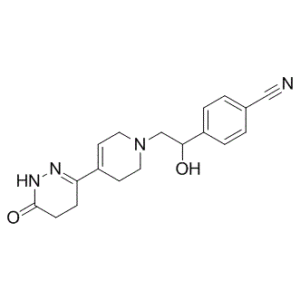
Description: SCH00013 is a novel and potent Ca2+ sensitizer that elicits a moderate positive inotropic effect without significant alteration of Ca2+ transients. As a cardiotonic agent, SCH00013 primarily acts via an increase in myofibrillar Ca++ sensitivity, with a significant Ca(2+)sensitizing effect at pH 7.2 to 7.4. SCH00013 does not have a positive chronotropic effect and has a weak PDE III inhibitory action and class III antiarrhythmic action. SCH00013 prolonged the survival in a animal heart failure model with genetic cardiomyopathy. The oral bioavailability of SCH00013 is high and equivalent to that via intravenous administration. The unique pharmacological profiles of SCH00013 imply that this agent may be potentially beneficial for pharmacotherapy of contractile dysfunction in congestive heart failure.
Physicochemical Properties
| Molecular Formula | C18H20N4O2 |
| Molecular Weight | 324.3770 |
| Exact Mass | 324.158 |
| CAS # | 217963-18-3 |
| PubChem CID | 9818684 |
| Appearance | Light yellow to yellow solid powder |
| Density | 1.3±0.1 g/cm3 |
| Index of Refraction | 1.659 |
| LogP | 0.15 |
| Hydrogen Bond Donor Count | 2 |
| Hydrogen Bond Acceptor Count | 5 |
| Rotatable Bond Count | 4 |
| Heavy Atom Count | 24 |
| Complexity | 581 |
| Defined Atom Stereocenter Count | 0 |
| SMILES | O([H])C([H])(C1C([H])=C([H])C(C#N)=C([H])C=1[H])C([H])([H])N1C([H])([H])C([H])=C(C2C([H])([H])C([H])([H])C(N([H])N=2)=O)C([H])([H])C1([H])[H] |
| InChi Key | BPEKLIDKLJZYOX-UHFFFAOYSA-N |
| InChi Code | InChI=1S/C18H20N4O2/c19-11-13-1-3-15(4-2-13)17(23)12-22-9-7-14(8-10-22)16-5-6-18(24)21-20-16/h1-4,7,17,23H,5-6,8-10,12H2,(H,21,24) |
| Chemical Name | 4-[1-hydroxy-2-[4-(6-oxo-4,5-dihydro-1H-pyridazin-3-yl)-3,6-dihydro-2H-pyridin-1-yl]ethyl]benzonitrile |
| HS Tariff Code | 2934.99.9001 |
| Storage |
Powder-20°C 3 years 4°C 2 years In solvent -80°C 6 months -20°C 1 month |
| Shipping Condition | Room temperature (This product is stable at ambient temperature for a few days during ordinary shipping and time spent in Customs) |
Biological Activity
| ln Vitro | SCH00013 elicits a positive inotropic effect mainly through an increase in myofilament Ca2+ sensitivity without increasing the heart rate. Lack of a positive chronotropic effect may be an important benefit because tachycardia causes an excessive energy consumption and drives the negative force-frequency relationship in severe CHF patients. In addition, SCH00013 possesses class III antiarrhythmic action. While the major potential disadvantage of Ca2+ sensitizers is postulated to be aggravation of the diastolic dysfunction in a failing heart, the effect of SCH00013 on diastolic function was much less than that induced by EMD 57033 in rabbit ventricular myocytes. |
| ln Vivo | SCH00013 had little effect on the rate of cardiac relaxation, an indication that the aggravation of diastolic dysfunction may not be a serious complication compared with other Ca2+ sensitizers such as EMD 57033. SCH00013 has a high oral bioavailability in dogs and a high safety margin in rats |
| References | :Cardiovasc Drug Rev. 2001 Winter;19(4):345-66.;J Pharmacol Sci. 2005 Jan;97(1):53-60. |
Solubility Data
| Solubility (In Vitro) | May dissolve in DMSO (in most cases), if not, try other solvents such as H2O, Ethanol, or DMF with a minute amount of products to avoid loss of samples |
| Solubility (In Vivo) |
Note: Listed below are some common formulations that may be used to formulate products with low water solubility (e.g. < 1 mg/mL), you may test these formulations using a minute amount of products to avoid loss of samples. Injection Formulations (e.g. IP/IV/IM/SC) Injection Formulation 1: DMSO : Tween 80: Saline = 10 : 5 : 85 (i.e. 100 μL DMSO stock solution → 50 μL Tween 80 → 850 μL Saline) *Preparation of saline: Dissolve 0.9 g of sodium chloride in 100 mL ddH ₂ O to obtain a clear solution. Injection Formulation 2: DMSO : PEG300 :Tween 80 : Saline = 10 : 40 : 5 : 45 (i.e. 100 μL DMSO → 400 μLPEG300 → 50 μL Tween 80 → 450 μL Saline) Injection Formulation 3: DMSO : Corn oil = 10 : 90 (i.e. 100 μL DMSO → 900 μL Corn oil) Example: Take the Injection Formulation 3 (DMSO : Corn oil = 10 : 90) as an example, if 1 mL of 2.5 mg/mL working solution is to be prepared, you can take 100 μL 25 mg/mL DMSO stock solution and add to 900 μL corn oil, mix well to obtain a clear or suspension solution (2.5 mg/mL, ready for use in animals). Injection Formulation 4: DMSO : 20% SBE-β-CD in saline = 10 : 90 [i.e. 100 μL DMSO → 900 μL (20% SBE-β-CD in saline)] *Preparation of 20% SBE-β-CD in Saline (4°C,1 week): Dissolve 2 g SBE-β-CD in 10 mL saline to obtain a clear solution. Injection Formulation 5: 2-Hydroxypropyl-β-cyclodextrin : Saline = 50 : 50 (i.e. 500 μL 2-Hydroxypropyl-β-cyclodextrin → 500 μL Saline) Injection Formulation 6: DMSO : PEG300 : castor oil : Saline = 5 : 10 : 20 : 65 (i.e. 50 μL DMSO → 100 μLPEG300 → 200 μL castor oil → 650 μL Saline) Injection Formulation 7: Ethanol : Cremophor : Saline = 10: 10 : 80 (i.e. 100 μL Ethanol → 100 μL Cremophor → 800 μL Saline) Injection Formulation 8: Dissolve in Cremophor/Ethanol (50 : 50), then diluted by Saline Injection Formulation 9: EtOH : Corn oil = 10 : 90 (i.e. 100 μL EtOH → 900 μL Corn oil) Injection Formulation 10: EtOH : PEG300:Tween 80 : Saline = 10 : 40 : 5 : 45 (i.e. 100 μL EtOH → 400 μLPEG300 → 50 μL Tween 80 → 450 μL Saline) Oral Formulations Oral Formulation 1: Suspend in 0.5% CMC Na (carboxymethylcellulose sodium) Oral Formulation 2: Suspend in 0.5% Carboxymethyl cellulose Example: Take the Oral Formulation 1 (Suspend in 0.5% CMC Na) as an example, if 100 mL of 2.5 mg/mL working solution is to be prepared, you can first prepare 0.5% CMC Na solution by measuring 0.5 g CMC Na and dissolve it in 100 mL ddH2O to obtain a clear solution; then add 250 mg of the product to 100 mL 0.5% CMC Na solution, to make the suspension solution (2.5 mg/mL, ready for use in animals). Oral Formulation 3: Dissolved in PEG400 Oral Formulation 4: Suspend in 0.2% Carboxymethyl cellulose Oral Formulation 5: Dissolve in 0.25% Tween 80 and 0.5% Carboxymethyl cellulose Oral Formulation 6: Mixing with food powders Note: Please be aware that the above formulations are for reference only. InvivoChem strongly recommends customers to read literature methods/protocols carefully before determining which formulation you should use for in vivo studies, as different compounds have different solubility properties and have to be formulated differently. (Please use freshly prepared in vivo formulations for optimal results.) |
| Preparing Stock Solutions | 1 mg | 5 mg | 10 mg | |
| 1 mM | 3.0828 mL | 15.4140 mL | 30.8280 mL | |
| 5 mM | 0.6166 mL | 3.0828 mL | 6.1656 mL | |
| 10 mM | 0.3083 mL | 1.5414 mL | 3.0828 mL |