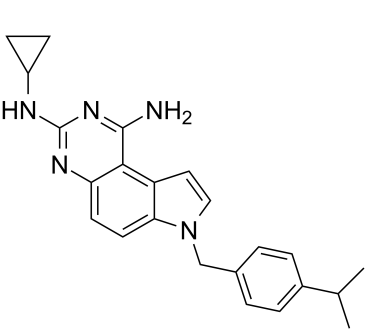
SCH-79797 (SCH79797) is a novel, potent and selective PAR1 (protease activated receptor 1) antagonist with an IC50 of 70 nM and a Ki of 35 nM. SCH-79797 limits myocardial ischemia/reperfusion injury in rat hearts. SCH79797 dihydrochloride inhibits thrombin-induced platelet aggregation with an IC50 of 3 μM. SCH 79797 protects against ischemia/reperfusion-induced arrhythmias in the rat hearts. SCH 79797 and its N-methyl analogue (SCH 203099) inhibited binding of a high-affinity thrombin receptor-activating peptide ([(3)H]haTRAP, Ala-Phe(p-F)-Arg-ChA-HArg-[(3)H]Tyr-NH(2)) to PAR-1 with IC(50) values of 70 and 45 nM, respectively.
Physicochemical Properties
| Molecular Formula | C23H25N5 |
| Molecular Weight | 371.488 |
| Exact Mass | 443.164 |
| CAS # | 245520-69-8 |
| Related CAS # | SCH79797 dihydrochloride;1216720-69-2 |
| PubChem CID | 4259181 |
| Appearance | Light yellow to brown solid powder |
| Boiling Point | 678.3ºC at 760mmHg |
| Flash Point | 364ºC |
| Vapour Pressure | 1.23E-18mmHg at 25°C |
| LogP | 7.17 |
| Hydrogen Bond Donor Count | 2 |
| Hydrogen Bond Acceptor Count | 4 |
| Rotatable Bond Count | 5 |
| Heavy Atom Count | 28 |
| Complexity | 527 |
| Defined Atom Stereocenter Count | 0 |
| InChi Key | AVXQPEKZIGPIJW-UHFFFAOYSA-N |
| InChi Code | InChI=1S/C23H25N5/c1-14(2)16-5-3-15(4-6-16)13-28-12-11-18-20(28)10-9-19-21(18)22(24)27-23(26-19)25-17-7-8-17/h3-6,9-12,14,17H,7-8,13H2,1-2H3,(H3,24,25,26,27) |
| Chemical Name | N3-cyclopropyl-7-[[4-(1-methylethyl)phenyl]methyl]-7H-pyrrolo[3, 2-f]quinazoline-1,3-diamine |
| Synonyms | SCH-79797 SCH 79797 SCH79797 |
| HS Tariff Code | 2934.99.9001 |
| Storage |
Powder-20°C 3 years 4°C 2 years In solvent -80°C 6 months -20°C 1 month |
| Shipping Condition | Room temperature (This product is stable at ambient temperature for a few days during ordinary shipping and time spent in Customs) |
Biological Activity
| ln Vitro | SCH79797 competitively prevents the high-affinity binding of the thrombin receptor activating peptide ([3H]haTRAP). Alpha-thrombin and haTRAP-induced human platelet aggregation is inhibited by SCH79797, but not that of tethering ligand agonists of protease-activated receptor 4 (PAR-4), gamma-thrombin, ADP, or collagen. In hCASMCs, thrombin produces a brief rise in the concentration of cytosolic free Ca2+ ([Ca2+]i). The rise in [Ca2+]i is effectively inhibited by SCH79797. TK-stimulated [3H]thymidine incorporation is totally inhibited by SCH79797 [1] and thrombin. In a concentration-dependent way, SCH79797 impedes the development of several human and animal cell lines. For NIH 3T3, HEK 293, and A375 cells, the corresponding ED50 values for growth inhibition were 75 nM, 81 nM, and 116 nM. At low doses, SCH79797 suppresses serum-stimulated p44/p42 mitogen-activated protein kinase (MAPK) activation in NIH 3T3 cells, but at higher concentrations, it promotes apoptosis [2]. |
| ln Vivo | In two models of myocardial ischemia/reperfusion (I/R) injury, intact rats' myocardial necrosis following cardiac I/R was decreased by SCH79797 (2.5-250 μg/kg; i.v.; male Sprague Dawley rats) when administered before to or during ischemia. The best dose for the dose-dependent response is 25 μg/kg [4]. |
| Animal Protocol |
Animal/Disease Models: Male Sprague Dawley rats (8 weeks old) with myocardial I/R injury [4] Doses: 2.5 μg/kg, 10 μg/kg, 25 μg/kg, 50 μg/kg, 100 μg/kg and 250 μg/kg Route of Administration: IV Experimental Results: Myocardial necrosis after I/R was diminished in intact rat hearts before or during ischemia. |
| References |
[1]. Inhibition of cellular action of thrombin by N3-cyclopropyl-7-[[4-(1-methylethyl)phenyl]methyl]-7H-pyrrolo[3, 2-f]quinazoline-1,3-diamine (SCH 79797), a nonpeptide thrombin receptor antagonist. Biochem Pharmacol. 2000 Nov 15;60(10):1425-34. [2]. Protease-activated receptor 1-selective antagonist SCH79797 inhibits cell proliferation and induces apoptosis by a protease-activated receptor 1-independent mechanism. Basic Clin Pharmacol Toxicol. 2007 Jul;101(1):63-9. [3]. A novel therapeutic target in various lung diseases: airway proteases and protease-activated receptors. Pharmacol Ther. 2007 Jul;115(1):70-83. [4]. SCH 79797, a selective PAR1 antagonist, limits myocardial ischemia/reperfusion injury in rat hearts. Basic Res Cardiol. 2007 Jul;102(4):350-8. |
| Additional Infomation | N3-cyclopropyl-7-[(4-propan-2-ylphenyl)methyl]pyrrolo[3,2-f]quinazoline-1,3-diamine is a member of quinazolines. |
Solubility Data
| Solubility (In Vitro) | DMSO : ~50 mg/mL (~134.60 mM) |
| Solubility (In Vivo) |
Solubility in Formulation 1: ≥ 2.5 mg/mL (6.73 mM) (saturation unknown) in 10% DMSO + 40% PEG300 + 5% Tween80 + 45% Saline (add these co-solvents sequentially from left to right, and one by one), clear solution. For example, if 1 mL of working solution is to be prepared, you can add 100 μL of 25.0 mg/mL clear DMSO stock solution to 400 μL PEG300 and mix evenly; then add 50 μL Tween-80 to the above solution and mix evenly; then add 450 μL normal saline to adjust the volume to 1 mL. Preparation of saline: Dissolve 0.9 g of sodium chloride in 100 mL ddH₂ O to obtain a clear solution. Solubility in Formulation 2: ≥ 2.5 mg/mL (6.73 mM) (saturation unknown) in 10% DMSO + 90% (20% SBE-β-CD in Saline) (add these co-solvents sequentially from left to right, and one by one), clear solution. For example, if 1 mL of working solution is to be prepared, you can add 100 μL of 25.0 mg/mL clear DMSO stock solution to 900 μL of 20% SBE-β-CD physiological saline solution and mix evenly. Preparation of 20% SBE-β-CD in Saline (4°C,1 week): Dissolve 2 g SBE-β-CD in 10 mL saline to obtain a clear solution. Solubility in Formulation 3: ≥ 2.5 mg/mL (6.73 mM) (saturation unknown) in 10% DMSO + 90% Corn Oil (add these co-solvents sequentially from left to right, and one by one), clear solution. For example, if 1 mL of working solution is to be prepared, you can add 100 μL of 25.0 mg/mL clear DMSO stock solution to 900 μL of corn oil and mix evenly. (Please use freshly prepared in vivo formulations for optimal results.) |
| Preparing Stock Solutions | 1 mg | 5 mg | 10 mg | |
| 1 mM | 2.6919 mL | 13.4593 mL | 26.9186 mL | |
| 5 mM | 0.5384 mL | 2.6919 mL | 5.3837 mL | |
| 10 mM | 0.2692 mL | 1.3459 mL | 2.6919 mL |