|
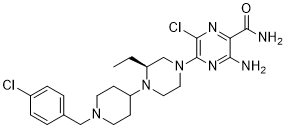
SCH-546738 (SCH546738) is a novel, potent selective, and non-competitive CXCR3 antagonist with potential anticancer, immunomodulatory and antiinflammatory activities. It inhibits CXCR3 with affinity constant (Ki) (binding to human CXCR3 receptor) of 0.4 nM in multiple experiments. It attenuates the development of autoimmune diseases and delays graft rejection.
|
Physicochemical Properties
| Molecular Formula |
C23H31N7OCL2
|
| Molecular Weight |
492.44454
|
| Exact Mass |
491.197
|
| CAS # |
906805-42-3
|
| PubChem CID |
11995774
|
| Appearance |
White to light yellow solid powder
|
| Density |
1.327 g/cm3
|
| Boiling Point |
628.202ºC at 760 mmHg
|
| Flash Point |
333.725ºC
|
| LogP |
4.252
|
| Hydrogen Bond Donor Count |
2
|
| Hydrogen Bond Acceptor Count |
7
|
| Rotatable Bond Count |
6
|
| Heavy Atom Count |
33
|
| Complexity |
642
|
| Defined Atom Stereocenter Count |
1
|
| SMILES |
CC[C@H]1CN(CCN1C2CCN(CC2)CC3=CC=C(C=C3)Cl)C4=NC(=C(N=C4Cl)C(=O)N)N
|
| InChi Key |
UYDYJFWSPRQEAX-KRWDZBQOSA-N
|
| InChi Code |
InChI=1S/C23H31Cl2N7O/c1-2-17-14-31(23-20(25)28-19(22(27)33)21(26)29-23)11-12-32(17)18-7-9-30(10-8-18)13-15-3-5-16(24)6-4-15/h3-6,17-18H,2,7-14H2,1H3,(H2,26,29)(H2,27,33)/t17-/m0/s1
|
| Chemical Name |
3-Amino-6-chloro-5-[(3S)-4-[1-[(4-chlorophenyl)methyl]piperidin-4-yl]-3-ethylpiperazin-1-yl]pyrazine-2-carboxamide
|
| Synonyms |
SCH-546738; SCH 546738; SCH546738
|
| HS Tariff Code |
2934.99.9001
|
| Storage |
Powder-20°C 3 years
4°C 2 years
In solvent -80°C 6 months
-20°C 1 month
|
| Shipping Condition |
Room temperature (This product is stable at ambient temperature for a few days during ordinary shipping and time spent in Customs)
|
|
Biological Activity
| ln Vitro |
SCH 546738's affinity for binding to the human CXCR3 receptor was assessed through a competitive binding assay, wherein the competitive tracer was 35S radiolabeled SCH 535390, a sulfonamide analog belonging to the CXCR3 compound series with a Kd of 0.6 nM. Furthermore, with an IC50 ranging from 0.8 to 2.2 nM, SCH 546738 non-competitively displaces radiolabeled CXCL10 and CXCL11 in human CXCR3. With an IC90 of roughly 10 nM, SCH 546738 potently and specifically inhibits CXCR3-mediated chemotaxis in human activated T cells [1].
|
| ln Vivo |
With IC50s of 1.3, 6.4, 5.9, and 4.2 nM, respectively, SCH 546738 exhibits substantial cross-species action against the binding of [125I]hCXCL10 to CXCR3 in monkeys, dogs, mice, and rats. According to in vivo research, SCH 546738 is a strong and selective CXCR3 antagonist with good PK [1].
|
| Enzyme Assay |
| A scintillation proximity assay is used for radioligand competition binding assays with some modifications. For each assay point, 1 µg of membrane is preincubated for 1 hr with 300 µg wheat germ agglutinin (WGA) coated SPA beads in the binding buffer (50 mM HEPES, 1 mM CaCl2, 5 mM MgCl2, 125 mM NaCl, 0.002% NaN3, 1.0% BSA) at room temperature. The beads are spun down, resuspended in the binding buffer and transferred to a 96-well Isoplate. The indicated concentrations of 125I-hCXCL10, 125I-hCXCL11 or 35S-SCH 535390 with a series of titrations of SCH-546738 (SCH546738) (1-10 μM) are added to start the reaction. After indicated reaction times at room temperature, the amount of radioactivity bound to the SPA beads is determined with a Wallac 1450 Microbeta counter[1]. |
|
| Cell Assay |
| The preparation of human activated T cells is performed. Human peripheral blood lymphocytes are prepared by Ficoll-Hypaque centrifugation, depleted of monocytes, and stimulated for 2 days with 1 µg/mL PHA and 100 U/mL IL-2 in RPMI 1640 supplemented with 10% fetal bovine serum (FBS), 2 mM L-Glutamine, 100 µg/mL Streptomycin, 100 U/mL Penecillin, 1% non-essential amino acids and 2 mM HEPES. Following stimulation, peripheral blood lymphocytes are cultured in above media containing 5% conditioned media for up to 15 days. uman activated T cell chemotaxis assays ae performed using 96-well ChemoTx microplates with a 3 µm filter. Activated T cells are washed with RPMI medium twice, and then resuspended in the medium containing 20% FBS. 1.25×10⁵ cells/reaction are mixed with indicated concentrations of SCH 546738 (1, 10 or 100 nM) and placed on the filter. SCH 546738 and chemokines are mixed and placed in the bottom well of the ChemoTx system. After 2.5 hours incubation at 37°C/5% CO2, the cells are scraped off and the plate system is centrifuged for 5 minutes at 1000 RPM. The filter screen is then removed and the ChemoTx plate is inverted into a 96 well plate with a funnel plate. The plate system is centrifuged for 5 minutes at 1000 RPM. The volume in the wells is brought to 100 μL with assay buffer and the plates are rested for approximately 15 minutes at room temperature. The number of migrated cells is measured using the Cell Titer Glo Luminescent Assay. Chemotaxis is expressed as a chemotactic index, which is a ratio versus the one without chemokines[1] |
|
| Animal Protocol |
| Mice[1] Female C57BL/6 mice are used. For immunization, 150 μg MOG35-55 peptide prepared by Princeton Biomolecules and 300 μg killed Mycobacterium tuberculosis are mixed in CFA and injected s.c. in two 50-μL injections over the flanks on day 1. Also, 200 ng of pertussis toxin is injected i.v. on days 0 and 2. SCH 546738 is administered orally 30 mpk in C57BL/6 mice twice daily. Dosing with SCH 546738 started at day 0, 24 h prior to MOG35-55 immunization (day 1). Mice are monitored daily and assessed for clinical signs of disease in a blinded fashion according to the following criteria: 0, no signs of disease; 1, tail paralysis; 2, limp tail and hind limb weakness; 3, hind limb paralysis; 4, hind limb plus forelimb paralysis; and 5, moribund or dead. Cumulative clinical scores are calculated by adding daily scores from the day of immunization until the end of the experiment. Mean clinical scores at separate days and mean maximal scores are calculated by adding the scores of individual mice and dividing with the number of mice in each group, including mice not developing signs of EAE. Rats[1] Male Lewis rats challenged by injection of 50 μL (30 mg) of a guinea pig spinal cord homogenate in complete Freunds adjuvant (CFA) into one footpad. SCH 546738 or 0.4% methylcellulose (vehicle) is orally administered at the indicated dose (0.2 mL) twice a day, starting on the day before transplantation until the day of graft rejection. SCH 546738 is administered orally at 10 mg/kg (mpk) in Lewis rats. To test whether SCH 546738 enhances the effect of conventional immunosuppressive reagent, the recipients are received treatment with subtherapeutic dose of CsA for one week combined with treatment with SCH 546738. Graft survival is analyzed using the log-rank test. The parametric data are analyzed by Student t test (2-tailed) using GraphPad InStat version. | |
|
| References |
[1]. A selective and potent CXCR3 antagonist SCH 546738 attenuates the development of autoimmune diseases and delays graft rejection. BMC Immunol. 2012 Jan 10;13:2. [2]. CXC chemokine receptor 3 promotes steatohepatitis in mice through mediating inflammatory cytokines, macrophages and autophagy. J Hepatol. 2016 Jan;64(1):160-70. [3]. STAT3 in CD8+ T Cells Inhibits Their Tumor Accumulation by Downregulating CXCR3/CXCL10 Axis. Cancer Immunol Res. 2015 Aug;3(8):864-870.
|
|
Solubility Data
| Solubility (In Vitro) |
DMSO : ~4.5 mg/mL (~9.14 mM)
H2O : ~1 mg/mL (~2.03 mM)
|
| Solubility (In Vivo) |
Solubility in Formulation 1: 1 mg/mL (2.03 mM) in Corn Oil (add these co-solvents sequentially from left to right, and one by one), suspension solution; with heating and sonication.
(Please use freshly prepared in vivo formulations for optimal results.)
|
| Preparing Stock Solutions |
|
1 mg |
5 mg |
10 mg |
| 1 mM |
2.0307 mL |
10.1535 mL |
20.3070 mL |
| 5 mM |
0.4061 mL |
2.0307 mL |
4.0614 mL |
| 10 mM |
0.2031 mL |
1.0154 mL |
2.0307 mL |
*Note: Please select an appropriate solvent for the preparation of stock solution based on your experiment needs. For most products, DMSO can be used for preparing stock solutions (e.g. 5 mM, 10 mM, or 20 mM concentration); some products with high aqueous solubility may be dissolved in water directly. Solubility information is available at the above Solubility Data section. Once the stock solution is prepared, aliquot it to routine usage volumes and store at -20°C or -80°C. Avoid repeated freeze and thaw cycles. |