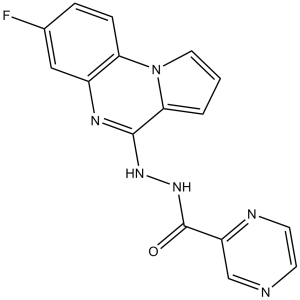
SC144 is a first-in-class small-molecule inhibitor of gp130 with oral activity in ovarian cancer. It can substantially increase the phosphorylation of gp130 (S782) in both OVCAR-8 and Caov-3 cells in a time- and dose-dependent manner. The increase phosphorylation then suppresses Stat3 signaling pathway since the constitutive Stat3 activation is maintained by extracellular gp130 ligands, Besides that, SC144 also causes substantial cell apoptosis in these cells.
Physicochemical Properties
| Molecular Formula | C16H11FN6O |
| Molecular Weight | 322.3 |
| Exact Mass | 322.097 |
| Elemental Analysis | C, 59.63; H, 3.44; F, 5.89; N, 26.08; O, 4.96 |
| CAS # | 895158-95-9 |
| Related CAS # | SC144 hydrochloride;917497-70-2 |
| PubChem CID | 400169 |
| Appearance | Light yellow to yellow solid powder |
| Density | 1.5±0.1 g/cm3 |
| Index of Refraction | 1.753 |
| LogP | 1.78 |
| Hydrogen Bond Donor Count | 2 |
| Hydrogen Bond Acceptor Count | 6 |
| Rotatable Bond Count | 3 |
| Heavy Atom Count | 24 |
| Complexity | 466 |
| Defined Atom Stereocenter Count | 0 |
| SMILES | O=C(C1C=NC=CN=1)NNC1C2N(C=CC=2)C2C(=CC(=CC=2)F)N=1 |
| InChi Key | UEADAWQSJOWXBK-UHFFFAOYSA-N |
| InChi Code | InChI=1S/C16H11FN6O/c17-10-3-4-13-11(8-10)20-15(14-2-1-7-23(13)14)21-22-16(24)12-9-18-5-6-19-12/h1-9H,(H,20,21)(H,22,24) |
| Chemical Name | 2-Pyrazinecarboxylic Acid 2-(7-Fluoropyrrolo[1,2-a]quinoxalin-4-yl)hydrazide |
| Synonyms | SC-144; SC144; 895158-95-9; N'-(7-fluoropyrrolo[1,2-a]quinoxalin-4-yl)pyrazine-2-carbohydrazidE; MFCD25976763; C16H11FN6O; NSC711679; SC 144; |
| HS Tariff Code | 2934.99.9001 |
| Storage |
Powder-20°C 3 years 4°C 2 years In solvent -80°C 6 months -20°C 1 month |
| Shipping Condition | Room temperature (This product is stable at ambient temperature for a few days during ordinary shipping and time spent in Customs) |
Biological Activity
| Targets |
gp130:SC144 is a selective inhibitor of gp130 with an IC₅₀ of 0.72 μM in biochemical binding assays, targeting the cytokine-binding domain to block downstream STAT3 phosphorylation. [1] |
| ln Vitro |
In a panel of human ovarian cancer cell lines, SC144 inhibits cell proliferation with IC50s in the submicromolar range (IC50=OVCAR-8, OVCAR-5, OVCAR-3= 0.72, 0.49, 0.95 μM)[1]. SC144's potency against NCI/ADR-RES (a resistance to Paclitaxel and Doxorubicin; IC50=0.43 μM) and HEY (a resistance to Cisplatin; IC50=0.88 μM) indicates that it may be able to overcome medication resistance in ovarian cancer[1]. Normal kidney epithelium and normal endometrial cells do not produce as much apoptosis in OVCAR-8 and Caov-3 as does SC144 (2 μM; 24 hours)[1]. In a time- and dose-dependent way, SC144 (0.5-2 μM; 0–6 hours) significantly increases the phosphorylation of gp130 (S782) in both OVCAR-8 and Caov-3 cells[1]. Through the regulation of Stat3-regulated gene expression and the inactivation of Akt and Stat3, SC144 is cytotoxic to ovarian cancer cells through the inhibition of gp130 function. Consequently, SC144 therapy ultimately results in apoptosis, anti-angiogenesis, and cell-cycle arrest[1]. - Antiproliferative activity:SC144 inhibits the growth of ovarian cancer cell lines (OVCAR-8, SKOV-3) with IC₅₀ values of 8–12 μM in MTT assays. After 96-hour treatment, cell viability is reduced by 30–50% compared to untreated controls. [1] - Signaling pathway inhibition:SC144 (5 μM) induces phosphorylation of gp130 at Ser782 and promotes its deglycosylation, reducing surface-bound gp130 by 40–60% in OVCAR-8 cells. It also blocks STAT3 phosphorylation at Tyr705 and nuclear translocation, leading to 70–90% downregulation of downstream target genes (Bcl-2, survivin, cyclin D1) as measured by Western blot and qPCR. [1] |
| ln Vivo |
- Tumor growth inhibition:In OVCAR-8 human ovarian cancer xenografts in nude mice, SC144 (10 mg/kg, oral or intraperitoneal, daily for 4 weeks) reduces tumor volume by 50–60% compared to vehicle controls. Immunohistochemical analysis of tumor tissues shows decreased gp130 expression and STAT3 phosphorylation. [1] In human ovarian cancer xenografts, SC144 (10 mg/kg; ip; daily for 58 days) inhibits the growth of tumors[1]. ?The average tumor volume in mice treated with SC144 (100 mg/kg; po; daily for 35 days) was 82% lower than in the control group[1]. |
| Enzyme Assay |
- gp130 inhibition assay:
1. Recombinant human gp130 protein is incubated with SC144 (0.1–10 μM) and ATP in kinase buffer at 37°C for 60 minutes.
2. Phosphorylation of a synthetic peptide substrate is detected using a phospho-specific ELISA kit.
3. The IC₅₀ value is calculated from dose-response curves, confirming 0.72 μM inhibition of gp130 activity. [1] |
| Cell Assay |
Apoptosis Analysis[1] Cell Types: OVCAR-8 and Caov-3 cells Tested Concentrations: 2 μM Incubation Duration: 24 hrs (hours) Experimental Results: Dramatically caused cell death in OVCAR-8 and Caov-3 cells. Western Blot Analysis[1] Cell Types: OVCAR-8, Caov-3 cells Tested Concentrations: 0.5-2 μM Incubation Duration: 0-6 hrs (hours) Experimental Results: Substantially increased the phosphorylation of gp130 (S782) in both OVCAR-8 and Caov-3 cells in a time- and dose-dependent manner. - MTT proliferation assay: 1. Ovarian cancer cells (OVCAR-8, SKOV-3) are seeded in 96-well plates at 5×10³ cells/well and treated with SC144 (0.1–20 μM) for 96 hours. 2. MTT solution is added, and after 4 hours, formazan crystals are dissolved in DMSO. 3. Absorbance at 570 nm is measured, and IC₅₀ values are determined for each cell line. [1] - Western blot for signaling proteins: 1. OVCAR-8 cells are treated with SC144 (5 μM) for 24 hours, then lysed in RIPA buffer. 2. Proteins are separated by SDS-PAGE, transferred to membranes, and probed with antibodies against gp130, p-STAT3 (Tyr705), STAT3, Bcl-2, and β-actin. 3. Densitometric analysis reveals reduced p-STAT3 and Bcl-2 levels compared to controls. [1] |
| Animal Protocol |
Animal/Disease Models: Athymic mice (human ovarian cancer xenograft)[1] Doses: 10 mg/kg Route of Administration: Ip; daily for 58 days Experimental Results: Dramatically inhibited tumor growth by about 73%. - Ovarian cancer xenograft model: 1. Female nude mice (6–8 weeks old) are subcutaneously injected with OVCAR-8 cells (5×10⁶ cells/mouse) into the flank. 2. When tumors reach 100 mm³, mice are randomized to receive SC144 (10 mg/kg) or vehicle. The drug is administered orally (formulated in 0.5% CMC) or intraperitoneally (dissolved in 40% propylene glycol in saline) daily for 28 days. 3. Tumor volume is measured twice weekly using calipers (volume = length × width² × 0.5). At study end, tumors are harvested for histopathological and protein expression analysis. [1] |
| ADME/Pharmacokinetics |
- Oral bioavailability:In mice, oral administration of SC144 (10 mg/kg) shows ~30% bioavailability, with peak plasma concentrations (Cmax) reached within 2–4 hours. [1] - Half-life:The terminal elimination half-life is ~12 hours in mice after intraperitoneal injection. [1] - Plasma protein binding:>95% bound to plasma proteins, primarily albumin. [1] |
| Toxicity/Toxicokinetics |
- Acute toxicity:Mice tolerate single oral doses of SC144 up to 500 mg/kg without mortality. Transient diarrhea and mild weight loss are observed at high doses. [1] - Subchronic toxicity:Rats treated with SC144 (10 mg/kg, daily for 28 days) show no significant changes in liver enzymes (ALT, AST) or renal function markers (BUN, creatinine). [1] |
| References |
[1]. Discovery of a novel orally active small-molecule gp130 inhibitor for the treatment of ovarian cancer. Mol Cancer Ther. 2013 Jun;12(6):937-49. |
| Additional Infomation |
- Mechanism of action:SC144 disrupts gp130-STAT3 signaling by modifying gp130 structure, inhibiting STAT3 activation, and suppressing anti-apoptotic and pro-proliferative pathways in ovarian cancer cells. [1] - Therapeutic potential:Investigated as a targeted therapy for ovarian cancer, with preclinical data supporting its efficacy in inhibiting tumor growth and synergizing with chemotherapy. [1] |
Solubility Data
| Solubility (In Vitro) |
|
|||
| Solubility (In Vivo) |
|
| Preparing Stock Solutions | 1 mg | 5 mg | 10 mg | |
| 1 mM | 3.1027 mL | 15.5135 mL | 31.0270 mL | |
| 5 mM | 0.6205 mL | 3.1027 mL | 6.2054 mL | |
| 10 mM | 0.3103 mL | 1.5513 mL | 3.1027 mL |