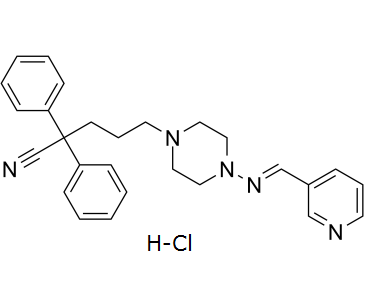
SC-26196 HCl is a novel, potent and orally bioactive D6D (Delta6 desaturase) inhibitor with IC50 of 0.2 µM in a rat liver microsomal assay. It completely blocks the conversion of linoleic acid to arachidonic acid (AA). SC-26196 inhibited the desaturation of 2 microM [1-14C] 18:2n-6 by 87-95% in cultured human skin fibroblasts, coronary artery smooth muscle cells, and astrocytes. By contrast, SC-26196 did not affect the conversion of [1-14C]20:3n-6 to 20:4 in the fibroblasts, demonstrating that it is selective for delta6-desaturase.
Physicochemical Properties
| Appearance | Typically exists as solid at room temperature |
| HS Tariff Code | 2934.99.9001 |
| Storage |
Powder-20°C 3 years 4°C 2 years In solvent -80°C 6 months -20°C 1 month |
| Shipping Condition | Room temperature (This product is stable at ambient temperature for a few days during ordinary shipping and time spent in Customs) |
Biological Activity
| Targets | Delta6 desaturase (D6D, FADS2) (IC50=0.2 μM) |
| ln Vitro |
The proliferation of peripheral blood mononuclear cells (PBMC) is inhibited by SC-26196 (200 nM), but not that of Jurkat cells [2].
For technical reasons, [13C]18:3n-3 could not be used in the experiment to test the effect of SC-26196 on PUFA synthesis in PBMCs. Consequently, the results are presented as the proportion of total n-3 PUFA. SC26196 significantly reduced the proportion of 20:4n-3 in stimulated PBMCs which was accompanied by a non-significant trend (P = 0.07) towards an increase in the proportion of 20:3n-3. There were also non-significant trends (P < 0.01) towards lower proportions of 20:5n-3 and 22:5n-3 (Figure 2B). Treatment of Jurkat cells with SC-26196 (200 nmoles/l) significantly increased [13C] enrichment of 18:3n-3 (59%; P = 0.009) and of 20:3n-3 (2-fold; P = 0.001), and decreased enrichment of 20:4n-3 (30%; P = 0.04), 20:5n-3 (19%; P = 0.02), and 22:5n-3 (33%; P = 0.0004) (Figure 2D). There was no significant effect of SC26196 on [13C] enrichment of 18:4n-3 and 22:6n-3.[2] SC-26196 and sterculic acid specifically inhibit the Delta6D and Delta9D activities with an IC(50) value of 0.1 microM and 0.9 microM, respectively. This medium-throughput cell assay provides an efficient tool in the identification of specific desaturase and elongase inhibitors[4]. |
| ln Vivo |
The computed Δ6-desaturase index in adipose tissue and liver decreased with the addition of SC-26196 to the diet (at doses of 0, 0.07, 0.21, or 0.7 mg/kg to obtain dosages of 0, 10, 30, and 100 mg/kg per day). Δ6-desaturase is inhibited when 100 mg of SC-26196 are fed daily per kilogram of body weight [3].
Decreased synthesis of arachidonic acid by inhibition of the Delta6 or Delta5 desaturase was evaluated as a means to mitigate inflammation. Using quantitative in vitro and in vivo radioassays, novel compounds representing five classes of Delta5 desaturase inhibitors and one class of Delta6 desaturase inhibitor were identified. The Delta6 desaturase inhibitor, SC-26196, had pharmacokinetic and pharmacodynamic profiles in mice that allowed for the evaluation of the pharmacological effects of chronic inhibition of desaturase activity. SC-26196 decreased edema to the same extent as indomethacin or essential fatty acid deficiency in the carrageenan paw edema model in the mouse. The antiinflammatory properties of SC-26196 were consistent with its mechanism of action as a Delta6 desaturase inhibitor: 1) A correlation existed between inhibition of liver Delta6 desaturase activity and decreases in edema. 2) The onset of the decrease in edema was time dependent. 3) Selective reduction of arachidonic acid occurred dose dependently in liver, plasma and peritoneal cells. 4) In the presence of SC-26196, controlled refeeding of arachidonic acid, but not oleic acid, reversed the changes resulting from desaturase inhibition. The Delta6 desaturase may be a target for development of antiinflammatory drugs whose mechanism of action is unique [1]. |
| Cell Assay |
Cell proliferation assay [2] Cell Types: PBMC and Jurkat cells Tested Concentrations: 200 nM Incubation Duration: 96 hrs (hours) for PBMC; 144 hrs (hours) for Jurkat cells Experimental Results: PBMC treatment Dramatically diminished the proportion of dividing cells, division index and proliferation index. Cell proliferation of Jurkat cells was not Dramatically altered. Measurement of Cell Proliferation [2] Peripheral blood mononuclear cell proliferation was measured by the dye dilution method. Cryopreserved PBMCs were thawed and 40 × 106 viable cells were suspended in 1 ml PBS containing 5% (v/v) FBS. PBMCs were either untreated or stimulated with Con. A (final concentration 5 µg/ml) and maintained in a humidified cell culture incubator at 37°C in a 5% CO2 atmosphere. Cells were stained with carboxyfluorescein succinimidyl ester according to the manufacturer’s instructions. Proliferation of Jurkat cells was measured by cell counting. Cells were seeded at 5 × 10⁵ cells/ml in RPMI-1640 medium containing 10% (v/v) FBS and incubated for up to 144 h either with or without SC-26196 (200 nM) or DMSO (final concentration 0.02% (v/v)). Aliquots were collected at 24 h intervals and cell number was determined using a Coulter Z1 Cell Counter [2]. |
| Animal Protocol |
Animal/Disease Models: Male mice (12 or 15 weeks old) [3] Doses: 0, 10, 30 and 100 mg/kg daily Doses: included in the diet at 0, 0.07, 0.21 or 0.7 mg/kg diet to achieve doses of 0, 10, 30 and 100 mg/kg per day. Experimental Results: Caused a decrease in calculated Δ6-desaturase index in adipose tissue and liver. |
| References |
[1]. Obukowicz\nMG, et al. Novel, selective delta6 or delta5 fatty acid desaturase\ninhibitors as antiinflammatory agents in mice. J Pharmacol Exp Ther.\n1998 Oct;287(1):157-66. [2]. Sibbons\nCM, et al. Polyunsaturated Fatty Acid Biosynthesis Involving \u03948\nDesaturation and Differential DNA Methylation of FADS2 Regulates\nProliferation of Human Peripheral Blood Mononuclear Cells. Front\nImmunol. 2018 Mar 5;9:432. [3]. Hargrave-Barnes\nKM, et al. Conjugated linoleic acid-induced fat loss dependence on\nDelta6-desaturase or cyclooxygenase. Obesity (Silver Spring). 2008\nOct;16(10):2245-52. [4]. Zhang\nL, et al. A multiplexed cell assay in HepG2 cells for the\nidentification of delta-5, delta-6, and delta-9desaturase and elongase\ninhibitors. J Biomol Screen. 2010 Feb;15(2):169-76. |
Solubility Data
| Solubility (In Vitro) | May dissolve in DMSO (in most cases), if not, try other solvents such as H2O, Ethanol, or DMF with a minute amount of products to avoid loss of samples |
| Solubility (In Vivo) |
Note: Listed below are some common formulations that may be used to formulate products with low water solubility (e.g. < 1 mg/mL), you may test these formulations using a minute amount of products to avoid loss of samples. Injection Formulations (e.g. IP/IV/IM/SC) Injection Formulation 1: DMSO : Tween 80: Saline = 10 : 5 : 85 (i.e. 100 μL DMSO stock solution → 50 μL Tween 80 → 850 μL Saline) *Preparation of saline: Dissolve 0.9 g of sodium chloride in 100 mL ddH ₂ O to obtain a clear solution. Injection Formulation 2: DMSO : PEG300 :Tween 80 : Saline = 10 : 40 : 5 : 45 (i.e. 100 μL DMSO → 400 μLPEG300 → 50 μL Tween 80 → 450 μL Saline) Injection Formulation 3: DMSO : Corn oil = 10 : 90 (i.e. 100 μL DMSO → 900 μL Corn oil) Example: Take the Injection Formulation 3 (DMSO : Corn oil = 10 : 90) as an example, if 1 mL of 2.5 mg/mL working solution is to be prepared, you can take 100 μL 25 mg/mL DMSO stock solution and add to 900 μL corn oil, mix well to obtain a clear or suspension solution (2.5 mg/mL, ready for use in animals). Injection Formulation 4: DMSO : 20% SBE-β-CD in saline = 10 : 90 [i.e. 100 μL DMSO → 900 μL (20% SBE-β-CD in saline)] *Preparation of 20% SBE-β-CD in Saline (4°C,1 week): Dissolve 2 g SBE-β-CD in 10 mL saline to obtain a clear solution. Injection Formulation 5: 2-Hydroxypropyl-β-cyclodextrin : Saline = 50 : 50 (i.e. 500 μL 2-Hydroxypropyl-β-cyclodextrin → 500 μL Saline) Injection Formulation 6: DMSO : PEG300 : castor oil : Saline = 5 : 10 : 20 : 65 (i.e. 50 μL DMSO → 100 μLPEG300 → 200 μL castor oil → 650 μL Saline) Injection Formulation 7: Ethanol : Cremophor : Saline = 10: 10 : 80 (i.e. 100 μL Ethanol → 100 μL Cremophor → 800 μL Saline) Injection Formulation 8: Dissolve in Cremophor/Ethanol (50 : 50), then diluted by Saline Injection Formulation 9: EtOH : Corn oil = 10 : 90 (i.e. 100 μL EtOH → 900 μL Corn oil) Injection Formulation 10: EtOH : PEG300:Tween 80 : Saline = 10 : 40 : 5 : 45 (i.e. 100 μL EtOH → 400 μLPEG300 → 50 μL Tween 80 → 450 μL Saline) Oral Formulations Oral Formulation 1: Suspend in 0.5% CMC Na (carboxymethylcellulose sodium) Oral Formulation 2: Suspend in 0.5% Carboxymethyl cellulose Example: Take the Oral Formulation 1 (Suspend in 0.5% CMC Na) as an example, if 100 mL of 2.5 mg/mL working solution is to be prepared, you can first prepare 0.5% CMC Na solution by measuring 0.5 g CMC Na and dissolve it in 100 mL ddH2O to obtain a clear solution; then add 250 mg of the product to 100 mL 0.5% CMC Na solution, to make the suspension solution (2.5 mg/mL, ready for use in animals). Oral Formulation 3: Dissolved in PEG400 Oral Formulation 4: Suspend in 0.2% Carboxymethyl cellulose Oral Formulation 5: Dissolve in 0.25% Tween 80 and 0.5% Carboxymethyl cellulose Oral Formulation 6: Mixing with food powders Note: Please be aware that the above formulations are for reference only. InvivoChem strongly recommends customers to read literature methods/protocols carefully before determining which formulation you should use for in vivo studies, as different compounds have different solubility properties and have to be formulated differently. (Please use freshly prepared in vivo formulations for optimal results.) |