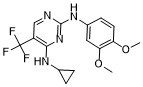
Physicochemical Properties
| Molecular Formula | C16H17F3N4O2 |
| Molecular Weight | 354.3270 |
| Exact Mass | 354.13 |
| Elemental Analysis | C, 54.24; H, 4.84; F, 16.09; N, 15.81; O, 9.03 |
| CAS # | 1884222-74-5 |
| PubChem CID | 132178569 |
| Appearance | White to off-white solid powder |
| LogP | 3.8 |
| Hydrogen Bond Donor Count | 2 |
| Hydrogen Bond Acceptor Count | 9 |
| Rotatable Bond Count | 6 |
| Heavy Atom Count | 25 |
| Complexity | 436 |
| Defined Atom Stereocenter Count | 0 |
| SMILES | FC(C1=C([H])N=C(N([H])C2C([H])=C([H])C(=C(C=2[H])OC([H])([H])[H])OC([H])([H])[H])N=C1N([H])C1([H])C([H])([H])C1([H])[H])(F)F |
| InChi Key | BQROJYIEHOOQBY-UHFFFAOYSA-N |
| InChi Code | InChI=1S/C16H17F3N4O2/c1-24-12-6-5-10(7-13(12)25-2)22-15-20-8-11(16(17,18)19)14(23-15)21-9-3-4-9/h5-9H,3-4H2,1-2H3,(H2,20,21,22,23) |
| Chemical Name | N4-cyclopropyl-N2-(3,4-dimethoxyphenyl)-5-(trifluoromethyl)pyrimidine-2,4-diamine |
| Synonyms | SBP 7455SBP7455 SBP-7455 |
| HS Tariff Code | 2934.99.9001 |
| Storage |
Powder-20°C 3 years 4°C 2 years In solvent -80°C 6 months -20°C 1 month |
| Shipping Condition | Room temperature (This product is stable at ambient temperature for a few days during ordinary shipping and time spent in Customs) |
Biological Activity
| ln Vitro | Compound 26, SBP-7455, inhibited MDA-MB-468 cell proliferation with an IC50 of 0.3 μM over a 72-hour period. In TNBC cells with autophagy Sy, SBP-7455 reduces the autophagy flux caused by starvation [1]. |
| ln Vivo | The mouse model received a single dose of 30 mg/kg of SBP-7455 (Compound 26). The Tmax and Cmax of SBP-7455 are 990 nM, 1.7 hours, and around an hour, respectively. The feeding concentration of SBP-7455 stayed above the ULK1 IC50 for over 4 hours following the first determination [1]. Two hours after mice were given oral gavage of SBP-7455 (compound 26) at a dose of 10 mg/kg, elephant samples were taken. According to the findings, SBP-7455 synchronizes the levels of ULK1 and total ATG13 and has a potent inhibitory effect on pATG13 (Ser318) [1]. |
| References |
[1]. Design, Synthesis, and Characterization of an Orally Active Dual-Specific ULK1/2 Autophagy Inhibitor that Synergizes with the PARP Inhibitor Olaparib for the Treatment of Triple-Negative Breast Cancer. J Med Chem. 2020 Dec 10;63(23):14609-14625. |
Solubility Data
| Solubility (In Vitro) | DMSO : ~125 mg/mL (~352.78 mM) |
| Solubility (In Vivo) |
Solubility in Formulation 1: ≥ 2.08 mg/mL (5.87 mM) (saturation unknown) in 10% DMSO + 40% PEG300 + 5% Tween80 + 45% Saline (add these co-solvents sequentially from left to right, and one by one), clear solution. For example, if 1 mL of working solution is to be prepared, you can add 100 μL of 20.8 mg/mL clear DMSO stock solution to 400 μL PEG300 and mix evenly; then add 50 μL Tween-80 to the above solution and mix evenly; then add 450 μL normal saline to adjust the volume to 1 mL. Preparation of saline: Dissolve 0.9 g of sodium chloride in 100 mL ddH₂ O to obtain a clear solution. Solubility in Formulation 2: ≥ 2.08 mg/mL (5.87 mM) (saturation unknown) in 10% DMSO + 90% Corn Oil (add these co-solvents sequentially from left to right, and one by one), clear solution. For example, if 1 mL of working solution is to be prepared, you can add 100 μL of 20.8 mg/mL clear DMSO stock solution to 900 μL of corn oil and mix evenly. (Please use freshly prepared in vivo formulations for optimal results.) |
| Preparing Stock Solutions | 1 mg | 5 mg | 10 mg | |
| 1 mM | 2.8222 mL | 14.1111 mL | 28.2223 mL | |
| 5 mM | 0.5644 mL | 2.8222 mL | 5.6445 mL | |
| 10 mM | 0.2822 mL | 1.4111 mL | 2.8222 mL |