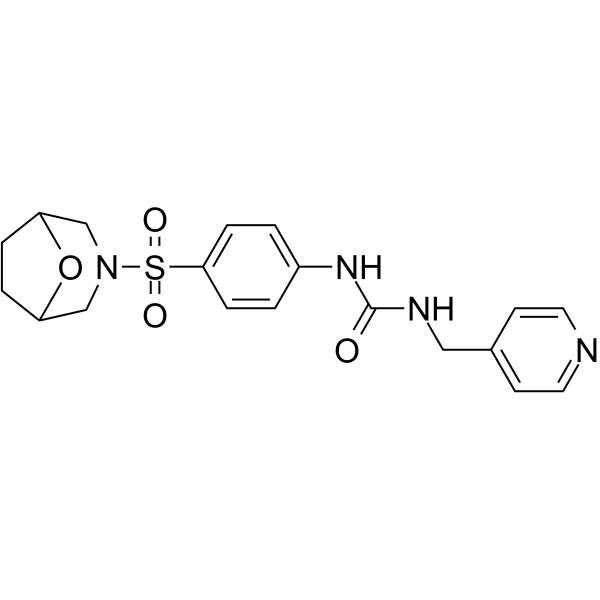
Physicochemical Properties
| Molecular Formula | C19H22N4O4S |
| Molecular Weight | 402.467382907867 |
| Exact Mass | 402.14 |
| Elemental Analysis | C, 56.70; H, 5.51; N, 13.92; O, 15.90; S, 7.97 |
| CAS # | 2237268-08-3 |
| PubChem CID | 135222620 |
| Appearance | Light yellow to yellow solid powder |
| LogP | 0.7 |
| Hydrogen Bond Donor Count | 2 |
| Hydrogen Bond Acceptor Count | 6 |
| Rotatable Bond Count | 5 |
| Heavy Atom Count | 28 |
| Complexity | 627 |
| Defined Atom Stereocenter Count | 0 |
| InChi Key | KTSOHNHLOLGQCY-UHFFFAOYSA-N |
| InChi Code | InChI=1S/C19H22N4O4S/c24-19(21-11-14-7-9-20-10-8-14)22-15-1-5-18(6-2-15)28(25,26)23-12-16-3-4-17(13-23)27-16/h1-2,5-10,16-17H,3-4,11-13H2,(H2,21,22,24) |
| Chemical Name | 1-[4-(8-oxa-3-azabicyclo[3.2.1]octan-3-ylsulfonyl)phenyl]-3-(pyridin-4-ylmethyl)urea |
| Synonyms | SBI-797812; SBI 797812; SBI797812; |
| HS Tariff Code | 2934.99.9001 |
| Storage |
Powder-20°C 3 years 4°C 2 years In solvent -80°C 6 months -20°C 1 month |
| Shipping Condition | Room temperature (This product is stable at ambient temperature for a few days during ordinary shipping and time spent in Customs) |
Biological Activity
| Targets | SBI-797812 specifically activates nicotinamide phosphoribosyltransferase (NAMPT) (EC50 = 0.17 μM for human recombinant NAMPT; activation fold = 2.8 at 1 μM)[1] |
| ln Vitro |
NAMPT is activated in a dose-signal manner by SBI-797812 (0–4 μM; 4 h), with an EC50 value of 0.37 μM. NAMPT-cell-introduced NMN is added by 1 μM and 2 μM; 1 h[1]. ATP (2 mM) is needed for SBI-797812 (2 μM; 1 or 4 hours) to activate NAMPT (30 nM) [1]. Nicotinamide mononucleotide (NMN) and NAD+ properties in tubes are affected by SBI-797812 (5 μM; 2 h) on PP (20 μM) consumption and pHisNAMPT response when SBI-797812 (0.4, 2, 10 μM; 4 h) is given to A549 human lung cancer cells and human or model primary muscle at 10 μM. As an activator of NAMPT, which is the ultimate accelerating enzyme in attaining the NAD+ endpoint during aging/senescence, SBI-797812 contributes to the chronic aging process [2]. SBI-797812 increased intracellular NAD+ levels in HEK293T cells in a dose-dependent manner, achieving a 2.2-fold increase at 10 μM after 24 hours[1] In primary mouse hepatocytes, SBI-797812 (1 μM, 24 hours) elevated NAD+ levels by 1.8-fold and upregulated PGC-1α transcriptional activity, as measured by luciferase reporter assay[1] The compound enhanced NAMPT enzymatic activity in vitro, increasing the production of nicotinamide mononucleotide (NMN) from nicotinamide and PRPP by 2.5-fold at 1 μM[1] In C2C12 myotubes, SBI-797812 (5 μM, 48 hours) increased NAD+ levels by 1.7-fold and improved mitochondrial respiration, as indicated by a 30% increase in oxygen consumption rate (OCR)[1] Western blot analysis showed that SBI-797812 (10 μM, 24 hours) reduced acetylated p53 levels (by 40%) and increased SIRT1-mediated deacetylation in HEK293T cells[1] |
| ln Vivo |
SBI-797812 (10 mg/kg; i.p. or o.p.; single dose) demonstrates significant intraperitoneal plasma exposure, with a Cmax value of 3297 ng/mL, or 8.2 μM[1]. The single dose of SBI-797812 (20 mg/kg; i.p.; assessed 2 h post-dose) significantly raises NAD+ in the liver of mice[1]. Oral administration of SBI-797812 (30 mg/kg, once daily for 7 days) to C57BL/6 mice increased hepatic NAD+ levels by 1.9-fold and skeletal muscle NAD+ levels by 1.6-fold compared to vehicle controls[1] In aged C57BL/6 mice (24 months old), SBI-797812 (30 mg/kg/day, oral for 14 days) restored hepatic NAD+ levels to those of young mice (6 months old) and reduced hepatic triglyceride accumulation by 35%[1] The compound improved glucose tolerance in diet-induced obese (DIO) mice: oral SBI-797812 (10 mg/kg/day for 21 days) reduced fasting blood glucose by 22% and improved insulin sensitivity (1.5-fold increase in insulin-mediated glucose uptake in skeletal muscle)[1] In mice subjected to acute liver injury (carbon tetrachloride-induced), SBI-797812 (30 mg/kg, oral 2 hours pre-injury) increased hepatic NAD+ levels by 1.8-fold and reduced serum ALT activity by 45% at 24 hours post-injury[1] |
| Enzyme Assay |
Recombinant human NAMPT was purified and used to measure the activating effect of SBI-797812[1] The assay was conducted in a reaction buffer containing nicotinamide (substrate), PRPP (cofactor), and MgCl2[1] Various concentrations of SBI-797812 were added to the reaction mixture, which was incubated at 37°C for 30 minutes[1] The product NMN was quantified by HPLC with UV detection at 260 nm[1] Enzymatic activity was calculated as NMN production rate, and activation fold and EC50 were determined by fitting dose-response curves[1] |
| Cell Assay |
HEK293T cells were seeded in 6-well plates and cultured to 80% confluency before treatment with serial dilutions of SBI-797812[1] After 24 hours of incubation, cells were harvested, and NAD+ was extracted using acidified ethanol[1] NAD+ levels were quantified by a cycling assay with diaphorase and resazurin, measuring fluorescence intensity at 590 nm[1] Primary mouse hepatocytes were isolated and plated in collagen-coated plates, then treated with SBI-797812 for 24 hours[1] Cells were lysed for luciferase reporter assay (to measure PGC-1α activity) or NAD+ extraction, and protein lysates were used for western blot analysis of acetylated proteins[1] C2C12 myoblasts were differentiated into myotubes over 7 days, then treated with SBI-797812 for 48 hours[1] Mitochondrial respiration was assessed using a Seahorse XF analyzer to measure OCR under basal and maximal respiration conditions[1] |
| Animal Protocol |
Animal/Disease Models: Male C57BL/6 J mice (8 weeks old) [1] Doses: 20 mg/kg; single dose; measured 2 hrs (hrs (hours)) after test) Significant mouse embryonic changes NAD+[1] in . intraperitoneal (ip) injection; dose after 1 hour fasting; add Buthanasia-D (165 mg/kg; intraperitoneal (ip) injection) 4 hrs (hrs (hours)) after fasting Experimental Results: LC-MS/MS shows NAD+ dry powder in liver, heart, gastrocnemius, and quadriceps muscles 0.311, 0.144, 0.078 and 0.078 μg/mg dry powder measurements respectively. 8-week-old male C57BL/6 mice were randomly assigned to vehicle (0.5% CMC-Na) or SBI-797812 treatment groups[1] The compound was administered via oral gavage at doses of 10 mg/kg, 30 mg/kg, or 100 mg/kg once daily for 7-21 days[1] At the end of treatment, mice were euthanized, and tissues (liver, skeletal muscle, adipose tissue) were collected and snap-frozen in liquid nitrogen for NAD+ extraction and biochemical analysis[1] Aged mice (24 months old) and DIO mice (fed a high-fat diet for 12 weeks) were treated with SBI-797812 (30 mg/kg/day and 10 mg/kg/day, respectively) via oral gavage for 14-21 days[1] Blood samples were collected via retro-orbital bleeding for glucose and insulin measurement, and oral glucose tolerance tests (OGTT) were performed on day 18 of treatment[1] For acute liver injury models, mice were treated with SBI-797812 (30 mg/kg, oral) 2 hours before intraperitoneal injection of carbon tetrachloride[1] Serum and liver tissues were collected 24 hours post-injury to measure ALT activity and NAD+ levels[1] |
| ADME/Pharmacokinetics |
SBI-797812 had an oral bioavailability of 48% in rats and 52% in mice[1] In rats, oral administration of 30 mg/kg resulted in a Cmax of 1.8 μg/mL, Tmax of 1.2 hours, and terminal half-life (t1/2) of 4.3 hours[1] In mice, oral 30 mg/kg gave a Cmax of 2.1 μg/mL, Tmax of 1.0 hour, and t1/2 of 3.8 hours[1] The volume of distribution (Vd) was 2.3 L/kg in rats and 1.9 L/kg in mice[1] Total body clearance (CL) was 0.32 L/h/kg in rats and 0.28 L/h/kg in mice[1] SBI-797812 showed widespread tissue distribution, with highest concentrations in liver, kidney, and skeletal muscle (1.5-2.0 fold higher than plasma)[1] Metabolism was primarily via glucuronidation, with ~60% of the dose excreted in feces as metabolites and <10% as unchanged drug in urine[1] |
| Toxicity/Toxicokinetics |
Acute toxicity studies in mice and rats showed no mortality or treatment-related adverse effects at oral doses up to 500 mg/kg[1] Subchronic toxicity (28-day) in rats at 100 mg/kg/day (oral) revealed no significant changes in body weight, hematology, clinical chemistry (liver/kidney function), or organ histopathology[1] Plasma protein binding of SBI-797812 was 78% in human plasma, 75% in rat plasma, and 72% in mouse plasma[1] No significant inhibition of major cytochrome P450 isoforms (CYP1A2, CYP2C9, CYP2C19, CYP2D6, CYP3A4) was observed at concentrations up to 10 μM in vitro[1] |
| References |
[1]. Boosting NAD+ with a small molecule that activates NAMPT. Nat Commun. 2019 Jul 19;10(1):3241. [2]. Nicotinamide Phosphoribosyltransferase as a Key Molecule of the Aging/Senescence Process. Int J Mol Sci. 2021 Apr 2;22(7):3709. |
| Additional Infomation |
SBI-797812 is a first-in-class small-molecule activator of NAMPT, the rate-limiting enzyme in the salvage pathway of NAD+ biosynthesis[1] It exerts its biological effects by enhancing NAMPT-mediated conversion of nicotinamide to NMN, thereby increasing cellular and tissue NAD+ levels[1] Elevated NAD+ activates sirtuins (e.g., SIRT1, SIRT3) and other NAD+-dependent enzymes, regulating metabolism, mitochondrial function, and stress resistance[1] SBI-797812 holds potential for the treatment of age-related metabolic disorders, liver diseases, and conditions associated with NAD+ depletion[1] |
Solubility Data
| Solubility (In Vitro) | DMSO : ~250 mg/mL (~621.16 mM) |
| Solubility (In Vivo) |
Solubility in Formulation 1: 2.08 mg/mL (5.17 mM) in 10% DMSO + 40% PEG300 + 5% Tween80 + 45% Saline (add these co-solvents sequentially from left to right, and one by one), clear solution; with sonication. For example, if 1 mL of working solution is to be prepared, you can add 100 μL of 20.8 mg/mL clear DMSO stock solution to 400 μL PEG300 and mix evenly; then add 50 μL Tween-80 to the above solution and mix evenly; then add 450 μL normal saline to adjust the volume to 1 mL. Preparation of saline: Dissolve 0.9 g of sodium chloride in 100 mL ddH₂ O to obtain a clear solution. Solubility in Formulation 2: ≥ 2.08 mg/mL (5.17 mM) (saturation unknown) in 10% DMSO + 90% (20% SBE-β-CD in Saline) (add these co-solvents sequentially from left to right, and one by one), clear solution. For example, if 1 mL of working solution is to be prepared, you can add 100 μL of 20.8 mg/mL clear DMSO stock solution to 900 μL of 20% SBE-β-CD physiological saline solution and mix evenly. Preparation of 20% SBE-β-CD in Saline (4°C,1 week): Dissolve 2 g SBE-β-CD in 10 mL saline to obtain a clear solution. Solubility in Formulation 3: ≥ 2.08 mg/mL (5.17 mM) (saturation unknown) in 10% DMSO + 90% Corn Oil (add these co-solvents sequentially from left to right, and one by one), clear solution. For example, if 1 mL of working solution is to be prepared, you can add 100 μL of 20.8 mg/mL clear DMSO stock solution to 900 μL of corn oil and mix evenly. (Please use freshly prepared in vivo formulations for optimal results.) |
| Preparing Stock Solutions | 1 mg | 5 mg | 10 mg | |
| 1 mM | 2.4847 mL | 12.4233 mL | 24.8466 mL | |
| 5 mM | 0.4969 mL | 2.4847 mL | 4.9693 mL | |
| 10 mM | 0.2485 mL | 1.2423 mL | 2.4847 mL |