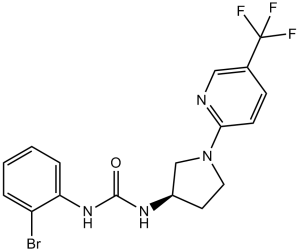
SB-705498 (SB705498; SB 705498) is an orally bioavailable and competitive antagonist of the capsaicin-mediated activation of TRPV1 (transient receptor potential vanilloid 1) receptors with important biological activity. It inhibits TRPV1 with pKis of 7.6, 7.5, and 7.3 for human, rat, and guinea pig, respectively.
Physicochemical Properties
| Molecular Formula | C17H16BRF3N4O | |
| Molecular Weight | 429.23 | |
| Exact Mass | 428.045 | |
| CAS # | 501951-42-4 | |
| Related CAS # |
|
|
| PubChem CID | 9910486 | |
| Appearance | White to off-white solid powder | |
| Density | 1.6±0.1 g/cm3 | |
| Boiling Point | 506.9±50.0 °C at 760 mmHg | |
| Flash Point | 260.4±30.1 °C | |
| Vapour Pressure | 0.0±1.3 mmHg at 25°C | |
| Index of Refraction | 1.617 | |
| LogP | 4.11 | |
| Hydrogen Bond Donor Count | 2 | |
| Hydrogen Bond Acceptor Count | 6 | |
| Rotatable Bond Count | 3 | |
| Heavy Atom Count | 26 | |
| Complexity | 493 | |
| Defined Atom Stereocenter Count | 1 | |
| SMILES | C1CN(C[C@@H]1NC(=O)NC2=CC=CC=C2Br)C3=NC=C(C=C3)C(F)(F)F |
|
| InChi Key | JYILLRHXRVTRSH-GFCCVEGCSA-N | |
| InChi Code | InChI=1S/C17H16BrF3N4O/c18-13-3-1-2-4-14(13)24-16(26)23-12-7-8-25(10-12)15-6-5-11(9-22-15)17(19,20)21/h1-6,9,12H,7-8,10H2,(H2,23,24,26)/t12-/m1/s1 | |
| Chemical Name | N-(2-bromophenyl)-N-[(3R)-1-[5-(trifluoromethyl)-2-pyridinyl]-3-pyrrolidinyl]-urea | |
| Synonyms |
|
|
| HS Tariff Code | 2934.99.9001 | |
| Storage |
Powder-20°C 3 years 4°C 2 years In solvent -80°C 6 months -20°C 1 month |
|
| Shipping Condition | Room temperature (This product is stable at ambient temperature for a few days during ordinary shipping and time spent in Customs) |
Biological Activity
| Targets |
Vanilloid Receptor-1 (TRPV1/VR1) (Ki: 0.7 nM; IC50 for capsaicin-induced activation: 3.2 nM; IC50 for acid-induced activation: 4.5 nM; IC50 for heat-induced activation: 5.1 nM)[1][2] |
| ln Vitro |
SB705498 (0.3 nM-1 μM) potently suppresses capsaicin-induced activation of human TRPV1 produced in 1321N1 cells or HEK293 cells with an apparent pKi of 7.5 or 7.6, respectively. Co-application of 100 nM SB705498 immediately, fully, and reversibly suppresses hTRPV1 expression in HEK293 cells. SB705498 had no significant influence on endogenous [Ca2+] responses in HEK293 cells depleting intracellular reserves with the Ca2+ pump inhibitor thapsigargin. SB705498 (10 pM-1 μM) and the tight TRPV1 receptor paralog TRPV4 transiently expressed in HEK293 cells and activated with the synthetic ligand 4α-phorbol-12,13-didecanoate (10 μM) There is no clear antagonistic effect. SB705498 demonstrated good antagonist efficacy against rat and guinea pig TRPV1. SB705498 antagonizes rat and guinea pig TRPV1 with pKi of 7.5 and 7.3, respectively. Coadministration of 100 nM to 10 μM SB705498, along with a maintained steady-state capsaicin response, resulted in quick and full suppression of hTRPV1 at -70 mV. SB705498 inhibits capsaicin-mediated activation of hTRPV1 with IC50 of 3 nM and 17 nM at positive and negative potentials (-70 mV and + 70 mV), respectively. Co-application of 1 μM SB705498 with the plateau phase of the reaction leads in full and reversible suppression of TRPV1-mediated conductance [1]. SB705498 displays activity that is broadly consistent with a wide array of chemical and physical modalities of TRPV1 receptor activation. SB705498 has limited activity against a number of ion channels, receptors, and enzymes. SB705498 provides complete heat blocking and pH activation of hTRPV1 [2]. In HEK293 cells stably expressing human TRPV1, SB705498 (0.1-100 nM) dose-dependently inhibited capsaicin (1 μM)-induced calcium influx, with an IC50 of 3.2 nM. At 10 nM, it blocked capsaicin-mediated current by 90% as measured by whole-cell patch-clamp[1] - In the same cell model, SB705498 (0.5-50 nM) inhibited acid (pH 5.0)-induced TRPV1 activation with an IC50 of 4.5 nM, and heat (43°C)-induced activation with an IC50 of 5.1 nM. The inhibition was reversible and competitive with capsaicin binding[1] - SB705498 showed high selectivity for TRPV1: at 1 μM, it had no significant effect on other ion channels (e.g., TRPV2, TRPV3, Nav1.2, Cav1.2) or receptors (e.g., μ-opioid, NMDA), with inhibition rates <10%[2] - In rat dorsal root ganglion (DRG) neurons, SB705498 (1-30 nM) suppressed capsaicin-induced neuropeptide (CGRP) release by 85% at 10 nM, confirming functional inhibition of endogenously expressed TRPV1[1] |
| ln Vivo |
The TRPV1 activation pathways mediated by heat, acid, and vanillin (capsaicin) are all potently and reversibly blocked by SB705498. SB705498 reversed allodynia well and shown excellent action at 10 and 30 mg/kg po. In the guinea pig FCA model, SB705498 (10 mg/kg po) reversed 80% of the allodynia [2]. In rats subjected to capsaicin-induced paw licking (pain model), oral administration of SB705498 (1 mg/kg, 3 mg/kg, 10 mg/kg) dose-dependently reduced licking time. The 10 mg/kg dose decreased licking duration by 78% compared to vehicle control, with an ED50 of 2.8 mg/kg[1] - In a rat model of acid-induced esophageal hyperalgesia, intravenous SB705498 (0.3 mg/kg, 1 mg/kg) inhibited acid-evoked referred mechanical hyperalgesia by 55% (0.3 mg/kg) and 80% (1 mg/kg) within 30 minutes of administration[1] - In mice with heat-induced tail flick (nociception model), oral SB705498 (3 mg/kg, 10 mg/kg) prolonged tail flick latency by 40% (3 mg/kg) and 65% (10 mg/kg) at 1 hour post-dosing, with effects lasting up to 6 hours[2] |
| Enzyme Assay |
TRPV1 binding assay: Membrane preparations from TRPV1-expressing HEK293 cells were incubated with [3H]-capsaicin and gradient concentrations of SB705498 (0.1-10 nM) at 25°C for 90 minutes. Bound and free ligands were separated by filtration, and radioactivity was measured. Ki value was calculated using competitive binding equations[1] - Calcium influx assay (TRPV1 activation): TRPV1-expressing HEK293 cells were loaded with a calcium-sensitive fluorescent probe and pre-treated with SB705498 (0.1-100 nM) for 30 minutes. Capsaicin (1 μM), acid (pH 5.0), or heat (43°C) was added, and fluorescence intensity was measured in real-time to quantify calcium influx inhibition[1] |
| Cell Assay |
DRG neuron neuropeptide release assay: Rat DRG neurons were isolated and cultured for 7 days. Cells were pre-treated with SB705498 (1 nM, 10 nM, 30 nM) for 1 hour, then stimulated with capsaicin (1 μM) for 15 minutes. CGRP levels in the supernatant were measured by ELISA to assess neuropeptide release inhibition[1] - Whole-cell patch-clamp assay for TRPV1 current: TRPV1-expressing HEK293 cells were plated on glass coverslips. SB705498 (0.5-50 nM) was added to the extracellular solution, and capsaicin-induced currents were recorded using a patch-clamp system. Voltage protocol included holding potential at -60 mV, depolarizing steps to +40 mV, and repolarization to -60 mV to measure current amplitude[1] |
| Animal Protocol |
10 and 30 mg/kg; Oral Guinea pig FCA model Capsaicin-induced paw licking rat model: Male Sprague-Dawley rats (200-250 g) were administered SB705498 (1 mg/kg, 3 mg/kg, 10 mg/kg) orally or vehicle 1 hour before intraplantar injection of capsaicin (10 μg/50 μL). Paw licking time was recorded for 5 minutes immediately after capsaicin injection[1] - Acid-induced esophageal hyperalgesia rat model: Rats were anesthetized, and the esophagus was perfused with acid (pH 1.5) to induce hyperalgesia. SB705498 (0.3 mg/kg, 1 mg/kg) was administered intravenously, and referred mechanical hyperalgesia was assessed by measuring paw withdrawal threshold to von Frey filaments at 15, 30, and 60 minutes post-dosing[1] - Heat-induced tail flick mouse model: Male CD-1 mice (20-25 g) were given oral SB705498 (3 mg/kg, 10 mg/kg) or vehicle. Tail flick latency was measured using a thermal stimulus (52°C) at 1, 3, and 6 hours post-administration to evaluate analgesic effect[2] |
| ADME/Pharmacokinetics |
Absorption: Oral bioavailability of SB705498 is 72% in rats and 68% in dogs, with peak plasma concentration (Cmax) of 120 ng/mL (rats, 10 mg/kg oral) achieved at 1.2 hours[2] - Distribution: Volume of distribution is 2.8 L/kg in rats and 3.5 L/kg in dogs, indicating extensive tissue penetration[2] - Metabolism: Metabolized primarily in the liver via cytochrome P450 3A4 (CYP3A4) to inactive hydroxylated metabolites[2] - Excretion: ~65% of the dose is excreted in feces, and ~25% in urine, with <5% excreted as parent drug[2] - Half-life: Elimination half-life is 3.5 hours in rats and 5.2 hours in dogs[2] |
| Toxicity/Toxicokinetics |
Plasma protein binding rate: SB705498 is 92% bound to rat plasma proteins and 94% bound to human plasma proteins[2] - Acute toxicity: No mortality observed in rats after oral administration of up to 200 mg/kg; no significant changes in body weight or clinical signs[2] - Organ toxicity: Subchronic toxicity studies (28 days, rats, 10-100 mg/kg oral) showed no significant elevations in ALT, AST, creatinine, or BUN; no histopathological changes in liver, kidney, or nervous system[2] - Drug-drug interactions: Inhibits CYP3A4 weakly (IC50 >10 μM), with low risk of interacting with CYP3A4 substrates[2] - Side effects: No significant behavioral or physiological side effects reported in animal studies; mild transient hypothermia observed at doses >50 mg/kg in rats[1] |
| References |
[1]. Characterization of SB-705498, a Potent and Selective Vanilloid Receptor-1 (VR1/TRPV1) Antagonist That Inhibits the Capsaicin-, Acid-, and Heat-Mediated Activation of the Receptor. JPET June 2007 vol. 321 no. 3 1183-1192. [2]. Discovery of SB-705498: a potent, selective and orally bioavailable TRPV1 antagonist suitable for clinical development. Bioorg Med Chem Lett. 2006 Jun 15;16(12):3287-91. |
| Additional Infomation |
SB-705498 has been investigated for the treatment of Rhinitis, Chronic Cough, and Non-allergic Rhinitis. SB705498 is a potent, selective, and orally bioavailable TRPV1 (VR1) antagonist developed for the treatment of pain and inflammatory disorders[1][2] - Its core mechanism involves competitive binding to the capsaicin-binding pocket of TRPV1, blocking activation by capsaicin, acid, and heat—key triggers of nociception[1] - It exhibits robust analgesic activity in preclinical pain models (capsaicin-induced, acid-induced, heat-induced) with favorable pharmacokinetics and safety profiles[1][2] - The drug’s high selectivity for TRPV1 minimizes off-target effects, supporting its suitability for clinical development[2] - It inhibits neuropeptide release from DRG neurons, suggesting potential efficacy in neuropathic and inflammatory pain conditions[1] |
Solubility Data
| Solubility (In Vitro) |
|
|||
| Solubility (In Vivo) |
Solubility in Formulation 1: 2.5 mg/mL (5.82 mM) in 10% DMSO + 40% PEG300 + 5% Tween80 + 45% Saline (add these co-solvents sequentially from left to right, and one by one), suspension solution; with sonication. For example, if 1 mL of working solution is to be prepared, you can add 100 μL of 25.0 mg/mL clear DMSO stock solution to 400 μL PEG300 and mix evenly; then add 50 μL Tween-80 to the above solution and mix evenly; then add 450 μL normal saline to adjust the volume to 1 mL. Preparation of saline: Dissolve 0.9 g of sodium chloride in 100 mL ddH₂ O to obtain a clear solution. Solubility in Formulation 2: ≥ 2.5 mg/mL (5.82 mM) (saturation unknown) in 10% DMSO + 90% Corn Oil (add these co-solvents sequentially from left to right, and one by one), clear solution. For example, if 1 mL of working solution is to be prepared, you can add 100 μL of 25.0 mg/mL clear DMSO stock solution to 900 μL of corn oil and mix evenly. (Please use freshly prepared in vivo formulations for optimal results.) |
| Preparing Stock Solutions | 1 mg | 5 mg | 10 mg | |
| 1 mM | 2.3298 mL | 11.6488 mL | 23.2975 mL | |
| 5 mM | 0.4660 mL | 2.3298 mL | 4.6595 mL | |
| 10 mM | 0.2330 mL | 1.1649 mL | 2.3298 mL |