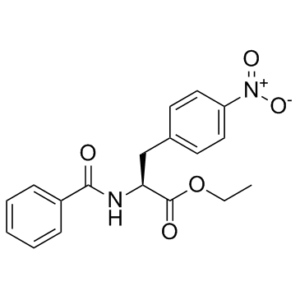
SB297006 (SB-297006) is an antagonist of CCR3 (Chemokine receptor, IC50 = 39 nM) with anticancer activity. It dramatically suppresses neurosphere formation and proliferation in neural progenitor cells treated with CCL11. Leukocytes have CCR3, which is the main receptor for CCL11. Neural progenitor cells (NPCs) exhibited the functional chemokine receptor CCR3, and when CCL11 was applied to NPCs, the CCR3 receptor antagonist SB297006 dramatically reduced NPC proliferation and neurosphere formation.
Physicochemical Properties
| Molecular Formula | C₁₈H₁₈N₂O₅ | |
| Molecular Weight | 342.35 | |
| Exact Mass | 342.122 | |
| Elemental Analysis | C, 63.15; H, 5.30; N, 8.18; O, 23.37 | |
| CAS # | 58816-69-6 | |
| Related CAS # |
|
|
| PubChem CID | 9840971 | |
| Appearance | White to off-white solid powder | |
| Melting Point | 121 °C | |
| LogP | 3.413 | |
| Hydrogen Bond Donor Count | 1 | |
| Hydrogen Bond Acceptor Count | 5 | |
| Rotatable Bond Count | 7 | |
| Heavy Atom Count | 25 | |
| Complexity | 463 | |
| Defined Atom Stereocenter Count | 1 | |
| SMILES | O(C([H])([H])C([H])([H])[H])C([C@]([H])(C([H])([H])C1C([H])=C([H])C(=C([H])C=1[H])[N+](=O)[O-])N([H])C(C1C([H])=C([H])C([H])=C([H])C=1[H])=O)=O |
|
| InChi Key | BEZXGSZPWXRHIN-INIZCTEOSA-N | |
| InChi Code | InChI=1S/C18H18N2O5/c1-2-25-18(22)16(19-17(21)14-6-4-3-5-7-14)12-13-8-10-15(11-9-13)20(23)24/h3-11,16H,2,12H2,1H3,(H,19,21)/t16-/m0/s1 | |
| Chemical Name | ethyl (2S)-2-benzamido-3-(4-nitrophenyl)propanoate | |
| Synonyms |
|
|
| HS Tariff Code | 2934.99.9001 | |
| Storage |
Powder-20°C 3 years 4°C 2 years In solvent -80°C 6 months -20°C 1 month |
|
| Shipping Condition | Room temperature (This product is stable at ambient temperature for a few days during ordinary shipping and time spent in Customs) |
Biological Activity
| Targets | CCR3 |
| ln Vitro | SB297006 is a CCR3 antagonist dramatically reduces neurosphere formation and proliferation in CCL11-treated neural progenitor cells (NPCs) at 100 μM[1]. |
| Cell Assay | Neural progenitor cells (NPCs) are stimulated with CCL11 (2 μg/mL) after 30 minutes of incubation with the CCR3 antagonist SB297006 (100 μM) to assess CCR3 blocking. NPCs are subjected to CCK-8 assays following a 3-day culture period. |
| References |
[1]. CCL11 promotes migration and proliferation of mouse neural progenitor cells. Stem Cell Res Ther. 2017 Feb 7;8(1):26. |
Solubility Data
| Solubility (In Vitro) |
|
|||
| Solubility (In Vivo) |
Solubility in Formulation 1: ≥ 2.5 mg/mL (7.30 mM) (saturation unknown) in 10% DMSO + 40% PEG300 + 5% Tween80 + 45% Saline (add these co-solvents sequentially from left to right, and one by one), clear solution. For example, if 1 mL of working solution is to be prepared, you can add 100 μL of 25.0 mg/mL clear DMSO stock solution to 400 μL PEG300 and mix evenly; then add 50 μL Tween-80 to the above solution and mix evenly; then add 450 μL normal saline to adjust the volume to 1 mL. Preparation of saline: Dissolve 0.9 g of sodium chloride in 100 mL ddH₂ O to obtain a clear solution. Solubility in Formulation 2: ≥ 2.5 mg/mL (7.30 mM) (saturation unknown) in 10% DMSO + 90% Corn Oil (add these co-solvents sequentially from left to right, and one by one), clear solution. For example, if 1 mL of working solution is to be prepared, you can add 100 μL of 25.0 mg/mL clear DMSO stock solution to 900 μL of corn oil and mix evenly. (Please use freshly prepared in vivo formulations for optimal results.) |
| Preparing Stock Solutions | 1 mg | 5 mg | 10 mg | |
| 1 mM | 2.9210 mL | 14.6049 mL | 29.2099 mL | |
| 5 mM | 0.5842 mL | 2.9210 mL | 5.8420 mL | |
| 10 mM | 0.2921 mL | 1.4605 mL | 2.9210 mL |