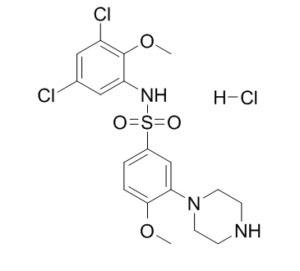
SB 399885 hydrochloride is a novel, potent, brain penetrant, and orally bioactive 5-HT6 receptor antagonist. It exhibits selectivity for SR-6 over other serotonin receptors by more than 200 times (pKi values for human recombinant, native rat, and native human SR-6 receptors, respectively, are 9.11, 8.81, and 9.02). Blockade of postsynaptic 5-HT₆ receptors with systemic administration of SB-399885 and RO-4368554 increases W and reduces SWS and REMS during the light phase of the sleep-wake cycle. Moreover, SB-399885 suppresses REMS during the dark phase. Furthermore, it was established that giving the rat the 5-HT(2A) receptor antagonist EMD 281014 increases SWS in both light-dark cycle phases.
Physicochemical Properties
| Molecular Formula | C18H22CL3N3O4S |
| Molecular Weight | 482.8090 |
| Exact Mass | 481.039 |
| Elemental Analysis | C, 44.78; H, 4.59; Cl, 22.03; N, 8.70; O, 13.26; S, 6.64 |
| CAS # | 402713-81-9 |
| Related CAS # | SB399885; 402713-80-8 |
| PubChem CID | 10277652 |
| Appearance | White to off-white solid powder |
| Hydrogen Bond Donor Count | 3 |
| Hydrogen Bond Acceptor Count | 7 |
| Rotatable Bond Count | 6 |
| Heavy Atom Count | 29 |
| Complexity | 600 |
| Defined Atom Stereocenter Count | 0 |
| SMILES | ClC1=C([H])C(=C([H])C(=C1OC([H])([H])[H])N([H])S(C1C([H])=C([H])C(=C(C=1[H])N1C([H])([H])C([H])([H])N([H])C([H])([H])C1([H])[H])OC([H])([H])[H])(=O)=O)Cl.Cl[H] |
| InChi Key | RNKCEBCFUSXSQE-UHFFFAOYSA-N |
| InChi Code | InChI=1S/C18H21Cl2N3O4S.ClH/c1-26-17-4-3-13(11-16(17)23-7-5-21-6-8-23)28(24,25)22-15-10-12(19)9-14(20)18(15)27-2;/h3-4,9-11,21-22H,5-8H2,1-2H3;1H |
| Chemical Name | N-(3,5-dichloro-2-methoxyphenyl)-4-methoxy-3-piperazin-1-ylbenzenesulfonamide;hydrochloride |
| Synonyms | SB399885 HCl; SB399885; SB399885 hydrochloride; SB 399885; SB-399885 |
| HS Tariff Code | 2934.99.9001 |
| Storage |
Powder-20°C 3 years 4°C 2 years In solvent -80°C 6 months -20°C 1 month Note: Please store this product in a sealed and protected environment, avoid exposure to moisture. |
| Shipping Condition | Room temperature (This product is stable at ambient temperature for a few days during ordinary shipping and time spent in Customs) |
Biological Activity
| Targets | 5-HT6 Receptor |
| ln Vivo | SB-399885 hydrochloride 10 mg/kg, when compared to the control vehicle, significantly increases wakefulness (W) (F(3,15)=3.32, P<0.05), while REM sleep, slow wave sleep, and the number of REM periods decrease (F(3,15)=4.0, P<0.01; F(3,15)=3.14, P<0.05, and F(3,15)=2.62, P<0.05, respectively). According to an analysis of sleep variables in 2-hour blocks, during the first 2-hour period, SB-399885 hydrochloride 10 mg/kg increases W (F(3,15)=5.48, P<0.01) and decreases SWS (F(3,15)=5.42, P<0.01) and REMS (F(3,15)= 4.05, P<0.01). Light sleep is enhanced by SB-399885 hydrochloride at doses of 5 and 10 mg/kg during the first (F(3,15)=3.46, P<0.01 and F(3,15)= 3.65, P<0.01, respectively) and second (F(3,15)=3.23, P<0.05 and F(3,15)=3.08, P<0.05) 2-hour recording periods. SB-399885 hydrochloride 10 mg/kg significantly increases REMS latency (F(3,15)=3.60, P<0.01) and reduces the number of REM periods during the first 2-h of recording (F(3,15)=3.88, P<0.01)[1]. |
| Animal Protocol | At the time of surgery, twelve male Wistar rats weighing between 350 and 400 g are utilized. For four weeks, beginning two hours after the start of the dark period, animals acclimated to a 12-hour light/12-hour dark cycle are given intraperitoneally SB-399885 hydrochloride 2.5, 5 and 10 mg/kg or a vehicle (1% aqueous solution of Tween 80) (n = 6). All twelve treatments are given to each animal. 15 minutes later, recordings start, and they last for 6 hours. Give the control solution and hydrochloride of SB-399885 no less than three days apart[1]. |
| References |
[1]. Effects of the 5-HT6 receptor antagonists SB-399885 and RO-4368554 and of the 5-HT(2A) receptor antagonist EMD 281014 on sleep and wakefulness in the rat during both phases of the light-dark cycle. Behav Brain Res. 2011 Jan 1;216(1):381-8 |
Solubility Data
| Solubility (In Vitro) |
DMSO: ~100 mg/mL (~207.1 mM) H2O: ~6.7 mg/mL (~13.8 mM) |
| Solubility (In Vivo) |
Solubility in Formulation 1: 2.5 mg/mL (5.18 mM) in 10% DMSO + 40% PEG300 + 5% Tween80 + 45% Saline (add these co-solvents sequentially from left to right, and one by one), suspension solution; with sonication. For example, if 1 mL of working solution is to be prepared, you can add 100 μL of 25.0 mg/mL clear DMSO stock solution to 400 μL PEG300 and mix evenly; then add 50 μL Tween-80 to the above solution and mix evenly; then add 450 μL normal saline to adjust the volume to 1 mL. Preparation of saline: Dissolve 0.9 g of sodium chloride in 100 mL ddH₂ O to obtain a clear solution. Solubility in Formulation 2: 2.5 mg/mL (5.18 mM) in 10% DMSO + 90% (20% SBE-β-CD in Saline) (add these co-solvents sequentially from left to right, and one by one), suspension solution; with ultrasonication. For example, if 1 mL of working solution is to be prepared, you can add 100 μL of 25.0 mg/mL clear DMSO stock solution to 900 μL of 20% SBE-β-CD physiological saline solution and mix evenly. Preparation of 20% SBE-β-CD in Saline (4°C,1 week): Dissolve 2 g SBE-β-CD in 10 mL saline to obtain a clear solution. Solubility in Formulation 3: ≥ 2.5 mg/mL (5.18 mM) (saturation unknown) in 10% DMSO + 90% Corn Oil (add these co-solvents sequentially from left to right, and one by one), clear solution. For example, if 1 mL of working solution is to be prepared, you can add 100 μL of 25.0 mg/mL clear DMSO stock solution to 900 μL of corn oil and mix evenly. (Please use freshly prepared in vivo formulations for optimal results.) |
| Preparing Stock Solutions | 1 mg | 5 mg | 10 mg | |
| 1 mM | 2.0712 mL | 10.3560 mL | 20.7121 mL | |
| 5 mM | 0.4142 mL | 2.0712 mL | 4.1424 mL | |
| 10 mM | 0.2071 mL | 1.0356 mL | 2.0712 mL |