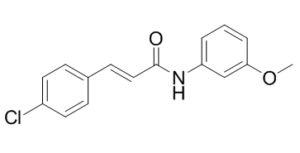
SB-366791 is a competitive and selective cinnamide TRPV1 (Vanilloid receptor 1) antagonist identified via high-throughput screening of a large chemical library. SB-366791 has IC50 of 5.7±1.2 nM. SB-366791 showed a concentration-dependent potentiation of pH 5-induced 45Ca2+uptake in CHO cells expressing rat TRPV1 but not in untransfected cells. In a FLIPR-based Ca(2+)-assay, SB-366791 produced a concentration-dependent inhibition of the response to capsaicin with an apparent pK(b) of 7.74 +/- 0.08. Schild analysis indicated a competitive mechanism of action with a pA2 of 7.71. In electrophysiological experiments, SB-366791 was demonstrated to be an effective antagonist of hTRPV1 when activated by different modalities, such as capsaicin, acid or noxious heat (50 degrees C). Unlike capsazepine, SB-366791 was also an effective antagonist vs. the acid-mediated activation of rTRPV1. In summary, SB-366791 is a new TRPV1 antagonist with high potency and an improved selectivity profile with respect to other commonly used TRPV1 antagonists. SB-366791 may therefore prove to be a useful tool to further study the biology of TRPV1.
Physicochemical Properties
| Molecular Formula | C₁₆H₁₄CLNO₂ | |
| Molecular Weight | 287.74 | |
| Exact Mass | 287.071 | |
| Elemental Analysis | C, 66.79; H, 4.90; Cl, 12.32; N, 4.87; O, 11.12 | |
| CAS # | 472981-92-3 | |
| Related CAS # |
|
|
| PubChem CID | 667594 | |
| Appearance | White to off-white solid powder | |
| Density | 1.3±0.1 g/cm3 | |
| Boiling Point | 494.2±45.0 °C at 760 mmHg | |
| Melting Point | 169 °C | |
| Flash Point | 252.7±28.7 °C | |
| Vapour Pressure | 0.0±1.3 mmHg at 25°C | |
| Index of Refraction | 1.650 | |
| LogP | 4.52 | |
| Hydrogen Bond Donor Count | 1 | |
| Hydrogen Bond Acceptor Count | 2 | |
| Rotatable Bond Count | 4 | |
| Heavy Atom Count | 20 | |
| Complexity | 337 | |
| Defined Atom Stereocenter Count | 0 | |
| SMILES | ClC1C([H])=C([H])C(=C([H])C=1[H])/C(/[H])=C(\[H])/C(N([H])C1C([H])=C([H])C([H])=C(C=1[H])OC([H])([H])[H])=O |
|
| InChi Key | RYAMDQKWNKKFHD-JXMROGBWSA-N | |
| InChi Code | InChI=1S/C16H14ClNO2/c1-20-15-4-2-3-14(11-15)18-16(19)10-7-12-5-8-13(17)9-6-12/h2-11H,1H3,(H,18,19)/b10-7+ | |
| Chemical Name | (E)-3-(4-chlorophenyl)-N-(3-methoxyphenyl)prop-2-enamide | |
| Synonyms |
|
|
| HS Tariff Code | 2934.99.9001 | |
| Storage |
Powder-20°C 3 years 4°C 2 years In solvent -80°C 6 months -20°C 1 month |
|
| Shipping Condition | Room temperature (This product is stable at ambient temperature for a few days during ordinary shipping and time spent in Customs) |
Biological Activity
| Targets |
Transient Receptor Potential Vanilloid 1 (TRPV1/VR1) (Ki = 0.7 nM, radioligand binding assay; IC50 = 9.3 nM for human TRPV1, 6.2 nM for rat TRPV1, 5.8 nM for mouse TRPV1, calcium influx assay) [2] Transient Receptor Potential Vanilloid 1 (TRPV1/VR1) (no additional numerical data, exerts effects by inhibiting TRPV1-mediated synaptic transmission) [1] |
| ln Vitro |
In vitro activity: SB-366791 is a novel, potent, competitive and selective, cinnamide TRPV1 (Vanilloid receptor 1) antagonist isolated via high-throughput screening of a large chemical library. SB-366791 has IC50 of 5.7±1.2 nM. SB-366791 showed a concentration-dependent potentiation of pH 5-induced 45Ca2+uptake in CHO cells expressing rat TRPV1 but not in untransfected cells. In a FLIPR-based Ca(2+)-assay, SB-366791 produced a concentration-dependent inhibition of the response to capsaicin with an apparent pK(b) of 7.74 +/- 0.08. Schild analysis indicated a competitive mechanism of action with a pA2 of 7.71. In electrophysiological experiments, SB-366791 was demonstrated to be an effective antagonist of hTRPV1 when activated by different modalities, such as capsaicin, acid or noxious heat (50 degrees C). Unlike capsazepine, SB-366791 was also an effective antagonist vs. the acid-mediated activation of rTRPV1. In summary, SB-366791 is a new TRPV1 antagonist with high potency and an improved selectivity profile with respect to other commonly used TRPV1 antagonists. SB-366791 may therefore prove to be a useful tool to further study the biology of TRPV1. Kinase Assay: SB-366791 is a novel, potent, competitive and selective, cinnamide TRPV1 (Vanilloid receptor 1) antagonist isolated via high-throughput screening of a large chemical library. SB-366791 has IC50 of 5.7±1.2 nM. Cell Assay: In a FLIPR-based Ca(2+)-assay, SB-366791 produced a concentration-dependent inhibition of the response to capsaicin with an apparent pK(b) of 7.74 +/- 0.08. Schild analysis indicated a competitive mechanism of action with a pA2 of 7.71. In electrophysiological experiments, SB-366791 was demonstrated to be an effective antagonist of hTRPV1 when activated by different modalities, such as capsaicin, acid or noxious heat (50 degrees C). Unlike capsazepine, SB-366791 was also an effective antagonist vs. the acid-mediated activation of rTRPV1. With the aim of defining a useful tool compound, we also profiled SB-366791 in a wide range of selectivity assays. SB-366791 had a good selectivity profile exhibiting little or no effect in a panel of 47 binding assays (containing a wide range of G-protein-coupled receptors and ion channels) and a number of electrophysiological assays including hippocampal synaptic transmission and action potential firing of locus coeruleus or dorsal raphe neurones. Furthermore, unlike capsazepine, SB-366791 had no effect on either the hyperpolarisation-activated current (I(h)) or Voltage-gated Ca(2+)-channels (VGCC) in cultured rodent sensory neurones. In summary, SB-366791 is a new TRPV1 antagonist with high potency and an improved selectivity profile with respect to other commonly used TRPV1 antagonists. SB-366791 may therefore prove to be a useful tool to further study the biology of TRPV1. 1. Acute spinal dorsal horn slices were prepared from rats, and whole-cell patch-clamp recordings were used to measure miniature excitatory postsynaptic currents (mEPSCs). Following peripheral inflammation induced by complete Freund's adjuvant (CFA), application of 10 μM SB-366791 significantly reduced the frequency of mEPSCs by approximately 40% without affecting their amplitude, indicating that the drug inhibits presynaptic glutamate release. Notably, the drug had no significant inhibitory effect on mEPSCs under non-inflammatory conditions, suggesting a selective action in the inflammatory state [1] 2. HEK293 cells transfected with human, rat, or mouse TRPV1 were loaded with calcium indicators. SB-366791 concentration-dependently inhibited capsaicin (1 μM)-induced calcium influx, with IC50 values of 9.3 nM (human TRPV1), 6.2 nM (rat TRPV1), and 5.8 nM (mouse TRPV1) [2] 3. Radioligand binding assays showed that SB-366791 bound to TRPV1 on rat brain cell membranes with a Ki value of 0.7 nM (competitive binding with [3H]RTX) [2] 4. Selectivity experiments demonstrated that SB-366791 had no significant affinity for other TRP channels (TRPV2, TRPV3, TRPV4, TRPA1) with IC50 > 10 μM, nor did it show obvious binding activity to vanilloid receptor-related receptor 1 (VRR1), α1-adrenergic receptors, or 5-HT receptors, indicating high selectivity [2] |
| ln Vivo |
The frequency of small excitatory postsynaptic currents (EPSCs) is inhibited by SB-366791 (30 μM). In the spinal cord slices of rats treated with FCA, the frequency of spontaneous EPSCs is decreased by SB-366791 (30 μM). EPSCs evoked by a C-fiber have their amplitude inhibited by SB-366791 (30 μM). Additionally, SB-366791 has been used in vivo to evaluate the possible analgesic effect of TRPV1 inhibition. It is known to significantly reduce capsaicin-induced hypothermia, eye wiping motions, and knee joint vasodilatation. By blocking glutamatergic transmission, SB-366791 appears to work through pre-synaptic mechanism(s)[1]. 1. A peripheral inflammation model was established in SD rats by intraplantar injection of CFA. Intrathecal administration of 10 μg SB-366791 per rat significantly reduced the frequency of mEPSCs in spinal dorsal horn slices, consistent with in vitro results. No behavioral experiments were mentioned, as the study focused on synaptic transmission [1] 2. In a capsaicin-induced pain model in ICR mice, intraperitoneal injection of SB-366791 (0.3-3 mg/kg) dose-dependently inhibited capsaicin-induced paw licking behavior with an ED50 of 0.8 mg/kg [2] 3. In a hot plate analgesia test in SD rats, intravenous injection of SB-366791 (1-10 mg/kg) significantly prolonged thermal pain latency, with the maximum analgesic effect observed 30 minutes after administration and lasting for approximately 2 hours [2] 4. In a formalin-induced pain model in SD rats, intraperitoneal injection of 3 mg/kg SB-366791 significantly inhibited the second phase of pain response (paw licking time reduced by approximately 50%) without obvious effect on the first phase [2] |
| Enzyme Assay |
1. Radioligand binding assay: Rat brain cell membrane suspensions were prepared and mixed with different concentrations of SB-366791 and a fixed concentration of [3H]RTX (0.2 nM). After incubation at 25℃ for 60 minutes, bound and free ligands were separated by filtration through glass fiber filters. The filters were washed, and radioactivity was measured to calculate the binding rate and Ki value [2] 2. Calcium influx assay: HEK293 cells transfected with TRPV1 were seeded in 96-well plates and loaded with Fura-2 AM calcium indicator. After incubation at 37℃ for 45 minutes and washing, different concentrations of SB-366791 were added and incubated for 10 minutes, followed by the addition of 1 μM capsaicin. Fluorescence intensity ratios at 340/380 nm were detected using a fluorescence microplate reader to reflect calcium influx levels, and IC50 values were calculated [2] |
| Cell Assay |
1. Spinal dorsal horn tissues were acutely isolated from sacrificed rats, and 150 μm thick slices were prepared and incubated in artificial cerebrospinal fluid for 1 hour (32℃, 5% CO2). Whole-cell patch-clamp recordings were performed to measure mEPSCs in layer Ⅱ neurons of the spinal dorsal horn at a holding potential of -70 mV. After stable recording, 10 μM SB-366791 was continuously perfused for 20 minutes to observe changes in mEPSC frequency and amplitude [1] 2. TRPV1-transfected HEK293 cells were cultured in flasks with serum-containing medium until 80% confluence, which were used for calcium influx assays or membrane preparation [2] 3. Primary dorsal root ganglion (DRG) neurons were isolated from rats, digested with trypsin, and seeded in culture dishes coated with matrix. The neurons were cultured in medium containing nerve growth factor for 24-48 hours and used for electrophysiological recordings. After drug treatment, capsaicin-induced current changes were recorded to verify the antagonistic effect of SB-366791 [2] |
| Animal Protocol |
SB-366791 was dissolved in absolute ethanol for stock solutions; Intraplantar (i.p.) injections Swiss mice (20–25 g; 5–7 weeks old) 1. Establishment of peripheral inflammation model: SD rats (200-250 g) were given an intraplantar injection of 50 μL complete Freund's adjuvant (CFA) to induce an inflammatory response, and experiments were performed 48 hours later [1] 2. Intrathecal administration: Rats were anesthetized, and 10 μg SB-366791 (dissolved in 10 μL normal saline) was administered intrathecally through the lumbar interspace. Spinal cord slices were prepared for electrophysiological recordings 30 minutes after administration [1] 3. Capsaicin-induced pain model: ICR mice (20-25 g) were intraperitoneally injected with different doses of SB-366791 (0.3, 1, 3 mg/kg, dissolved in normal saline containing 5% DMSO). Thirty minutes after administration, 20 μL of 0.5% capsaicin was injected into the plantar surface, and paw licking time within 10 minutes was recorded [2] 4. Hot plate test: SD rats (250-300 g) were intravenously injected with SB-366791 (1, 3, 10 mg/kg). Thermal pain latency was measured at 15, 30, 60, and 120 minutes after administration using a 55℃ hot plate [2] 5. Formalin test: SD rats were given an intraplantar injection of 20 μL 5% formalin. Rats in the treatment group received an intraperitoneal injection of 3 mg/kg SB-366791 30 minutes before formalin injection, and paw licking time during the first phase (0-5 minutes) and second phase (15-30 minutes) was recorded [2] |
| ADME/Pharmacokinetics |
In rats, after intravenous administration of 5 mg/kg SB-366791, the plasma clearance was 11 mL/min/kg, the volume of distribution was 0.8 L/kg, and the half-life (t1/2) was 58 minutes; the oral bioavailability after administration of 20 mg/kg was 12% [2] |
| References |
[1]. TRPV1 antagonist, SB-366791, inhibits glutamatergic synaptic transmission in rat spinal dorsal horn following peripheral inflammation. Eur J Pharmacol. 2006;540(1-3):73-81. [2]. Identification and characterisation of SB-366791, a potent and selective vanilloid receptor (VR1/TRPV1) antagonist [published correction appears in Neuropharmacology. 2004 May;46(6):905]. Neuropharmacology. 2004;46(1):133-149. |
| Additional Infomation |
3-(4-chlorophenyl)-N-(3-methoxyphenyl)-2-propenamide is a member of cinnamamides and a secondary carboxamide. 1. As a TRPV1 antagonist, SB-366791 can inhibit presynaptic glutamate release in the spinal dorsal horn under peripheral inflammatory conditions, blocking glutamatergic synaptic transmission, which may exert an analgesic effect. Its mechanism of action is related to regulating presynaptic neurotransmitter release rather than affecting postsynaptic receptor sensitivity [1] 2. SB-366791 is the first identified potent and selective TRPV1 antagonist. It competitively binds to the vanilloid binding site of TRPV1, preventing agonist-induced (e.g., capsaicin, protons, thermal stimulation) channel opening, thereby inhibiting calcium influx and neurotransmitter release to exert analgesic effects. The drug is effective in various pain models with high selectivity and no obvious off-target effects, providing a potential target for pain treatment [2] |
Solubility Data
| Solubility (In Vitro) |
|
|||
| Solubility (In Vivo) |
Solubility in Formulation 1: ≥ 2.5 mg/mL (8.69 mM) (saturation unknown) in 10% DMSO + 40% PEG300 + 5% Tween80 + 45% Saline (add these co-solvents sequentially from left to right, and one by one), clear solution. For example, if 1 mL of working solution is to be prepared, you can add 100 μL of 25.0 mg/mL clear DMSO stock solution to 400 μL PEG300 and mix evenly; then add 50 μL Tween-80 to the above solution and mix evenly; then add 450 μL normal saline to adjust the volume to 1 mL. Preparation of saline: Dissolve 0.9 g of sodium chloride in 100 mL ddH₂ O to obtain a clear solution. Solubility in Formulation 2: 2.5 mg/mL (8.69 mM) in 10% DMSO + 90% (20% SBE-β-CD in Saline) (add these co-solvents sequentially from left to right, and one by one), suspension solution; with ultrasonication. For example, if 1 mL of working solution is to be prepared, you can add 100 μL of 25.0 mg/mL clear DMSO stock solution to 900 μL of 20% SBE-β-CD physiological saline solution and mix evenly. Preparation of 20% SBE-β-CD in Saline (4°C,1 week): Dissolve 2 g SBE-β-CD in 10 mL saline to obtain a clear solution. Solubility in Formulation 3: ≥ 2.5 mg/mL (8.69 mM) (saturation unknown) in 10% DMSO + 90% Corn Oil (add these co-solvents sequentially from left to right, and one by one), clear solution. For example, if 1 mL of working solution is to be prepared, you can add 100 μL of 25.0 mg/mL clear DMSO stock solution to 900 μL of corn oil and mix evenly. (Please use freshly prepared in vivo formulations for optimal results.) |
| Preparing Stock Solutions | 1 mg | 5 mg | 10 mg | |
| 1 mM | 3.4754 mL | 17.3768 mL | 34.7536 mL | |
| 5 mM | 0.6951 mL | 3.4754 mL | 6.9507 mL | |
| 10 mM | 0.3475 mL | 1.7377 mL | 3.4754 mL |