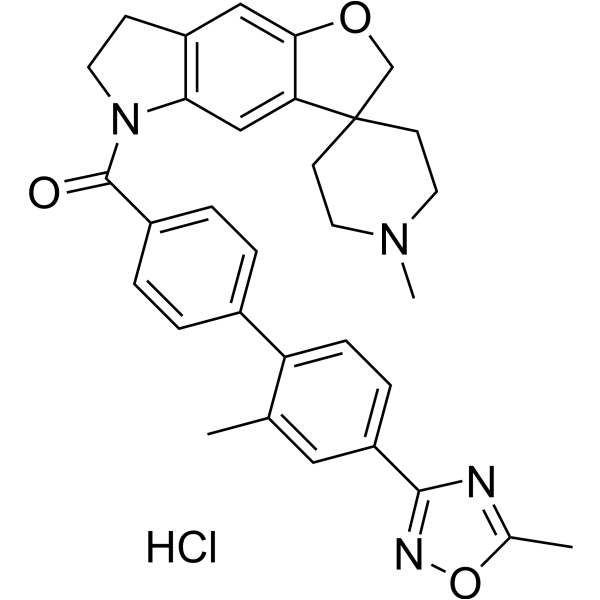
Physicochemical Properties
| Molecular Formula | C32H32N4O3.HCL |
| Molecular Weight | 557.08242 |
| Exact Mass | 556.224 |
| CAS # | 180084-26-8 |
| Related CAS # | SB-224289;180083-23-2 |
| PubChem CID | 11226716 |
| Appearance | White to off-white solid powder |
| Boiling Point | 724.8ºC at 760 mmHg |
| Flash Point | 392.2ºC |
| Vapour Pressure | 7.29E-21mmHg at 25°C |
| LogP | 6.384 |
| Hydrogen Bond Donor Count | 1 |
| Hydrogen Bond Acceptor Count | 6 |
| Rotatable Bond Count | 3 |
| Heavy Atom Count | 40 |
| Complexity | 885 |
| Defined Atom Stereocenter Count | 0 |
| InChi Key | GKGKBZYMDILCOF-UHFFFAOYSA-N |
| InChi Code | InChI=1S/C32H32N4O3.ClH/c1-20-16-25(30-33-21(2)39-34-30)8-9-26(20)22-4-6-23(7-5-22)31(37)36-13-10-24-17-29-27(18-28(24)36)32(19-38-29)11-14-35(3)15-12-32;/h4-9,16-18H,10-15,19H2,1-3H3;1H |
| Chemical Name | [4-[2-methyl-4-(5-methyl-1,2,4-oxadiazol-3-yl)phenyl]phenyl]-(1'-methylspiro[6,7-dihydro-2H-furo[2,3-f]indole-3,4'-piperidine]-5-yl)methanone;hydrochloride |
| Synonyms | SB-224289 hydrochloride; SB-224289A; sb224289 hydrochloride; SB 224289A; SB 224289 HCl; RTX59ZSB74; |
| HS Tariff Code | 2934.99.9001 |
| Storage |
Powder-20°C 3 years 4°C 2 years In solvent -80°C 6 months -20°C 1 month Note: Please store this product in a sealed and protected environment (e.g. under nitrogen), avoid exposure to moisture. |
| Shipping Condition | Room temperature (This product is stable at ambient temperature for a few days during ordinary shipping and time spent in Customs) |
Biological Activity
| Targets |
5-HT1B Receptor Cho1p is not inhibited by SB-224289 hydrochloride, however it does have a particular toxin swelling ability. The hydrochloride of SB-224289 (100 μM–25 μM) consistently showed effectiveness in giving resistance against Pap-A. Additionally, SB-224289 hydrochloride inhibited the activity of babuamide in this in vitro experiment, but not that of other film-disrupting compounds. While SB-224289 hydrochloride can offer protection against TPap, it is unable to preserve wild-type cell scaffold KF connections. Compared to the nearly comparable 5-HT1B receptor, the human cloned 5-HT1B receptor shows a higher pKi of 8 for SB-224289 hydrochloride. -Over 80x axis is displayed by the HT1D receiver and a number of other receivers. Hydrochloride SB-224289 is a strong antagonist with a pEC50 of 7.9±0.1. The hydrochloride of SB-224289 shifts the 5-HT concentration curve parallel to the right, with a pA2 of 8.4±0.2. In guinea pig cerebral cortex slices, SB-224289 hydrochloride (100 nM and 1 μM) also markedly enhanced [3H]-5HT release [3]. |
| ln Vitro |
Cho1p is not inhibited by SB-224289 hydrochloride, however it does have a particular toxin swelling ability. The hydrochloride of SB-224289 (100 μM–25 μM) consistently showed effectiveness in giving resistance against Pap-A. Additionally, SB-224289 hydrochloride inhibited the activity of babuamide in this in vitro experiment, but not that of other film-disrupting compounds. While SB-224289 hydrochloride can offer protection against TPap, it is unable to preserve wild-type cell scaffold KF connections. Compared to the nearly comparable 5-HT1B receptor, the human cloned 5-HT1B receptor shows a higher pKi of 8 for SB-224289 hydrochloride. -Over 80x axis is displayed by the HT1D receiver and a number of other receivers. Hydrochloride SB-224289 is a strong antagonist with a pEC50 of 7.9±0.1. The hydrochloride of SB-224289 shifts the 5-HT concentration curve parallel to the right, with a pA2 of 8.4±0.2. In guinea pig cerebral cortex slices, SB-224289 hydrochloride (100 nM and 1 μM) also markedly enhanced [3H]-5HT release [3]. SB-224289 (at concentrations ranging from 25 μM to 100 μM) confers resistance to wild-type Candida albicans against the lethal effects of the cyclic depsipeptide toxin papuamide A (Pap-A). This protection is highly specific, as SB-224289 does not protect cells against other cytotoxic depsipeptides such as valinomycin or kahalalide F, but does protect against the structurally similar toxin theopapuamide A (TPap-A). [1] Structurally similar analogs or truncated fragments of SB-224289 (including GR-127935, GMC 2-29, SB-216641, and synthesized compounds 2945, 2946, 3047, 3048) do not confer Pap-A resistance, indicating the full molecular structure of SB-224289 is required for its activity. [1] Treatment of wild-type C. albicans with SB-224289 does not induce ethanolamine auxotrophy, a phenotype associated with loss of phosphatidylserine (PS) synthesis. [1] Treatment of wild-type C. albicans with SB-224289 does not cause unmasking of β (1-3)-glucan in the cell wall, another phenotype associated with PS deficiency. [1] |
| ln Vivo |
SB-224289 hydrochloride (SB 224289) may either when used alone or in conjunction with cocaine, exacerbate anxiety-like behaviors. When cocaine is used, SB 224289 dramatically lowers locomotor activity. SB 224289 Compared to animals treated with a vehicle, animals treated in purple stayed considerably longer. [2]. SB 224289 is a strong antagonist that causes guinea pigs to become hypothermic when exposed to SK&F-99101; its bone ED50 is 3.6 mg/kg. Additionally, SB 224289 (4 mg/kg, bone) reversed the suppression of 5-HT release mediated by sumatriptan, suggesting that it is a strong in vivo interstitial 5-HT autoreceptor antagonist. Among guinea pigs, SB 224289 (2-16 mg/kg, bay) does not raise 5-HT in prefrontal potentials. Nonetheless, guinea pigs' dentate gyrus significantly increases 5-HT levels when exposed to SB 224289 (4 mg/kg, wall). [3]. In an open field/novel object exploration test, systemic administration of SB 224289 (5 mg/kg, i.p.) reduced cocaine-induced locomotor activity in rats. SB 224289 increased anxiety-like behavior, both when administered alone and in combination with cocaine, as measured by increased time spent in the corners of the open field and increased latency to exit the start box.[2] |
| Enzyme Assay |
Phosphatidylserine synthase assay[1] This procedure was done as described in with minor alterations. Cultures were grown overnight and then diluted to approximately 0.1 OD600/ml in 1 L YPD, and were shaken at 30°C for 6 to 10 hours. Cells were harvested by centrifugation at 6,000 x g for 20 minutes. Pellets were then transferred to 50 ml conical tubes and washed with water and re-pelleted. Supernatant was removed and the wet weight of the samples was taken. Cell pellets were stored overnight at -80°C. The following day, a cold mixture of 0.1 M Tris-Cl pH 7.5, 5 mM β-mercaptoethanol (BME), 10% glycerol, and protease inhibitors 1.7 μg/ml PMSF, 1 μg/ml leupeptin, and 1 μg/ml pepstatin was added to the frozen pellets (1 ml/g [wet weight]) and allowed to thaw on ice. Cells were lysed using a French press (three passes at approximately 13,000 lb/in2). The homogenate was centrifuged at 4°C for 5 minutes at 3,000 rpm to clear unbroken cells and heavy material. Supernatant was then spun again at 27,000 x g for 10 minutes at 4°C. For some experiments, the resulting supernatant was then spun at 100,000 x g to collect the lower density membranes. Pellets were resuspended in 500 μl to 1 ml of 0.1 M Tris-Cl pH 7.5, 5 mM BME, 10% glycerol, and protease inhibitors. This mixture was aliquoted into microcentrifuge tubes and homogenized to break apart clumps, keeping on ice as much as possible. Total crude protein concentration was determined using a Bradford Assay. The optimal assay mixture contained 50 mM Tris-HCl pH 7.5, 0.1% Triton X-100, 0.5 mM MnCl2, 0.1 mM CDP-DAG added as a suspension in 1% - 20% Triton X-100, and 0.4–0.5 mg protein in a total volume of 0.1 ml. SB-224289 and MG-624 were added to the reaction mixture at varying concentrations to monitor their ability to inhibit [3H]-PS production. The PS synthase assay was performed by monitoring the incorporation of 0.5 mM l-serine spiked with 5% [3H]-l-serine (or 0.02 μM) into the chloroform-soluble product at 37°C for a predetermined amount of time. The reaction was terminated by the addition of 1 ml chloroform: methanol (2:1). Following a low-speed spin, 800–1000 μl of the supernatant was removed to a fresh tube and washed with 200 μl 0.9% NaCl. Following a second low-speed spin, 400–500 μl of the organic phase was removed to a new tube and washed with 500 μl of chloroform: methanol: 0.9% NaCl (3:48:47). Following a third low-speed spin, 200–300 μl was transferred into scintillation vials. Tubes were dried under the chemical hood and 2.5 ml Cytoscint-ES liquid scintillation cocktail.was added to each tube and counted in a Packard TriCarb 2900TR Liquid Scintillation Analyzer. SB-224289 has a pKi of 8.1 at human cloned 5-HT1B receptors and displays ≥80 fold selectivity over the closely related 5-HT1D receptor and a range of other receptors. In [35S]GTPγS radioligand binding studies in CHO cells expressing human cloned 5-HT1B receptors, SB-224289 behaves as a potent inverse agonist with pEC50 = 7.9 ± 0.1 (5-HT, pEC50 = 7.8 ± 0.1, -GR127935, pEC50 = 8.1 ± 0.1). In antagonist studies in this system SB-224289 evoked a parallel rightward shift in the 5-HT concentration response curve with pA2 of 8.4 ± 0.2. At concentrations of 100 nM and 1 mM, SB-224289 significantly increased [3H]5-HT release in electrically stimulated guinea-pig brain cortex slices demonstrating that it is a terminal 5-HT autoreceptor antagonist in vitro[3]. A phosphatidylserine (PS) synthase (Cho1p) activity assay was performed using cell-free extracts from Candida albicans. The assay mixture contained Tris-HCl buffer (pH 7.5), Triton X-100, MnCl2, CDP-diacylglycerol, and L-serine (including trace amounts of tritiated L-serine). The reaction was incubated at 37°C and terminated by adding chloroform:methanol. The incorporation of radiolabeled serine into chloroform-soluble PS was measured by liquid scintillation counting. The addition of varying concentrations of SB-224289 to this assay did not inhibit the enzymatic activity of Cho1p, indicating that SB-224289 is not a direct inhibitor of the PS synthase enzyme. [1] |
| Cell Assay |
Papuamide A resistance assay[1] Strains were grown overnight in liquid YPD shaking at 30°C to saturation, and cultures were diluted to 2 x 10⁴ cells/ml in YPD. Compounds of interest were diluted to twice the working concentration by serial dilution in a 96 well plate or by preparing separately and adding to the wells directly, in a volume of 37.5 μl of YPD. Then 37.5 μl of cells at 2 x 10⁴ cells/ml in YPD were added. Plates were incubated at 37°C for 6 hours or 3 hours depending on the experiment, and then 75 μl of YPD containing depsipeptide (Pap-A at 8 μg/ml, VA at 6 μg/ml, KF at 30 μg/ml, or TPap-A at 12 μg/ml) were added to each well, diluting those concentrations by half. This addition was followed by a 37°C overnight incubation. Cell survival was measured the next day by fluorescence intensity or optical density. For fluorescence intensity, Alamar Blue was added to the wells at a 1:10 dilution. Plates were allowed to incubate again at 37°C for 30 minutes to 2 hours until color change was apparent. Fluorescence was then read at excitation 550 nm and emission 590 nm. For optical density, plates were removed from overnight incubation and absorbance was read in a plate reader at a wavelength of 600 nm. All measurements were performed on a Cytation3 BioTek plate reader using Gen 5 software. A high-throughput Pap-A resistance assay was developed. Wild-type C. albicans cells were diluted and dispensed into 384-well plates containing test compounds (final concentration 50-75 μM). After a 6-hour pre-incubation at 37°C, Pap-A was added to a final concentration of 4 μg/ml. Plates were incubated overnight at 37°C. Cell survival was quantified the next day by adding a resazurin-based viability dye (Alamar Blue) and measuring fluorescence (excitation 550 nm/emission 590 nm). [1] For dose-response and specificity assays, cells were treated with serial dilutions of SB-224289 (or other compounds) for 3 or 6 hours at 37°C, followed by the addition of a lethal dose of Pap-A, theopapuamide A (TPap-A), valinomycin (VA), or kahalalide F (KF). After overnight incubation, cell survival was measured either by optical density at 600 nm or by the Alamar Blue fluorescence method. [1] To assess β (1-3)-glucan exposure, wild-type C. albicans cells were treated with SB-224289 for 3 hours, then stained with a β (1-3)-glucan antibody and visualized by epifluorescence microscopy. [1] |
| Animal Protocol |
In an in vivo model of 5-HT1B receptor function, SK&F-99101-induced hypothermia in the guinea-pig, SB-224289 was a potent antagonist with an ED50 of 3.6 mg/kg p.o. In microdialysis studies in the frontal cortex of the freely moving guinea-pig, SB-224289 (4 mg/kg p.o.) reversed sumatriptan-induced inhibition of 5-HT release demonstrating that it is also a potent terminal 5-HT autoreceptor antagonist in vivo. In the guinea-pig frontal cortex SB-224289 alone (2–16 mg/ kg p.o.) did not increase 5-HT levels. In contrast, in the guinea-pig dentate gyrus, SB-224289 evoked a significant increase in levels of 5-HT at 4 mg/kg p.o. These results may reflect regional differences in terminal 5-HT autoreceptor tone[3]. SB-224289 and cocaine experiment[2] Day 1: Each animal was injected with sterile saline (1 ml/kg ip) immediately before it was placed in the start box.[2] Day 2: Ninety minutes before each animal was tested, it received an ip injection of either 5 mg/kg SB 224289 in a vehicle of 10% Trappsol in sterile water or vehicle alone (total volume 1 ml/kg). This dosage of this drug has been shown to be effective as a pharmacological agent in previous studies. The rat was put back in its home cage until just before it was to be tested. Just prior to testing, each rat was injected with cocaine (15 mg/kg ip) dissolved in sterile saline (15 mg/ml) or with saline alone as a control. Validation experiment To validate the usefulness of this procedure as a measure of anxiety, a validation test was performed using diazepam. Seven animals were used in each experimental group. The animals were unique to this study. Day 1: Each animal was injected with sterile saline (1 ml/kg ip) immediately before it was placed in the start box. Day 2: Fifteen minutes before each animal was tested, it received an ip injection of either 0.5 mg/kg diazepam or vehicle alone (total volume 1 ml/kg). This dosage has been shown to have anxiolytic effects without seriously impairing motor function. The animal was put back in its home cage until just before it was to be tested. Analysis: The validation experiments were analyzed using a two-tailed t-test. All the SB 224289/cocaine data were analyzed using a 2×2 ANOVA (SB 224289×cocaine). Scheffe's post hoc test was used where appropriate. All analysis was performed with the Statistica™ software package. Analysis of latency to exit was performed using Fischerˈs exact test. Analysis excluded any effects of time or order of testing on any results on either day. Male Sprague–Dawley rats (250–300 g) were used. SB 224289 was dissolved in a vehicle of 10% Trappool in sterile water and administered intraperitoneally at a dose of 5 mg/kg (1 mL/kg) 90 minutes before behavioral testing. Cocaine was dissolved in sterile saline (15 mg/mL) and administered intraperitoneally at a dose of 15 mg/kg just prior to testing. The open field/novel object task was conducted over two days. On day 1, all animals received saline. On day 2, animals received either SB 224289 or vehicle, followed by cocaine or saline. Behavioral parameters including latency to exit start box, distance traveled, time in corners/center, and novel object exploration were recorded.[2] |
| References |
[1]. SB-224289 Antagonizes the Antifungal Mechanism of the Marine Depsipeptide Papuamide A. PLoS One. 2016 May 16;11(5):e0154932. [2]. The effects of SB 224289 on anxiety and cocaine-related behaviors in a novel object task. Physiol Behav. 2005 Apr 13;84(5):707-14. Epub 2005 Apr 13. [3]. The selective 5-HT1B receptor inverse agonist SB-224289, potently blocks terminal 5-HT autoreceptor function both in vitro and in vivo. Ann N Y Acad Sci. 1998 Dec 15;861:270-1. |
| Additional Infomation |
SB 224289 hydrochloride is a hydrochloride that is the monohydrochloride salt of SB 224289. Selective 5-HT1B receptor antagonist (pKi = 8.2). Displays >60-fold selectivity over 5-HT1D, 5-HT1A, 5-HT1E, 5-HT1F, 5-HT2A and 5-HT2C receptors in radioligand binding and functional assays. Centrally active following oral administration in vivo. It has a role as a prodrug and a serotonergic antagonist. It contains a SB 224289(1+). SB-224289 was identified from a phenotypic screen of ~5,600 bioactive compounds designed to find inhibitors of the fungal phosphatidylserine synthase (Cho1p), using resistance to the PS-binding toxin Pap-A as a readout. [1] The mechanism by which SB-224289 antagonizes Pap-A (and TPap-A) toxicity is not through inhibition of PS synthesis. It may involve a direct physical interaction with the toxin or an indirect cellular protective response. The specificity of the interaction suggests the screening assay could be adapted to discover antagonists for other medically or environmentally relevant membrane-active toxins. [1] SB 224289 is used to study the role of 5-HT1B receptors in cocaine-related behaviors and anxiety. It may reduce some behavioral effects of cocaine (e.g., hyperlocomotion) but can also increase anxiety-like behavior, which may limit its therapeutic potential for cocaine abuse. The effects of SB 224289 are likely mediated through 5-HT1B receptors in mesolimbic circuits, possibly involving GABAergic terminals in the VTA.[2] |
Solubility Data
| Solubility (In Vitro) |
DMSO : ~8.33 mg/mL (~14.95 mM) H2O : < 0.1 mg/mL |
| Solubility (In Vivo) |
Solubility in Formulation 1: ≥ 0.83 mg/mL (1.49 mM) (saturation unknown) in 10% DMSO + 40% PEG300 + 5% Tween80 + 45% Saline (add these co-solvents sequentially from left to right, and one by one), clear solution. For example, if 1 mL of working solution is to be prepared, you can add 100 μL of 8.3 mg/mL clear DMSO stock solution to 400 μL of PEG300 and mix evenly; then add 50 μL of Tween-80 to the above solution and mix evenly; then add 450 μL of normal saline to adjust the volume to 1 mL. Preparation of saline: Dissolve 0.9 g of sodium chloride in 100 mL ddH₂ O to obtain a clear solution. Solubility in Formulation 2: ≥ 0.83 mg/mL (1.49 mM) (saturation unknown) in 10% DMSO + 90% (20% SBE-β-CD in Saline) (add these co-solvents sequentially from left to right, and one by one), clear solution. For example, if 1 mL of working solution is to be prepared, you can add 100 μL of 8.3 mg/mL clear DMSO stock solution to 900 μL of 20% SBE-β-CD physiological saline solution and mix evenly. Preparation of 20% SBE-β-CD in Saline (4°C,1 week): Dissolve 2 g SBE-β-CD in 10 mL saline to obtain a clear solution. Solubility in Formulation 3: ≥ 0.83 mg/mL (1.49 mM) (saturation unknown) in 10% DMSO + 90% Corn Oil (add these co-solvents sequentially from left to right, and one by one), clear solution. For example, if 1 mL of working solution is to be prepared, you can add 100 μL of 8.3 mg/mL clear DMSO stock solution to 900 μL of corn oil and mix evenly. (Please use freshly prepared in vivo formulations for optimal results.) |
| Preparing Stock Solutions | 1 mg | 5 mg | 10 mg | |
| 1 mM | 1.7951 mL | 8.9754 mL | 17.9507 mL | |
| 5 mM | 0.3590 mL | 1.7951 mL | 3.5901 mL | |
| 10 mM | 0.1795 mL | 0.8975 mL | 1.7951 mL |