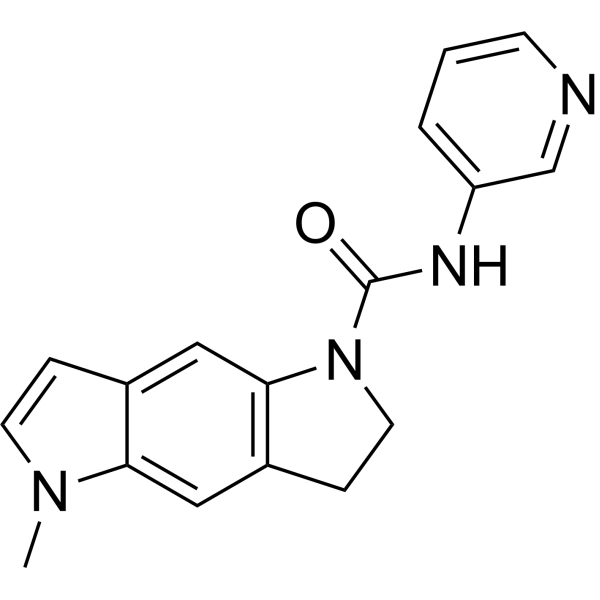
Physicochemical Properties
| Molecular Formula | C17H16N4O |
| Exact Mass | 292.132 |
| CAS # | 158942-04-2 |
| PubChem CID | 5163 |
| Appearance | Typically exists as solid at room temperature |
| Density | 1.33 g/cm3 |
| Boiling Point | 575.4ºC at 760 mmHg |
| Melting Point | 250 - 252ºC |
| Flash Point | 301.8ºC |
| Vapour Pressure | 3.04E-13mmHg at 25°C |
| LogP | 3.305 |
| Hydrogen Bond Donor Count | 1 |
| Hydrogen Bond Acceptor Count | 2 |
| Rotatable Bond Count | 1 |
| Heavy Atom Count | 22 |
| Complexity | 429 |
| Defined Atom Stereocenter Count | 0 |
| InChi Key | QJQORSLQNXDVGE-UHFFFAOYSA-N |
| InChi Code | InChI=1S/C17H16N4O/c1-20-7-4-12-10-16-13(9-15(12)20)5-8-21(16)17(22)19-14-3-2-6-18-11-14/h2-4,6-7,9-11H,5,8H2,1H3,(H,19,22) |
| Chemical Name | 1-methyl-N-pyridin-3-yl-6,7-dihydropyrrolo[2,3-f]indole-5-carboxamide |
| Synonyms | 158942-04-2; SB 206553; SB-206553; 5-Methyl-N-(pyridin-3-yl)-2,3-dihydropyrrolo[2,3-f]indole-1(5H)-carboxamide; Benzo(1,2-b:4,5-b')dipyrrole-1(2H)-carboxamide, 3,5-dihydro-5-methyl-N-3-pyridinyl-; 1-methyl-N-pyridin-3-yl-6,7-dihydropyrrolo[2,3-f]indole-5-carboxamide; |
| HS Tariff Code | 2934.99.9001 |
| Storage |
Powder-20°C 3 years 4°C 2 years In solvent -80°C 6 months -20°C 1 month |
| Shipping Condition | Room temperature (This product is stable at ambient temperature for a few days during ordinary shipping and time spent in Customs) |
Biological Activity
| Targets | pKi: 5.6 nM (5-HT2A), 7.7 nM (5-HT2B) and 7.8 nM (5-HT2C)[1]. |
| ln Vitro |
SB 206553 (5-methyl-1-(3-pyridylcarbamoyl)-1,2,3,5-tetrahydropyrrolo[2,3-f]indole) displays a high affinity (pK1 7.9) for the cloned human 5-HT2C receptor expressed in HEK 293 cells and the 5-HT2B receptor (pA2 8.9) as measured in the rat stomach fundus preparation. SB 206553 has low affinity for cloned human 5-HT2A receptors expressed in HEK 293 cells (pK1 5.8) and (pK1 <6) for a wide variety of other neurotransmitter receptors.[3] SB 206553 appears to be a surmountable antagonist of 5-HT-stimulated phosphoinositide hydrolysis in HEK 293 cells expressing the human 5-HT2C receptor (pKB 9.0). [3] |
| ln Vivo |
At similar doses (2–20 mg kg−1, p.o.) SB 206553 increased total interaction scores in a rat social interaction test and increased punished responding in a rat Geller-Seifter conflict test. These effects are consistent with the possession of anxiolytic properties.[2] SB 206553 also increased suppressed responding in a marmoset conflict model of anxiety at somewhat higher doses (15 and 20 mg kg−1, p.o.) but also reduced unsuppressed responding.[3] These results suggest that SB 206553 is a potent mixed 5-HT2C/5-HT2B receptor antagonist with selectivity over the 5-HT2A and all other sites studied and possesses anxiolytic-like properties.[3] |
| Animal Protocol |
SB 206553 (SB206), a 5-HT2C inverse agonist, was dissolved in 1 % lactic acid in deionized water and injected ip (1.0, 5.0, and 10.0 mg/kg). Serotonin2C ligands were administered in volumes of 1.0 ml/kg with the exception of 10.0 mg/kg SB206, which was administered at 2 ml/kg (from a 5.0 mg/ml stock solution). All drugs were administered as the base. pKi values of SDZ, SB242 and SB206 for 5-HT2 receptor subtypes are provided in Table 1. [1] Cue reactivity testing[1] Rats were tested for CR after a 30 min pretreatment of 0.1, 0.3, 1.0 mg/kg SDZ and vehicle (treatment group 1) or 1.0, 5.0, 10.0 mg/kg SB 206553 (SB206), and vehicle (group 2). The 5-HT2C receptor antagonist, SB242, was tested against the 5-HT2C receptor inverse agonist SB 206553 (SB206) in the same rats, wherein SB242 (3.0 mg/kg ip) was administered 45 min, and SB206 (5.0 or 10.0 mg/kg ip) was administered 30 min, prior to the onset of CR testing. Dose order was randomized for all treatment groups. Doses of SB206 and SB242 were guided by literature demonstrating significant neurochemical effects in the nucleus accumbens. Doses of SDZ were selected based on reports revealing an enhancement of the interoceptive cues of cocaine and cocaine-evoked motor activity in naïve rats. [1] Motor assessments[1] A subset of rats tested for CR dose–response assessments was used to determine the motor effects of SDZ (1.0 mg/kg ip) and SB 206553 (SB206) (5.0 and 10.0 mg/kg ip) in the presence and absence of meth (1.0 mg/kg ip). For this study, rats were withdrawn from meth and remained in their home cages during protocol days 28–32 and received no treatment (refer to Figure 1). After this 5 day period, rats were tested for motor activity for 3 consecutive days (days 33–35). All motor assessments were conducted using automated small animal activity boxes equipped with two banks of photobeams positioned at different heights to characterize motor activity in three dimensional space. Rats were habituated to activity chambers for 1 hr prior to each motor test. On day 33, rats were administered 1 ml/kg of the respective vehicle for each test drug (rats for effects of SDZ were administered saline and rats tested for SB 206553 (SB206)-induced effects were administered 1 % lactic acid in deionized water). The injected rats were immediately returned to motor boxes for 1 hr after which rats were injected with either SDZ (1.0 mg/kg), or SB 206553 (SB206) (5.0 or 10.0 mg/kg) and behavior was recorded for an additional 1 hr. Motor data collected 30 min post-injection were subsequently analyzed; this time frame reflected the one that was relevant to CR behaviors. On day 34, rats were administered a 30 min pretreatment of vehicle (saline or 1 % lactic acid), then administered 1 mg/kg meth (ip) and behavior recorded for 1 hr. On day 35, the procedure from day 34 was repeated using SDZ (1.0 mg/kg), or SB 206553 (SB206) (5.0 or 10.0 mg/kg) (ip) instead of respective vehicles. Peak meth effects occurred 15 min post meth injection; meth-evoked motor activity was therefore analyzed for the last 45 min of testing (i.e., 15 min post meth injection). Horizontal activity (number of beam breaks in the horizontal plane), vertical activity (number of beam breaks in the vertical plane indicating rearing-like behavior), and total distance (cm traversed within the chamber) were recorded. These assessments provide a reliable index of overall motor patterns evoked by this dose of meth. Stereotypy (rapid, repetitive behaviors) is a prominent component of meth-induced motor activity; therefore, stereotypy number (the number of beam breaks repetitively disrupted) also was analyzed for meth-evoked motor activity. Rats tested for effects of SDZ on motor function were also tested for SDZ effects on CR; similarly, rats tested for effects of SB 206553 (SB206)on motor function had prior exposure to SB 206553 (SB206) during CR assessments. Like mirtazapine, pretreatment with SB 206553 (SB206) (1.0, 5.0, and 10.0 mg/kg), attenuated meth-seeking. In contrast, the antagonists, SDZ Ser 082 (0.1, 0.3, and 1.0 mg/kg) and SB 242084 (3.0 mg/kg) had no effect on cue reactivity (CR). SB 242084 (3.0 mg/kg) failed to attenuate the effects of 5.0 and 10 mg/kg SB 206553 on CR. Motor function was largely unaltered by the 5-HT2C ligands; however, SB 206553 (SB206), at the highest dose tested (10.0 mg/kg), attenuated meth-induced rearing behavior. Conclusions: The lack of effect by 5-HT2C antagonists suggests that meth-seeking and meth-evoked motor activity are independent of endogenous 5-HT acting at 5-HT2C receptors. While SB 206553 (SB206) dramatically impacted meth-evoked behaviors it is unclear whether the observed effects were 5-HT2C receptor mediated. Thus, SB 206553 deserves further attention in the study of psychostimulant abuse disorders.[1] |
| References |
[1].SB 206553, a putative 5-HT2C inverse agonist, attenuates methamphetamine-seeking in rats. BMC Neurosci. 2012 Jun 14;13:65. [2].5-Methyl-1-(3-pyridylcarbamoyl)-1,2,3,5-tetrahydropyrrolo[2,3-f]indole: a novel 5-HT2C/5-HT2B receptor antagonist with improved affinity, selectivity, and oral activity. J Med Chem. 1995 Jul 7;38(14):2524-30. |
| Additional Infomation |
SB 206553 (SB206) is a pyrroloindole. Background: Methamphetamine (meth) dependence presents a substantial socioeconomic burden. Despite the need, there is no FDA-approved pharmacotherapy for psychostimulant dependence. We consider 5-HT2C receptors as viable therapeutic targets. We recently revealed that the atypical antidepressant, mirtazapine, attenuates meth-seeking in a rodent model of human substance abuse. Mirtazapine historically has been considered to be an antagonist at 5-HT2C receptors, but more recently shown to exhibit inverse agonism at constitutively active 5-HT2C receptors. To help distinguish the roles for antagonism vs. inverse agonism, here we explored the ability of a more selective 5-HT2C inverse agonist, SB 206553 (SB206) to attenuate meth-seeking behavior, and compared its effects to those obtained with 5-HT2C antagonists, SDZ Ser 082 and SB 242084. To do so, rats were trained to self-administer meth and tested for seeking-like behavior in cue reactivity sessions consisting of contingently presenting meth-associated cues without meth reinforcement. We also explored motor function to determine the influence of SB 206553 and SDZ Ser 082 on motor activity in the presence and absence of meth. Results: Like mirtazapine, pretreatment with SB 206553 (1.0, 5.0, and 10.0 mg/kg), attenuated meth-seeking. In contrast, the antagonists, SDZ Ser 082 (0.1, 0.3, and 1.0 mg/kg) and SB 242084 (3.0 mg/kg) had no effect on cue reactivity (CR). SB 242084 (3.0 mg/kg) failed to attenuate the effects of 5.0 and 10 mg/kg SB 206553 on CR. Motor function was largely unaltered by the 5-HT2C ligands; however, SB 206553, at the highest dose tested (10.0 mg/kg), attenuated meth-induced rearing behavior. Conclusions: The lack of effect by 5-HT2C antagonists suggests that meth-seeking and meth-evoked motor activity are independent of endogenous 5-HT acting at 5-HT2C receptors. While SB 206553 dramatically impacted meth-evoked behaviors it is unclear whether the observed effects were 5-HT2C receptor mediated. Thus, SB 206553 deserves further attention in the study of psychostimulant abuse disorders.[1] |
Solubility Data
| Solubility (In Vitro) | Typically soluble in DMSO (e.g. 10 mM) |
| Solubility (In Vivo) |
Note: Listed below are some common formulations that may be used to formulate products with low water solubility (e.g. < 1 mg/mL), you may test these formulations using a minute amount of products to avoid loss of samples. Injection Formulations (e.g. IP/IV/IM/SC) Injection Formulation 1: DMSO : Tween 80: Saline = 10 : 5 : 85 (i.e. 100 μL DMSO stock solution → 50 μL Tween 80 → 850 μL Saline) *Preparation of saline: Dissolve 0.9 g of sodium chloride in 100 mL ddH ₂ O to obtain a clear solution. Injection Formulation 2: DMSO : PEG300 :Tween 80 : Saline = 10 : 40 : 5 : 45 (i.e. 100 μL DMSO → 400 μLPEG300 → 50 μL Tween 80 → 450 μL Saline) Injection Formulation 3: DMSO : Corn oil = 10 : 90 (i.e. 100 μL DMSO → 900 μL Corn oil) Example: Take the Injection Formulation 3 (DMSO : Corn oil = 10 : 90) as an example, if 1 mL of 2.5 mg/mL working solution is to be prepared, you can take 100 μL 25 mg/mL DMSO stock solution and add to 900 μL corn oil, mix well to obtain a clear or suspension solution (2.5 mg/mL, ready for use in animals). Injection Formulation 4: DMSO : 20% SBE-β-CD in saline = 10 : 90 [i.e. 100 μL DMSO → 900 μL (20% SBE-β-CD in saline)] *Preparation of 20% SBE-β-CD in Saline (4°C,1 week): Dissolve 2 g SBE-β-CD in 10 mL saline to obtain a clear solution. Injection Formulation 5: 2-Hydroxypropyl-β-cyclodextrin : Saline = 50 : 50 (i.e. 500 μL 2-Hydroxypropyl-β-cyclodextrin → 500 μL Saline) Injection Formulation 6: DMSO : PEG300 : castor oil : Saline = 5 : 10 : 20 : 65 (i.e. 50 μL DMSO → 100 μLPEG300 → 200 μL castor oil → 650 μL Saline) Injection Formulation 7: Ethanol : Cremophor : Saline = 10: 10 : 80 (i.e. 100 μL Ethanol → 100 μL Cremophor → 800 μL Saline) Injection Formulation 8: Dissolve in Cremophor/Ethanol (50 : 50), then diluted by Saline Injection Formulation 9: EtOH : Corn oil = 10 : 90 (i.e. 100 μL EtOH → 900 μL Corn oil) Injection Formulation 10: EtOH : PEG300:Tween 80 : Saline = 10 : 40 : 5 : 45 (i.e. 100 μL EtOH → 400 μLPEG300 → 50 μL Tween 80 → 450 μL Saline) Oral Formulations Oral Formulation 1: Suspend in 0.5% CMC Na (carboxymethylcellulose sodium) Oral Formulation 2: Suspend in 0.5% Carboxymethyl cellulose Example: Take the Oral Formulation 1 (Suspend in 0.5% CMC Na) as an example, if 100 mL of 2.5 mg/mL working solution is to be prepared, you can first prepare 0.5% CMC Na solution by measuring 0.5 g CMC Na and dissolve it in 100 mL ddH2O to obtain a clear solution; then add 250 mg of the product to 100 mL 0.5% CMC Na solution, to make the suspension solution (2.5 mg/mL, ready for use in animals). Oral Formulation 3: Dissolved in PEG400 Oral Formulation 4: Suspend in 0.2% Carboxymethyl cellulose Oral Formulation 5: Dissolve in 0.25% Tween 80 and 0.5% Carboxymethyl cellulose Oral Formulation 6: Mixing with food powders Note: Please be aware that the above formulations are for reference only. InvivoChem strongly recommends customers to read literature methods/protocols carefully before determining which formulation you should use for in vivo studies, as different compounds have different solubility properties and have to be formulated differently. (Please use freshly prepared in vivo formulations for optimal results.) |