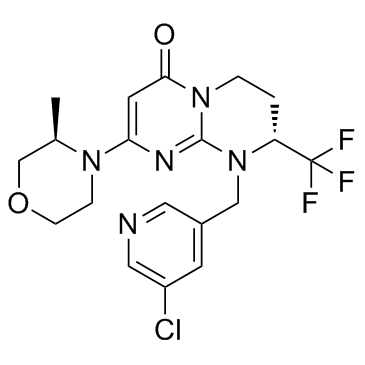
Physicochemical Properties
| Molecular Formula | C19H21CLF3N5O2 |
| Molecular Weight | 443.850553274155 |
| Exact Mass | 443.133 |
| CAS # | 1946010-79-2 |
| Related CAS # | SAR405;1523406-39-4 |
| PubChem CID | 91933781 |
| Appearance | White to off-white solid powder |
| Density | 1.5±0.1 g/cm3 |
| Boiling Point | 526.5±60.0 °C at 760 mmHg |
| Flash Point | 272.2±32.9 °C |
| Vapour Pressure | 0.0±1.4 mmHg at 25°C |
| Index of Refraction | 1.635 |
| LogP | 1.97 |
| Hydrogen Bond Donor Count | 0 |
| Hydrogen Bond Acceptor Count | 8 |
| Rotatable Bond Count | 3 |
| Heavy Atom Count | 30 |
| Complexity | 731 |
| Defined Atom Stereocenter Count | 2 |
| SMILES | C[C@@H]1COCCN1C2=CC(=O)N3CC[C@@H](N(C3=N2)CC4=CC(=CN=C4)Cl)C(F)(F)F |
| InChi Key | SPDQRCUBFSRAFI-IUODEOHRSA-N |
| InChi Code | InChI=1S/C19H21ClF3N5O2/c1-12-11-30-5-4-26(12)16-7-17(29)27-3-2-15(19(21,22)23)28(18(27)25-16)10-13-6-14(20)9-24-8-13/h6-9,12,15H,2-5,10-11H2,1H3/t12-,15-/m1/s1 |
| Chemical Name | (8R)-9-[(5-chloropyridin-3-yl)methyl]-2-[(3R)-3-methylmorpholin-4-yl]-8-(trifluoromethyl)-7,8-dihydro-6H-pyrimido[1,2-a]pyrimidin-4-one |
| HS Tariff Code | 2934.99.9001 |
| Storage |
Powder-20°C 3 years 4°C 2 years In solvent -80°C 6 months -20°C 1 month |
| Shipping Condition | Room temperature (This product is stable at ambient temperature for a few days during ordinary shipping and time spent in Customs) |
Biological Activity
| Targets |
1. PIK3C3/Vps34 (class III phosphatidylinositol 3-kinase, IC50 = 1.5 nM; the compound shows high selectivity against other lipid and protein kinases with no significant inhibition at concentrations up to 100 nM) [1] |
| ln Vitro |
1. Kinase inhibitory activity: SAR405 R enantiomer is a highly potent and selective inhibitor of PIK3C3/Vps34 with an IC50 of 1.5 nM; it exhibits no obvious inhibitory effect on other lipid kinases (e.g., class I PI3K isoforms) and protein kinases at concentrations up to 100 nM, confirming its target specificity [1] 2. Autophagy inhibition: SAR405 R enantiomer effectively blocks autophagy induced by either nutrient starvation or MTOR inhibition in tumor cells. In starvation-induced autophagy models, treatment with the compound (10 nM) reduces the formation of autophagosomes by 82% and inhibits the conversion of LC3-I to LC3-II (a marker of autophagosome formation) by 78% at 12 h post-treatment; in MTOR inhibitor (everolimus)-induced autophagy models, 10 nM of the compound suppresses LC3-II accumulation by 75% [1] 3. Vesicle trafficking disruption: SAR405 R enantiomer (5-20 nM) disrupts vesicle trafficking from late endosomes to lysosomes in tumor cells, as evidenced by the accumulation of late endosome markers (e.g., Rab7) and reduced colocalization of late endosomes with lysosomes (colocalization rate decreased from 68% in control to 22% at 20 nM) [1] 4. Synergistic anti-proliferative effect with MTOR inhibition: In renal tumor cells, combination treatment with SAR405 R enantiomer (5 nM) and everolimus (10 nM) results in a significant synergistic reduction in cell proliferation (inhibition rate of 72%), which is much higher than the single-agent effects of SAR405 R enantiomer (28% inhibition at 5 nM) or everolimus (32% inhibition at 10 nM) alone [1] |
| Enzyme Assay |
1. PIK3C3/Vps34 kinase activity assay: Purified recombinant PIK3C3/Vps34 enzyme was incubated with serial dilutions of SAR405 R enantiomer (0.1-1000 nM) in a reaction buffer containing phosphatidylinositol substrate and ATP. The reaction was carried out at 30℃ for 30 min and terminated by adding a stop solution. The production of phosphatidylinositol 3-phosphate (PI3P) was detected using a specific detection reagent, and the absorbance at the corresponding wavelength was measured. The enzyme activity was calculated based on the PI3P level, and the IC50 value was obtained by fitting the dose-response curve with a statistical model [1] 2. Kinase selectivity assay: The activity of a panel of lipid kinases (class I PI3K p110α/β/δ/γ) and protein kinases was detected using corresponding substrate and detection systems. SAR405 R enantiomer was added at concentrations up to 100 nM, and the residual enzyme activity was calculated relative to the vehicle control to evaluate the compound’s selectivity for PIK3C3/Vps34 [1] |
| Cell Assay |
1. Autophagy detection assay (LC3 conversion): Tumor cells were seeded in 6-well plates (1×10⁶ cells/well) and incubated for 24 h to attach. The cells were then divided into three groups: nutrient starvation group (culture in HBSS), MTOR inhibition group (treatment with everolimus at 10 nM), and combination group (starvation or everolimus treatment plus serial concentrations of SAR405 R enantiomer). After 12 h of treatment, total cellular protein was extracted, and the expression levels of LC3-I and LC3-II were detected by western blot. The ratio of LC3-II/LC3-I was quantified to assess autophagy activity [1] 2. Late endosome-lysosome colocalization assay: Tumor cells were seeded on coverslips and treated with SAR405 R enantiomer (0-20 nM) for 12 h. The cells were fixed with paraformaldehyde, permeabilized, and incubated with primary antibodies against Rab7 (late endosome marker) and LAMP1 (lysosome marker) overnight at 4℃, followed by incubation with fluorescent secondary antibodies for 1 h at room temperature. The colocalization of Rab7 and LAMP1 was observed under a confocal microscope, and the colocalization rate was calculated using image analysis software [1] 3. Cell proliferation synergistic assay: Renal tumor cells were seeded in 96-well plates (5×10³ cells/well) and attached for 24 h. The cells were treated with SAR405 R enantiomer alone (0.1-20 nM), everolimus alone (0.1-20 nM), or their combinations at fixed ratios for 72 h. A cell viability detection reagent was added and incubated for 2 h at 37℃, and the absorbance was measured to calculate cell proliferation inhibition rates. The synergistic effect was evaluated by calculating the combination index (CI < 1 indicates synergy) [1] |
| References |
[1]. Pasquier B. SAR405, a PIK3C3/Vps34 inhibitor that prevents autophagy and synergizes with MTOR inhibition in tumor cells. Autophagy. 2015 Apr 3;11(4):725-6. |
| Additional Infomation |
1. SAR405 R enantiomer is the active stereoisomer of SAR405, a low-molecular-mass pyrimidinone-derived kinase inhibitor optimized for selective targeting of PIK3C3/Vps34 [1] 2. The action mechanism of SAR405 R enantiomer involves inhibiting the catalytic activity of PIK3C3/Vps34, which blocks the production of PI3P (a key lipid signal for autophagosome formation and late endosome-lysosome trafficking). This dual inhibition of autophagy and endosomal trafficking disrupts tumor cell survival pathways under metabolic stress, and synergizes with MTOR inhibition to enhance anti-tumor effects by blocking compensatory autophagy induced by MTOR inhibitors [1] 3. SAR405 R enantiomer has potential therapeutic applications in cancer (especially renal cell carcinoma) as a single agent or in combination with MTOR inhibitors, with its high selectivity for PIK3C3/Vps34 reducing the risk of off-target side effects [1] |
Solubility Data
| Solubility (In Vitro) | DMSO : ~100 mg/mL (~225.30 mM) |
| Solubility (In Vivo) |
Solubility in Formulation 1: ≥ 2.5 mg/mL (5.63 mM) (saturation unknown) in 10% DMSO + 40% PEG300 + 5% Tween80 + 45% Saline (add these co-solvents sequentially from left to right, and one by one), clear solution. For example, if 1 mL of working solution is to be prepared, you can add 100 μL of 25.0 mg/mL clear DMSO stock solution to 400 μL PEG300 and mix evenly; then add 50 μL Tween-80 to the above solution and mix evenly; then add 450 μL normal saline to adjust the volume to 1 mL. Preparation of saline: Dissolve 0.9 g of sodium chloride in 100 mL ddH₂ O to obtain a clear solution. Solubility in Formulation 2: ≥ 2.5 mg/mL (5.63 mM) (saturation unknown) in 10% DMSO + 90% (20% SBE-β-CD in Saline) (add these co-solvents sequentially from left to right, and one by one), clear solution. For example, if 1 mL of working solution is to be prepared, you can add 100 μL of 25.0 mg/mL clear DMSO stock solution to 900 μL of 20% SBE-β-CD physiological saline solution and mix evenly. Preparation of 20% SBE-β-CD in Saline (4°C,1 week): Dissolve 2 g SBE-β-CD in 10 mL saline to obtain a clear solution. Solubility in Formulation 3: ≥ 2.5 mg/mL (5.63 mM) (saturation unknown) in 10% DMSO + 90% Corn Oil (add these co-solvents sequentially from left to right, and one by one), clear solution. For example, if 1 mL of working solution is to be prepared, you can add 100 μL of 25.0 mg/mL clear DMSO stock solution to 900 μL of corn oil and mix evenly. (Please use freshly prepared in vivo formulations for optimal results.) |
| Preparing Stock Solutions | 1 mg | 5 mg | 10 mg | |
| 1 mM | 2.2530 mL | 11.2651 mL | 22.5301 mL | |
| 5 mM | 0.4506 mL | 2.2530 mL | 4.5060 mL | |
| 10 mM | 0.2253 mL | 1.1265 mL | 2.2530 mL |