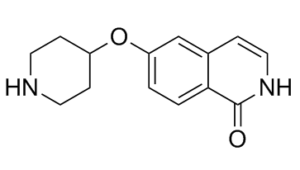
SAR407899 is a novel, potent, selective, and ATP-competitive ROCK inhibitor with an IC50 of 135 nM for ROCK-2, and Kis of 36 nM and 41 nM for human and rat ROCK-2, respectively. SAR407899 is highly selective in panel of 117 receptor and enzyme targets. SAR407899 is approximately 8-fold more active than fasudil. In vitro, SAR407899 demonstrated concentration-dependent inhibition of Rho-kinase-mediated phosphorylation of myosin phosphatase, thrombin-induced stress fiber formation, platelet-derived growth factor-induced proliferation, and monocyte chemotactic protein-1-stimulated chemotaxis. SAR407899 potently (mean IC(50) values: 122 to 280 nM) and species-independently relaxed precontracted isolated arteries of different species and different vascular beds. In vivo, over the dose range 3 to 30 mg/kg PO, SAR407899 lowered blood pressure in a variety of rodent models of arterial hypertension. The antihypertensive effect of SAR407899 was superior to that of fasudil and Y-27632. In conclusion, SAR407899 is a novel and potent selective Rho-kinase inhibitor with promising antihypertensive activity.
Physicochemical Properties
| Molecular Formula | C14H16N2O2 |
| Molecular Weight | 244.2890 |
| Exact Mass | 244.121 |
| CAS # | 923359-38-0 |
| Related CAS # | SAR407899 hydrochloride;923262-96-8 |
| PubChem CID | 15604510 |
| Appearance | Light yellow to yellow solid powder |
| Density | 1.2±0.1 g/cm3 |
| Boiling Point | 517.8±50.0 °C at 760 mmHg |
| Flash Point | 267.0±30.1 °C |
| Vapour Pressure | 0.0±1.3 mmHg at 25°C |
| Index of Refraction | 1.579 |
| LogP | 1.1 |
| Hydrogen Bond Donor Count | 2 |
| Hydrogen Bond Acceptor Count | 3 |
| Rotatable Bond Count | 2 |
| Heavy Atom Count | 18 |
| Complexity | 337 |
| Defined Atom Stereocenter Count | 0 |
| InChi Key | IPEXHQGMTHOKQV-UHFFFAOYSA-N |
| InChi Code | InChI=1S/C14H16N2O2/c17-14-13-2-1-12(9-10(13)3-8-16-14)18-11-4-6-15-7-5-11/h1-3,8-9,11,15H,4-7H2,(H,16,17) |
| Chemical Name | 6-piperidin-4-yloxy-2H-isoquinolin-1-one |
| HS Tariff Code | 2934.99.9001 |
| Storage |
Powder-20°C 3 years 4°C 2 years In solvent -80°C 6 months -20°C 1 month |
| Shipping Condition | Room temperature (This product is stable at ambient temperature for a few days during ordinary shipping and time spent in Customs) |
Biological Activity
| ln Vitro | Dapoxetine decreases the uptake of 5-HT, norepinephrine, and dopamine via binding to the transporters of these chemicals. Potency is arranged as follows: 5-HT > norepinephrine ≫ dopamine. In addition to inhibiting the uptake of [3H] norepinephrine by the norepinephrine reuptake transporter, which has an IC50 value of 1.12 nM, dapoxetine also inhibits the uptake of [3H] dopamine by the dopamine reuptake transporter, which has an IC50 value of 202 nM and 1720 nM, respectively, and [3H] 5HT by the 5-HT reuptake transporter. [1] |
| ln Vivo | In the thoracic aorta of spontaneously hypertensive rats (SHR), SAR407899 (3 mg/kg, i.v.) inhibits ROCK-mediated MYPTT696 phosphorylation. The intravenous administration of SAR407899 (0.01-0.30 mg/kg) effectively decreases the pressor response to vasoconstrictors in rats. Blood pressure in hypertensive SHR is dose-dependently lowered by SAR407899 (1, 3, 10, and 30 mg/kg, oral) [1]. In healthy rabbits, penis length is increased by SAR407899 (1-3 mg/kg intravenously or 3, 10 mg/kg orally). In addition, SAR407899 (3–10 mg/kg, orally) lengthens the penis in diabetic rabbits in a dose-dependent manner [2]. |
| References |
[1]. Pharmacological characterization of SAR407899, a novel rho-kinase inhibitor. Hypertension. 2009 Sep;54(3):676-83. [2]. Erectile properties of the Rho-kinase inhibitor SAR407899 in diabetic animals and human isolated corpora cavernosa. J Transl Med. 2012 Mar 23;10:59. [3]. Chemical screening identifies ROCK1 as a regulator of migrasome formation. Cell Discov. 2020 Aug 4;6(1):51. |
Solubility Data
| Solubility (In Vitro) | DMSO : ~6 mg/mL (~24.56 mM) |
| Solubility (In Vivo) |
Note: Listed below are some common formulations that may be used to formulate products with low water solubility (e.g. < 1 mg/mL), you may test these formulations using a minute amount of products to avoid loss of samples. Injection Formulations (e.g. IP/IV/IM/SC) Injection Formulation 1: DMSO : Tween 80: Saline = 10 : 5 : 85 (i.e. 100 μL DMSO stock solution → 50 μL Tween 80 → 850 μL Saline) *Preparation of saline: Dissolve 0.9 g of sodium chloride in 100 mL ddH ₂ O to obtain a clear solution. Injection Formulation 2: DMSO : PEG300 :Tween 80 : Saline = 10 : 40 : 5 : 45 (i.e. 100 μL DMSO → 400 μLPEG300 → 50 μL Tween 80 → 450 μL Saline) Injection Formulation 3: DMSO : Corn oil = 10 : 90 (i.e. 100 μL DMSO → 900 μL Corn oil) Example: Take the Injection Formulation 3 (DMSO : Corn oil = 10 : 90) as an example, if 1 mL of 2.5 mg/mL working solution is to be prepared, you can take 100 μL 25 mg/mL DMSO stock solution and add to 900 μL corn oil, mix well to obtain a clear or suspension solution (2.5 mg/mL, ready for use in animals). Injection Formulation 4: DMSO : 20% SBE-β-CD in saline = 10 : 90 [i.e. 100 μL DMSO → 900 μL (20% SBE-β-CD in saline)] *Preparation of 20% SBE-β-CD in Saline (4°C,1 week): Dissolve 2 g SBE-β-CD in 10 mL saline to obtain a clear solution. Injection Formulation 5: 2-Hydroxypropyl-β-cyclodextrin : Saline = 50 : 50 (i.e. 500 μL 2-Hydroxypropyl-β-cyclodextrin → 500 μL Saline) Injection Formulation 6: DMSO : PEG300 : castor oil : Saline = 5 : 10 : 20 : 65 (i.e. 50 μL DMSO → 100 μLPEG300 → 200 μL castor oil → 650 μL Saline) Injection Formulation 7: Ethanol : Cremophor : Saline = 10: 10 : 80 (i.e. 100 μL Ethanol → 100 μL Cremophor → 800 μL Saline) Injection Formulation 8: Dissolve in Cremophor/Ethanol (50 : 50), then diluted by Saline Injection Formulation 9: EtOH : Corn oil = 10 : 90 (i.e. 100 μL EtOH → 900 μL Corn oil) Injection Formulation 10: EtOH : PEG300:Tween 80 : Saline = 10 : 40 : 5 : 45 (i.e. 100 μL EtOH → 400 μLPEG300 → 50 μL Tween 80 → 450 μL Saline) Oral Formulations Oral Formulation 1: Suspend in 0.5% CMC Na (carboxymethylcellulose sodium) Oral Formulation 2: Suspend in 0.5% Carboxymethyl cellulose Example: Take the Oral Formulation 1 (Suspend in 0.5% CMC Na) as an example, if 100 mL of 2.5 mg/mL working solution is to be prepared, you can first prepare 0.5% CMC Na solution by measuring 0.5 g CMC Na and dissolve it in 100 mL ddH2O to obtain a clear solution; then add 250 mg of the product to 100 mL 0.5% CMC Na solution, to make the suspension solution (2.5 mg/mL, ready for use in animals). Oral Formulation 3: Dissolved in PEG400 Oral Formulation 4: Suspend in 0.2% Carboxymethyl cellulose Oral Formulation 5: Dissolve in 0.25% Tween 80 and 0.5% Carboxymethyl cellulose Oral Formulation 6: Mixing with food powders Note: Please be aware that the above formulations are for reference only. InvivoChem strongly recommends customers to read literature methods/protocols carefully before determining which formulation you should use for in vivo studies, as different compounds have different solubility properties and have to be formulated differently. (Please use freshly prepared in vivo formulations for optimal results.) |
| Preparing Stock Solutions | 1 mg | 5 mg | 10 mg | |
| 1 mM | 4.0935 mL | 20.4675 mL | 40.9350 mL | |
| 5 mM | 0.8187 mL | 4.0935 mL | 8.1870 mL | |
| 10 mM | 0.4093 mL | 2.0467 mL | 4.0935 mL |