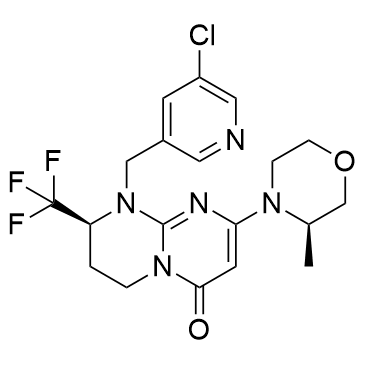
SAR405 (SAR-405) is a novel, potent and selective PIK3C3/Vps34 inhibitor (IC50 = 1.2 nM) with anticancer activity. In tumor cells, SAR405 inhibits MTOR while preventing autophagy. Treatment with SAR405 also blocks autophagy brought on by starvation or MTOR (mechanistic target of rapamycin) inhibition. When using renal tumor cells, the combination of SAR405 and everolimus significantly reduces cell proliferation.
Physicochemical Properties
| Molecular Formula | C19H21CLF3N5O2 |
| Molecular Weight | 443.8506 |
| Exact Mass | 443.133 |
| Elemental Analysis | C, 51.42; H, 4.77; Cl, 7.99; F, 12.84; N, 15.78; O, 7.21 |
| CAS # | 1523406-39-4 |
| Related CAS # | SAR405 R enantiomer;1946010-79-2 |
| PubChem CID | 72709209 |
| Appearance | Off-white to light yellow solid powder |
| Density | 1.5±0.1 g/cm3 |
| Boiling Point | 526.5±60.0 °C at 760 mmHg |
| Flash Point | 272.2±32.9 °C |
| Vapour Pressure | 0.0±1.4 mmHg at 25°C |
| Index of Refraction | 1.635 |
| LogP | 1.97 |
| Hydrogen Bond Donor Count | 0 |
| Hydrogen Bond Acceptor Count | 8 |
| Rotatable Bond Count | 3 |
| Heavy Atom Count | 30 |
| Complexity | 731 |
| Defined Atom Stereocenter Count | 2 |
| SMILES | ClC1=C([H])N=C([H])C(=C1[H])C([H])([H])N1C2=NC(=C([H])C(N2C([H])([H])C([H])([H])[C@@]1([H])C(F)(F)F)=O)N1C([H])([H])C([H])([H])OC([H])([H])[C@@]1([H])C([H])([H])[H] |
| InChi Key | SPDQRCUBFSRAFI-DOMZBBRYSA-N |
| InChi Code | InChI=1S/C19H21ClF3N5O2/c1-12-11-30-5-4-26(12)16-7-17(29)27-3-2-15(19(21,22)23)28(18(27)25-16)10-13-6-14(20)9-24-8-13/h6-9,12,15H,2-5,10-11H2,1H3/t12-,15+/m1/s1 |
| Chemical Name | (8S)-9-[(5-chloropyridin-3-yl)methyl]-2-[(3R)-3-methylmorpholin-4-yl]-8-(trifluoromethyl)-7,8-dihydro-6H-pyrimido[1,2-a]pyrimidin-4-one |
| Synonyms | SAR405; SAR 405; SAR-405 |
| HS Tariff Code | 2934.99.9001 |
| Storage |
Powder-20°C 3 years 4°C 2 years In solvent -80°C 6 months -20°C 1 month |
| Shipping Condition | Room temperature (This product is stable at ambient temperature for a few days during ordinary shipping and time spent in Customs) |
Biological Activity
| Targets | Vps34 (IC50 = 1.2 nM); Vps34 (Kd = 1.5 nM); Autophagy |
| ln Vitro | SAR405 is an inhibitor that was highly specific for Vps34 with regard to protein kinases and other phosphoinositide kinases. The human recombinant Vps34 enzyme phosphorylates a PtdIns substrate with an IC50 of 1 nM for SAR405 in this process. This compound shows a binding equilibrium constant KD of 1.52 ± 0.77 nM (± s.d.) and a dissociation rate constant, koff, of 3.03 ± 0.55 10−3/s, corresponding to a residence half-life, t1/2, of 3.8 min. SAR405 has no effect on the phosphorylation of Akt. SAR405 affects the movement of vesicles from late endosomes to lysosomes. Additionally, it is a strong inhibitor of autophagy[1]. |
| ln Vivo | SAR405 is a first-in-class, selective, and ATP-competitive PI3K class III (PIK3C3) isoform Vps34 inhibitor. |
| Enzyme Assay | KiNativ profiling is performed. Jurkat cell lysates are treated with 1 μM of SAR405. After 15-min incubation, the desthiobiotin-ATP-acylphosphate probe is added and incubated for 10 min. Samples are prepared for targeted MS analysis. In a nutshell, samples are denatured and then reduced in alkylate to prepare them for trypsin digestion. Trypsin is then used to digest the samples, and desthiobiotinylated peptides are then enriched on streptavidin resin. Using a unique data collection technique, enriched probe-labeled peptides are analyzed by LC tandem MS on an ion trap mass spectrometer from Thermo-LTQ. Extraction of distinctive fragment ion signals from targeted MS/MS spectra and comparison of signals in control and treated samples are used for all quantification. |
| Cell Assay | GFP-LC3 HeLa cells are starved for 2 h in EBSS plus 10 μM hydroxychloroquine with Vps34 compound or DMSO. GFP-LC3 H1299 cells are treated with 1 μM AZD8055 for 4 hours while being fed (DMEM, 10% FCS, 1 mM L-glutamine with SAR405, or DMSO) to test the mTOR inhibitor. The nuclei of the cells are then stained with 2 g/ml Hoechst 33342 after they have been fixed with 4% PFA. An imaging cytometer is used to analyze fluorescence. When there are more than four green spots per cell, with a total of 25 fields acquired, cells are deemed positive. The product's activity is estimated. |
| Animal Protocol |
Nude mice 2 mg/kg Oral gavage |
| References |
[1]. Nat Chem Biol. 2014 Dec;10(12):1013-9. Cell Mol Immunol. 2021 Aug;18(8):2024-2039. |
Solubility Data
| Solubility (In Vitro) |
DMSO: 27~89 mg/mL (60.8~200.5 mM) H2O: <0.1 mg/mL |
| Solubility (In Vivo) |
Solubility in Formulation 1: ≥ 2.5 mg/mL (5.63 mM) (saturation unknown) in 10% DMSO + 40% PEG300 + 5% Tween80 + 45% Saline (add these co-solvents sequentially from left to right, and one by one), clear solution. For example, if 1 mL of working solution is to be prepared, you can add 100 μL of 25.0 mg/mL clear DMSO stock solution to 400 μL PEG300 and mix evenly; then add 50 μL Tween-80 to the above solution and mix evenly; then add 450 μL normal saline to adjust the volume to 1 mL. Preparation of saline: Dissolve 0.9 g of sodium chloride in 100 mL ddH₂ O to obtain a clear solution. Solubility in Formulation 2: ≥ 2.5 mg/mL (5.63 mM) (saturation unknown) in 10% DMSO + 90% (20% SBE-β-CD in Saline) (add these co-solvents sequentially from left to right, and one by one), clear solution. For example, if 1 mL of working solution is to be prepared, you can add 100 μL of 25.0 mg/mL clear DMSO stock solution to 900 μL of 20% SBE-β-CD physiological saline solution and mix evenly. Preparation of 20% SBE-β-CD in Saline (4°C,1 week): Dissolve 2 g SBE-β-CD in 10 mL saline to obtain a clear solution. Solubility in Formulation 3: ≥ 2.5 mg/mL (5.63 mM) (saturation unknown) in 10% DMSO + 90% Corn Oil (add these co-solvents sequentially from left to right, and one by one), clear solution. For example, if 1 mL of working solution is to be prepared, you can add 100 μL of 25.0 mg/mL clear DMSO stock solution to 900 μL of corn oil and mix evenly. Solubility in Formulation 4: ≥ 2.5 mg/mL (5.63 mM) (saturation unknown) in 5% DMSO + 95% (20% SBE-β-CD in Saline) (add these co-solvents sequentially from left to right, and one by one), clear solution. Preparation of 20% SBE-β-CD in Saline (4°C,1 week): Dissolve 2 g SBE-β-CD in 10 mL saline to obtain a clear solution. Solubility in Formulation 5: 2% DMSO+30% PEG 300+2% Tween 80+ddH2O: 4mg/mL (Please use freshly prepared in vivo formulations for optimal results.) |
| Preparing Stock Solutions | 1 mg | 5 mg | 10 mg | |
| 1 mM | 2.2530 mL | 11.2651 mL | 22.5301 mL | |
| 5 mM | 0.4506 mL | 2.2530 mL | 4.5060 mL | |
| 10 mM | 0.2253 mL | 1.1265 mL | 2.2530 mL |