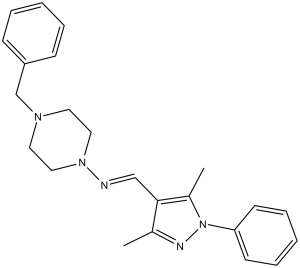
SANT-1 (SANT1; SANT 1) is a novel, potent and selective Sonic hedgehog (Shh) enzyme inhibitor/Smo antagonist with potential antineoplastic activity. It blocks the Sonic Hedgehog (Shh) enzyme in the Shh-LIGHT2 and SmoA1-LIGHT2 assays, with IC50 values of 20 nM and 30 nM, respectively. By directly attaching to the Smoothened (Smo) receptor and blocking the effects of Smo agonists with an IC50 of 20 NM, it may have anticancer properties. Its Kd is 1.2 nM. Drug resistance in AML cancer stem cells is largely dependent on Sonic Hedgehog (Shh), which is expressed in AML biopsies.
Physicochemical Properties
| Molecular Formula | C23H27N5 | |
| Molecular Weight | 373.49 | |
| Exact Mass | 373.227 | |
| Elemental Analysis | C, 73.96; H, 7.29; N, 18.75 | |
| CAS # | 304909-07-7 | |
| Related CAS # |
|
|
| PubChem CID | 6878030 | |
| Appearance | White to off-white solid powder | |
| Density | 1.13g/cm3 | |
| Boiling Point | 547.4ºC at 760mmHg | |
| Melting Point | 104-106ºC | |
| Flash Point | 284.8ºC | |
| Index of Refraction | 1.623 | |
| LogP | 3.516 | |
| Hydrogen Bond Donor Count | 0 | |
| Hydrogen Bond Acceptor Count | 4 | |
| Rotatable Bond Count | 5 | |
| Heavy Atom Count | 28 | |
| Complexity | 489 | |
| Defined Atom Stereocenter Count | 0 | |
| SMILES | CC1=NN(C(=C1/C=N/N2CCN(CC2)CC3=CC=CC=C3)C)C4=CC=CC=C4 |
|
| InChi Key | FOORCIAZMIWALX-JJIBRWJFSA-N | |
| InChi Code | InChI=1S/C23H27N5/c1-19-23(20(2)28(25-19)22-11-7-4-8-12-22)17-24-27-15-13-26(14-16-27)18-21-9-5-3-6-10-21/h3-12,17H,13-16,18H2,1-2H3/b24-17+ | |
| Chemical Name | (E)-N-(4-benzylpiperazin-1-yl)-1-(3,5-dimethyl-1-phenylpyrazol-4-yl)methanimine | |
| Synonyms |
|
|
| HS Tariff Code | 2934.99.9001 | |
| Storage |
Powder-20°C 3 years 4°C 2 years In solvent -80°C 6 months -20°C 1 month |
|
| Shipping Condition | Room temperature (This product is stable at ambient temperature for a few days during ordinary shipping and time spent in Customs) |
Biological Activity
| Targets | Shh signaling ( IC50 = 20 nM ); SmoA1 ( IC50 = 30 nM ) | ||
| ln Vitro |
|
||
| ln Vivo |
|
||
| Enzyme Assay | Shh-N (the N-terminal segment of Shh without cholesterol modification)-conditioned medium is made from HEK 293 cells that have been transfected with neomycin resistance constructs and Shh-N expression in a stable manner. The HEK 293 cells that produce Shh-N are cultured to 80% confluency in DMEM that contains 400 μg/ml G418 and 10% (vol/vol) FBS. Subsequently, the medium is substituted with DMEM supplemented with 2% (vol/vol) FBS. Following a 24-hour growth period, the medium is gathered and passed through a 0.22-μm membrane filter. HEK 293 cells are used to produce the control medium. Following confluency in 96-well plates, Shh-LIGHT2 cells are treated with the small molecules (0.714 μg/mL; approximately 2 μM compound in each well) in the presence of either HEK 293 control medium (1:25 dilution into DMEM containing 0.5% bovine calf serum) or Shh-N-conditioned medium. The activities of Renilla luciferase and cellular firefly are measured after the treated cells are incubated for 30 hours at 37°C. | ||
| Animal Protocol |
|
||
| References |
[1]. Proc Natl Acad Sci U S A . 2002 Oct 29;99(22):14071-6. [2]. PLoS One . 2009;4(4):e5182. [3]. Cancer Biol Ther . 2009 Jul;8(14):1328-39. |
||
| Additional Infomation | 1-(3,5-dimethyl-1-phenyl-4-pyrazolyl)-N-[4-(phenylmethyl)-1-piperazinyl]methanimine is a ring assembly and a member of pyrazoles. |
Solubility Data
| Solubility (In Vitro) |
|
|||
| Solubility (In Vivo) |
Solubility in Formulation 1: ≥ 2.5 mg/mL (6.69 mM) (saturation unknown) in 10% DMSO + 40% PEG300 + 5% Tween80 + 45% Saline (add these co-solvents sequentially from left to right, and one by one), clear solution. For example, if 1 mL of working solution is to be prepared, you can add 100 μL of 25.0 mg/mL clear DMSO stock solution to 400 μL PEG300 and mix evenly; then add 50 μL Tween-80 to the above solution and mix evenly; then add 450 μL normal saline to adjust the volume to 1 mL. Preparation of saline: Dissolve 0.9 g of sodium chloride in 100 mL ddH₂ O to obtain a clear solution. Solubility in Formulation 2: ≥ 2.08 mg/mL (5.57 mM) (saturation unknown) in 10% DMSO + 90% (20% SBE-β-CD in Saline) (add these co-solvents sequentially from left to right, and one by one), clear solution. For example, if 1 mL of working solution is to be prepared, you can add 100 μL of 20.8 mg/mL clear DMSO stock solution to 900 μL of 20% SBE-β-CD physiological saline solution and mix evenly. Preparation of 20% SBE-β-CD in Saline (4°C,1 week): Dissolve 2 g SBE-β-CD in 10 mL saline to obtain a clear solution. Solubility in Formulation 3: ≥ 2.08 mg/mL (5.57 mM) (saturation unknown) in 10% DMSO + 90% Corn Oil (add these co-solvents sequentially from left to right, and one by one), clear solution. For example, if 1 mL of working solution is to be prepared, you can add 100 μL of 20.8 mg/mL clear DMSO stock solution to 900 μL of corn oil and mix evenly. Solubility in Formulation 4: 5% DMSO + 95% Corn oil: 1.05mg/ml (2.81mM) (Please use freshly prepared in vivo formulations for optimal results.) |
| Preparing Stock Solutions | 1 mg | 5 mg | 10 mg | |
| 1 mM | 2.6774 mL | 13.3872 mL | 26.7745 mL | |
| 5 mM | 0.5355 mL | 2.6774 mL | 5.3549 mL | |
| 10 mM | 0.2677 mL | 1.3387 mL | 2.6774 mL |