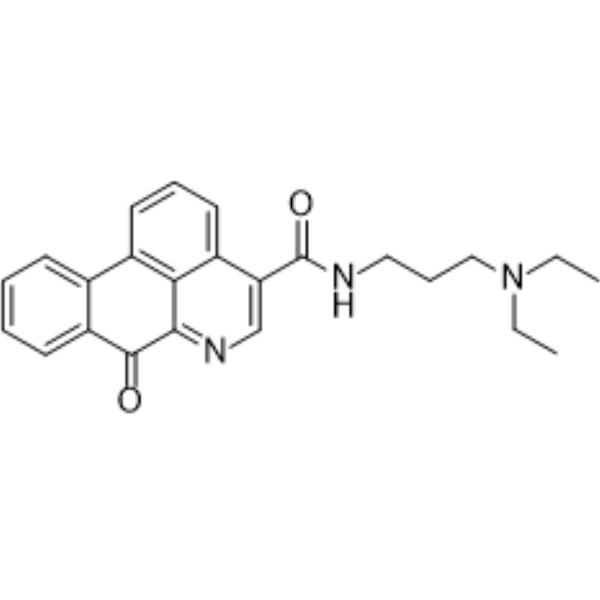
Physicochemical Properties
| Molecular Formula | C24H25N3O2 |
| Molecular Weight | 387.474205732346 |
| Exact Mass | 387.194 |
| CAS # | 1160852-22-1 |
| PubChem CID | 44128205 |
| Appearance | White to off-white solid powder |
| LogP | 4 |
| Hydrogen Bond Donor Count | 1 |
| Hydrogen Bond Acceptor Count | 4 |
| Rotatable Bond Count | 7 |
| Heavy Atom Count | 29 |
| Complexity | 591 |
| Defined Atom Stereocenter Count | 0 |
| SMILES | O=C1C2C=CC=CC=2C2C=CC=C3C(=CN=C1C=23)C(NCCCN(CC)CC)=O |
| InChi Key | DZUCZYXRADUTMW-UHFFFAOYSA-N |
| InChi Code | InChI=1S/C24H25N3O2/c1-3-27(4-2)14-8-13-25-24(29)20-15-26-22-21-17(11-7-12-18(20)21)16-9-5-6-10-19(16)23(22)28/h5-7,9-12,15H,3-4,8,13-14H2,1-2H3,(H,25,29) |
| Chemical Name | N-[3-(diethylamino)propyl]-8-oxo-10-azatetracyclo[7.7.1.02,7.013,17]heptadeca-1(16),2,4,6,9,11,13(17),14-octaene-12-carboxamide |
| HS Tariff Code | 2934.99.9001 |
| Storage |
Powder-20°C 3 years 4°C 2 years In solvent -80°C 6 months -20°C 1 month |
| Shipping Condition | Room temperature (This product is stable at ambient temperature for a few days during ordinary shipping and time spent in Customs) |
Biological Activity
| ln Vitro | S130 causes increased cytotoxicity by blocking ATG4B, which in turn stops autophagy and triggers apoptosis [1]. S130 (10 μM; 6 hours) suppresses autophagy in late autolysosomal degradation or early LC3 initiation [1]. More lipidated LC3 is accumulated in autolysosomes by S130 [1]. At doses greater than 6.3 μM, ATG4B activity is inhibited by S130 (0-25 μM; 48 hours), which results in cell death. Also, necroptosis—the process by which cells die—may not result from this cytotoxicity [1]. S130-induced cytotoxicity is increased by malnutrition [1]. S130 (0-10 μM; 24 hours) prevented ATG4B KO cells from cleaving full-length LC3-GST by roughly 79% at 10 μM without consuming any substrate. The effect of S130 on ATG4B is strongly inhibitory [1]. |
| ln Vivo | In vivo, S130 (20 mg/kg; intraperitoneal injection; daily; 3-week duration) effectively suppresses tumor development and exhibits anti-tumor effects while maintaining a favorable safety profile for critical organs [1]. |
| Cell Assay |
Cytotoxicity assay [1] Cell Types: HeLa cells, HCT116 cells, HL60 cells Tested Concentrations: 0 μM, 3.1 μM, 6.3 μM, 12.5 μM, 25 μM Incubation Duration: 48 hrs (hours) Experimental Results: Significant cytotoxic effect on HeLa cells (IC50 = 16.1 µM), HCT116 cells (IC50 = 9.0 µM) and HL60 cells (IC50 = 4.7 µM) at doses above 6.3 µM. And this cytotoxicity may not lead to cell death via necroptosis. Autophagy assay [1] Cell Types: HeLa cells and MEF cells Tested Concentrations: 10 μM Incubation Duration: 6 hrs (hours) Experimental Results: Inhibition of autophagy in the early stage of LC3 initiation or late stage of autolysosomal degradation. Western Blot Analysis[1] Cell Types: HeLa Cell Tested Concentrations: 0 μM, 5 μM, 10 μM Incubation Duration: 24 hrs (hours) Experimental Results: 10 μM inhibited ~79% cleavage of full-length LC3-GST with no substrate in ATG4B KO processed in cells. |
| Animal Protocol |
Animal/Disease Models: BALB/c female nude mice (4 weeks), HCT116 cell xenotransplantation [1] Doses: 20 mg/kg Route of Administration: intraperitoneal (ip) injection; daily; 3 weeks Experimental Results: able to inhibit tumor growth and have effects on important organs Good security. |
| References |
[1]. Discovery of a small molecule targeting autophagy via ATG4B inhibition and cell death of colorectal cancer cells in vitro and in vivo. Autophagy. 2018 Sep 20:1-17. |
Solubility Data
| Solubility (In Vitro) | DMSO : ~125 mg/mL (~322.61 mM) |
| Solubility (In Vivo) |
Solubility in Formulation 1: ≥ 2.25 mg/mL (5.81 mM) (saturation unknown) in 10% DMSO + 40% PEG300 + 5% Tween80 + 45% Saline (add these co-solvents sequentially from left to right, and one by one), clear solution. For example, if 1 mL of working solution is to be prepared, you can add 100 μL of 22.5 mg/mL clear DMSO stock solution to 400 μL PEG300 and mix evenly; then add 50 μL Tween-80 to the above solution and mix evenly; then add 450 μL normal saline to adjust the volume to 1 mL. Preparation of saline: Dissolve 0.9 g of sodium chloride in 100 mL ddH₂ O to obtain a clear solution. Solubility in Formulation 2: ≥ 2.25 mg/mL (5.81 mM) (saturation unknown) in 10% DMSO + 90% (20% SBE-β-CD in Saline) (add these co-solvents sequentially from left to right, and one by one), clear solution. For example, if 1 mL of working solution is to be prepared, you can add 100 μL of 22.5 mg/mL clear DMSO stock solution to 900 μL of 20% SBE-β-CD physiological saline solution and mix evenly. Preparation of 20% SBE-β-CD in Saline (4°C,1 week): Dissolve 2 g SBE-β-CD in 10 mL saline to obtain a clear solution. Solubility in Formulation 3: ≥ 2.08 mg/mL (5.37 mM) (saturation unknown) in 10% DMSO + 90% Corn Oil (add these co-solvents sequentially from left to right, and one by one), clear solution. For example, if 1 mL of working solution is to be prepared, you can add 100 μL of 20.8 mg/mL clear DMSO stock solution to 900 μL of corn oil and mix evenly. (Please use freshly prepared in vivo formulations for optimal results.) |
| Preparing Stock Solutions | 1 mg | 5 mg | 10 mg | |
| 1 mM | 2.5808 mL | 12.9042 mL | 25.8084 mL | |
| 5 mM | 0.5162 mL | 2.5808 mL | 5.1617 mL | |
| 10 mM | 0.2581 mL | 1.2904 mL | 2.5808 mL |